







Question: PART 2. A well-known data set first published by R.A. Fisher in 1936 listed petal and sepal lengths (in cm) of various irises (flowers).
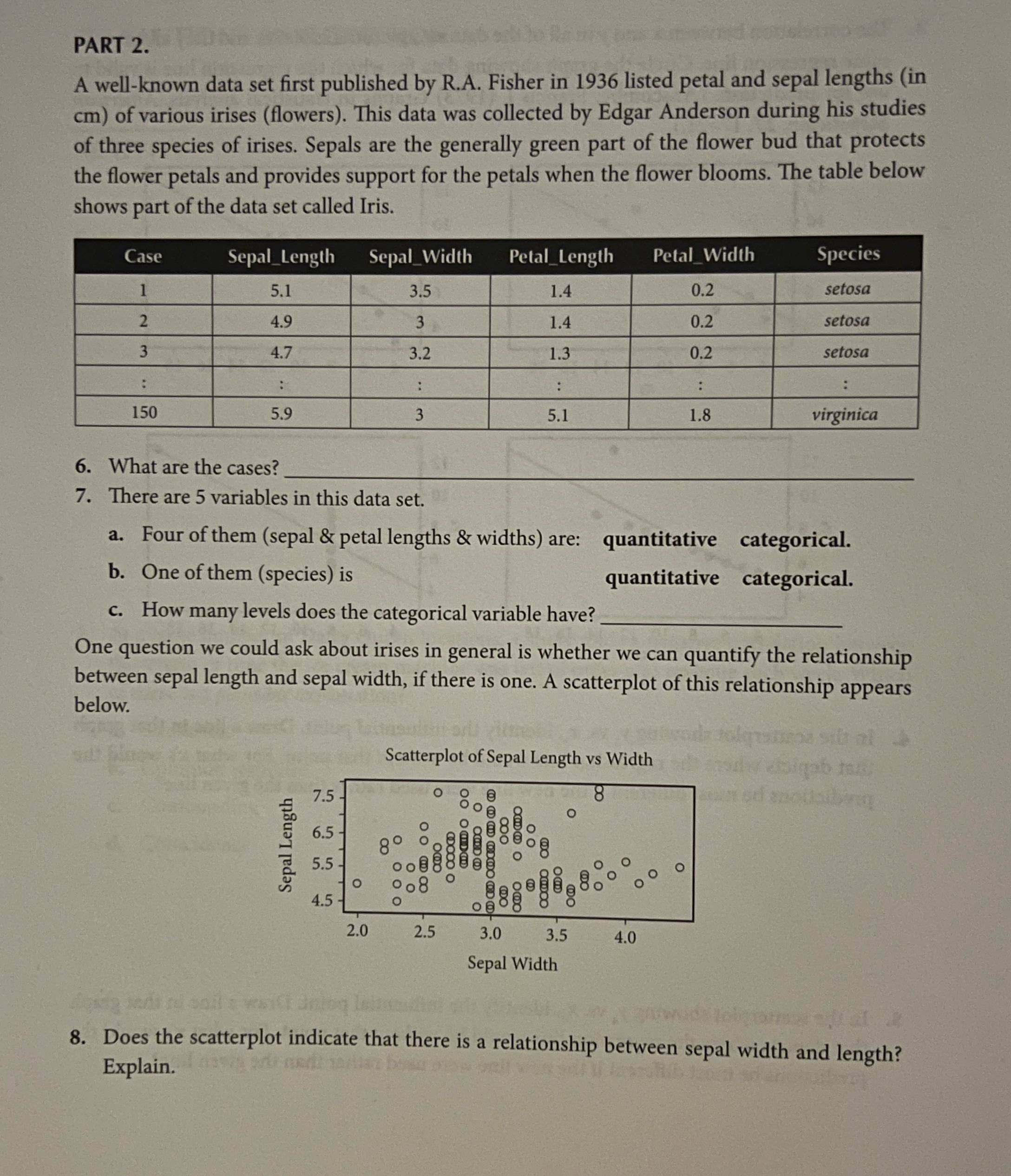
PART 2. A well-known data set first published by R.A. Fisher in 1936 listed petal and sepal lengths (in cm) of various irises (flowers). This data was collected by Edgar Anderson during his studies of three species of irises. Sepals are the generally green part of the flower bud that protects the flower petals and provides support for the petals when the flower blooms. The table below shows part of the data set called Iris. Case Sepal_Length Sepal_Width Petal_Length Petal_Width Species 1 5.1 3.5 1.4 0.2 setosa 2 4.9 3 1.4 0.2 setosa 3 4.7 3.2 1.3 0.2 setosa 0:0 : : 150 5.9 3 5.1 1.8 virginica 6. What are the cases? 7. There are 5 variables in this data set. a. Four of them (sepal & petal lengths & widths) are: quantitative categorical. b. One of them (species) is quantitative categorical. c. How many levels does the categorical variable have? One question we could ask about irises in general is whether we can quantify the relationship between sepal length and sepal width, if there is one. A scatterplot of this relationship appears below. Scatterplot of Sepal Length vs Width Sepal Length 7.5 6.5 8 5.5 0 BO@ @xx o OOO O 4.5 2.0 2.5 DOO OO ODO O OOOO OOO O O 00 DO 6@ @O amx 8 3.5 4.0 3.0 Sepal Width od spottailing 8. Does the scatterplot indicate that there is a relationship between sepal width and length? Explain.
Step by Step Solution
There are 3 Steps involved in it

Get step-by-step solutions from verified subject matter experts
 Study Help