







Question: Part 2: Programming Question (60 marks The General Automobile Registration Office (GARO) keeps records of car registrations. It operates on multiple lists of n car
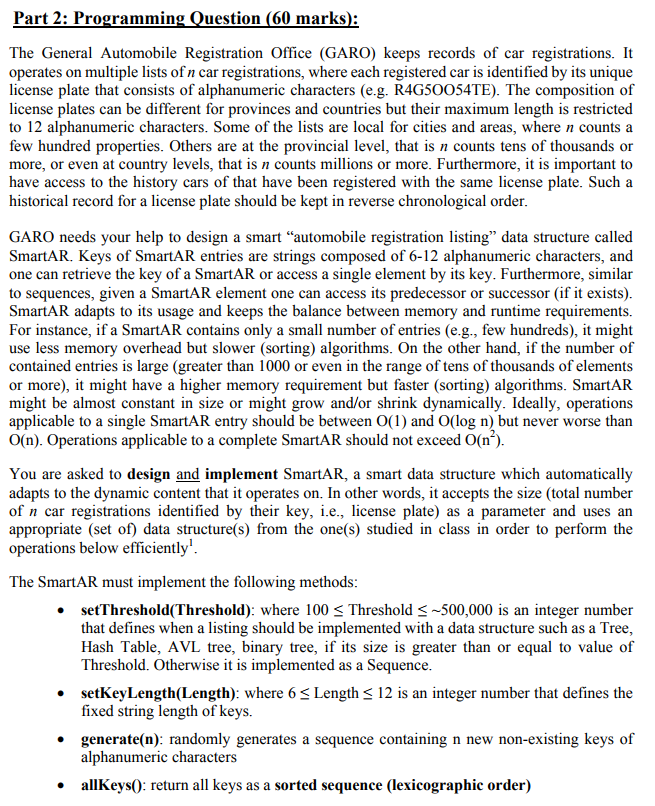
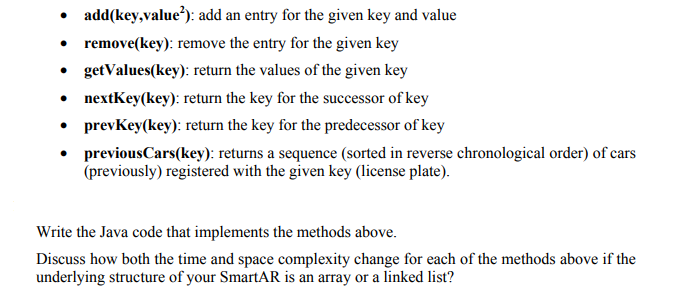
Part 2: Programming Question (60 marks The General Automobile Registration Office (GARO) keeps records of car registrations. It operates on multiple lists of n car registrations, where each registered car is identified by its unique license plate that consists of alphanumeric characters (e.g. R4G50054TE). The composition of license plates can be different for provinces and countries but their maximum length is restricted to 12 alphanumeric characters. Some of the lists are local for cities and areas, where n counts a few hundred properties. Others are at the provincial level, that is n counts tens of thousands or more, or even at country levels, that is n counts millions or more. Furthermore, it is important to have access to the history cars of that have been registered with the same license plate. Such a historical record for a license plate should be kept in reverse chronological order. GARO needs your help to design a smart "automobile registration listing" data structure called SmartAR. Keys of SmartAR entries are strings composed of 6-12 alphanumeric characters, and one can retrieve the key of a SmartAR or access a single element by its key. Furthermore, similar to sequences, given a SmartAR element one can access its predecessor or successor (if it exists) SmartAR adapts to its usage and keeps the balance between memory and runtime requirements. For instance, if a SmartAR contains only a small number of entries (e.g., few hundreds), it might use less memory overhead but slower (sorting) algorithms. On the other hand, if the number of contained entries is large (greater than 1000 or even in the range of tens of thousands of elements or more), t might have a higher memory requirement but faster (sorting) algorithms. SmartAR might be almost constant in size or might grow and/or shrink dynamically. Ideally, operations applicable to a single SmartAR entry should be between O(1) and O(log n) but never worse than O(n). Operations applicable to a complete SmartAR should not exceed O(n') You are asked to design and implement SmartAR, a smart data structure which automatically adapts to the dynamic content that it operates on. In other words, it accepts the size (total number of n car registrations identified by their key, i.e., license plate) as a parameter and uses an appropriate (set of) data structure(s) from the one(s) studied in class in order to perform the operations below efficiently The SmartAR must implement the following methods Threshold -500,000 is an integer number setThreshold(Threshold): where 100 that defines when a listing should be implemented with a data structure such as a Tree Hash Table, AVL tree, binary tree, if its size is greater than or equal to value of Threshold. Otherwise it is implemented as a Sequence * * setKeyLength(Length): where 6 Length 12 is an integer number that defines the . generate(n): randomly generates a sequence containing n new non-existing keys of * allKeys0: return all keys as a sorted sequence (lexicographic order) fixed string length of keys. alphanumeric characters Part 2: Programming Question (60 marks The General Automobile Registration Office (GARO) keeps records of car registrations. It operates on multiple lists of n car registrations, where each registered car is identified by its unique license plate that consists of alphanumeric characters (e.g. R4G50054TE). The composition of license plates can be different for provinces and countries but their maximum length is restricted to 12 alphanumeric characters. Some of the lists are local for cities and areas, where n counts a few hundred properties. Others are at the provincial level, that is n counts tens of thousands or more, or even at country levels, that is n counts millions or more. Furthermore, it is important to have access to the history cars of that have been registered with the same license plate. Such a historical record for a license plate should be kept in reverse chronological order. GARO needs your help to design a smart "automobile registration listing" data structure called SmartAR. Keys of SmartAR entries are strings composed of 6-12 alphanumeric characters, and one can retrieve the key of a SmartAR or access a single element by its key. Furthermore, similar to sequences, given a SmartAR element one can access its predecessor or successor (if it exists) SmartAR adapts to its usage and keeps the balance between memory and runtime requirements. For instance, if a SmartAR contains only a small number of entries (e.g., few hundreds), it might use less memory overhead but slower (sorting) algorithms. On the other hand, if the number of contained entries is large (greater than 1000 or even in the range of tens of thousands of elements or more), t might have a higher memory requirement but faster (sorting) algorithms. SmartAR might be almost constant in size or might grow and/or shrink dynamically. Ideally, operations applicable to a single SmartAR entry should be between O(1) and O(log n) but never worse than O(n). Operations applicable to a complete SmartAR should not exceed O(n') You are asked to design and implement SmartAR, a smart data structure which automatically adapts to the dynamic content that it operates on. In other words, it accepts the size (total number of n car registrations identified by their key, i.e., license plate) as a parameter and uses an appropriate (set of) data structure(s) from the one(s) studied in class in order to perform the operations below efficiently The SmartAR must implement the following methods Threshold -500,000 is an integer number setThreshold(Threshold): where 100 that defines when a listing should be implemented with a data structure such as a Tree Hash Table, AVL tree, binary tree, if its size is greater than or equal to value of Threshold. Otherwise it is implemented as a Sequence * * setKeyLength(Length): where 6 Length 12 is an integer number that defines the . generate(n): randomly generates a sequence containing n new non-existing keys of * allKeys0: return all keys as a sorted sequence (lexicographic order) fixed string length of keys. alphanumeric characters
Step by Step Solution
There are 3 Steps involved in it

Get step-by-step solutions from verified subject matter experts
 Study Help