







Question: Part 2: Suppose, in an OS multilevel-feedback queue scheduling is implemented in which process cannot move back to previous queue. There are three queues to
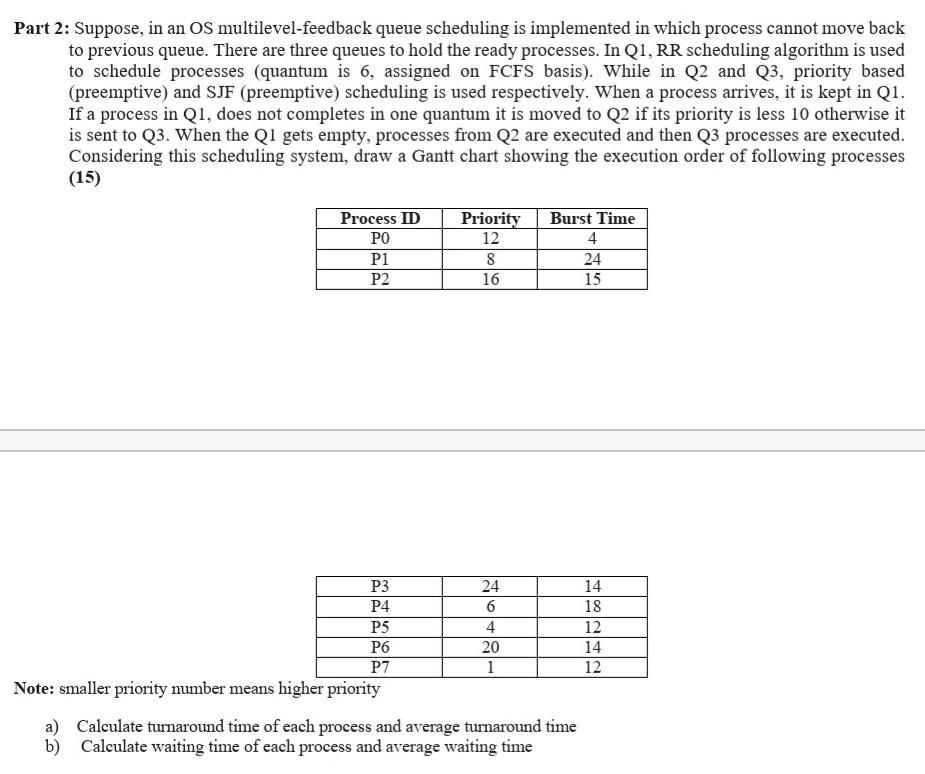
Part 2: Suppose, in an OS multilevel-feedback queue scheduling is implemented in which process cannot move back to previous queue. There are three queues to hold the ready processes. In Q1, RR scheduling algorithm is used to schedule processes (quantum is 6, assigned on FCFS basis). While in Q2 and Q3, priority based (preemptive) and SJF (preemptive) scheduling is used respectively. When a process arrives, it is kept in Q1. If a process in Q1, does not completes in one quantum it is moved to Q2 if its priority is less 10 otherwise it is sent to Q3. When the QI gets empty, processes from Q2 are executed and then Q3 processes are executed. Considering this scheduling system, draw a Gantt chart showing the execution order of following processes (15) Process ID Priority Burst Time 4 PO 12 P1 24 8 16 P2 15 14 P3 24 14 P4 6 18 P5 4 12 P6 20 1 12 Note: smaller priority number means higher priority a) Calculate turnaround time of each process and average turnaround time b) Calculate waiting time of each process and average waiting time P7
Step by Step Solution
There are 3 Steps involved in it

Get step-by-step solutions from verified subject matter experts
 Study Help