







Question: PART A Collaborative Space Use the following structure by adding both human factors and ergonomics definitions and your scholarly source citation to the Wiki Workspace.
PART A
Collaborative Space
Use the following structure by addingboth human factors and ergonomics definitions and your scholarly source citationto the Wiki Workspace. Additionalcontributions by the instructors and peerscan be added to enhance each other's initial contributions by adding the next number to the first student's number(s) and so on to the sublists for all entries.Contributors shall also add scholarly source citations. If we have fifteen students, there should be fifteen final student entries, beginning with name and topic. Please try to stay within the structure.
Return to theWiki Instructions for Definitions and Collaborationpage if needed.
IMPORTANT NOTE:Start by selecting theEDITbutton -top right of the pageand using this template to replace thebold type with your namein the order you edit the page.
Important Tip:Simultaneous Edits
NOTE:Any edits that are done simultaneously may override each other, so use a document or notepad to copy and paste your entries from. The instructor's comments will be ingreen text.
- Adam Skelton:Human Factors/Ergonomics
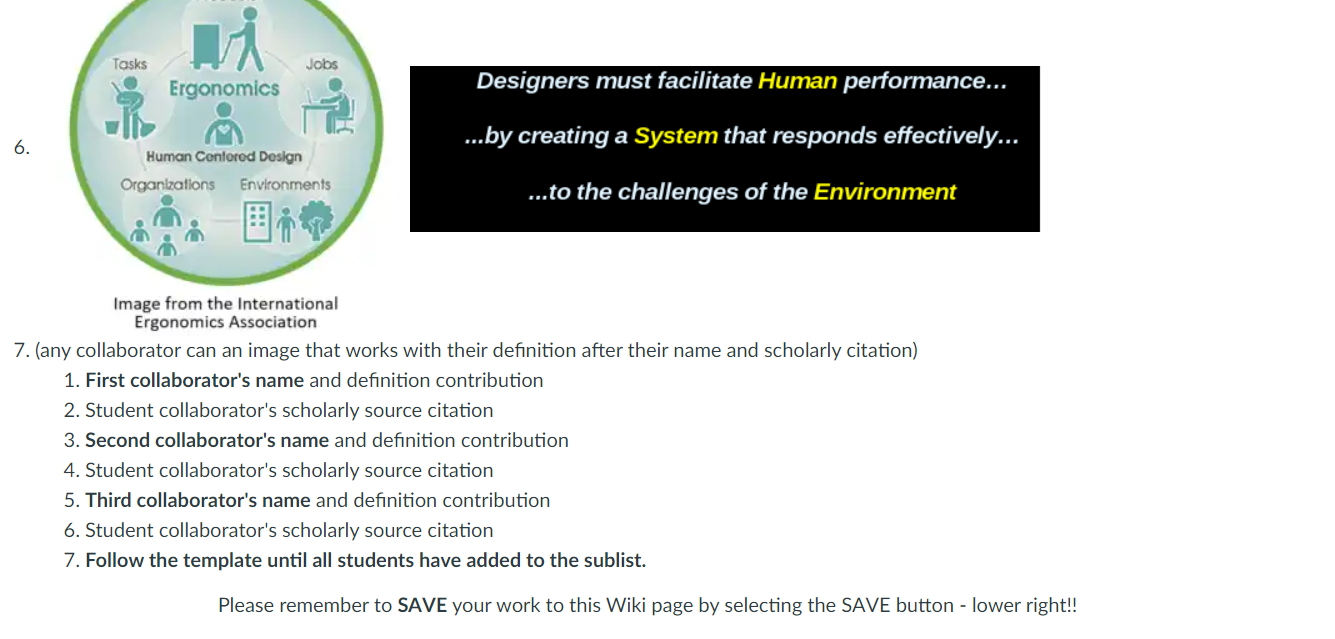
- Ergonomics: Knowledge based on scientific studies of ordinary people in work situations...applied to the design of processes and machines, to the layout of work places, to methods of work, and to the control of the physical environment, in order to achieve greater efficiency of both men and machines.
- Human Factor: The study, discovery, and application of information about human abilities, human limitations, and other human characteristics to the design of tools, devices, machines, systems, job tasks and environments for effective human performance.
- Wilson, J. R. (2000). Fundamentals of ergonomics in theory and practice.Applied ergonomics,31(6), 557-567.
- Chapanis, A. (1996). Human Factors in.Systems Engineering.
- (any collaborator can an image that works with their definition after their name and scholarly citation)
- First collaborator's nameand definition contribution
- Student collaborator's scholarly source citation
- Second collaborator's nameand definition contribution
- Student collaborator's scholarly source citation
- Third collaborator's nameand definition contribution
- Student collaborator's scholarly source citation
- Follow the template until all students have added to the sublist. IMAGE IS ABOVE MENTIONED QUESTION
SFTY 321 Wiki Workspace Collaborative Space Use the following structure by adding both human factors and ergonomics definitions and your scholarly source citation to the Wiki Workspace. Additional contributions by the instructors and peers can be added to enhance each other's initial contributions by adding the next number to the first student's number(s) and so on to the sublists for all entries. Contributors shall also add scholarly source citations. If we have fifteen students, there should be fifteen final student entries, beginning with name and topic. Please try to stay within the structure. Return to the Wiki Instructions for Definitions and Collaboration page if needed. IMPORTANT NOTE: Start by selecting the EDIT button - top right of the page and using this template to replace the bold type with your name in the order you edit the page. Important Tip: Simultaneous Edits NOTE: Any edits that are done simultaneously may override each other, so use a document or notepad to copy and paste your entries from. The instructor's comments will be in green text. 1. Adam Skelton: Human Factors/Ergonomics 2. Ergonomics: Knowledge based on scientific studies of ordinary people in work situations..applied to the design of processes and machines, to the layout of work places, to methods of work, and to the control of the physical environment, in order to achieve greater efficiency of both men and machines. 3. Human Factor: The study, discovery, and application of information about human abilities, human limitations, and other human characteristics to the design of tools, devices, machines, systems, job tasks and environments for effective human performance. 4. Wilson, J. R. (2000). Fundamentals of ergonomics in theory and practice. Applied ergonomics, 31(6), 557-567. 5. Chapanis, A. (1996). Human Factors in. Systems Engineering. ProductsTasks Jobs Ergonomics Designers must facilitate Human performance... 6. ..by creating a System that responds effectively... Human Centered Design Organizations Environments ...to the challenges of the Environment Image from the International Ergonomics Association 7. (any collaborator can an image that works with their definition after their name and scholarly citation) 1. First collaborator's name and definition contribution 2. Student collaborator's scholarly source citation 3. Second collaborator's name and definition contribution 4. Student collaborator's scholarly source citation 5. Third collaborator's name and definition contribution 6. Student collaborator's scholarly source citation 7. Follow the template until all students have added to the sublist. Please remember to SAVE your work to this Wiki page by selecting the SAVE button - lower right!Details Module 1 Wiki Page Definitions Please copy and paste your human factors and ergonomics definitions and your scholarly source citation from the Wiki Workspace page, and submit it here for grading. Half your grade will come from an assessment of the class as a whole and half from your individual contribution. ERGONOMICS Each student will receive a grade from 0-100%. Grading is based on instructor discretion, and as long as you meet the assignment criteria your assignment will grade well. Add the definitions and your scholarly source citation as a text entry or as a file. Save your assignment file using a naming convention that includes your first and last name and the activity number (or description). Do not add punctuation or special characters. Wiki Workspace This activity supports Module Objective 2 and Learning Outcome
Step by Step Solution
There are 3 Steps involved in it

Get step-by-step solutions from verified subject matter experts
 Study Help