



Question: Part A: Fixed at both ends 1. Find the lowest frequency that will establish a standing wave. This is the fundamenta frequency. 2. Determine the
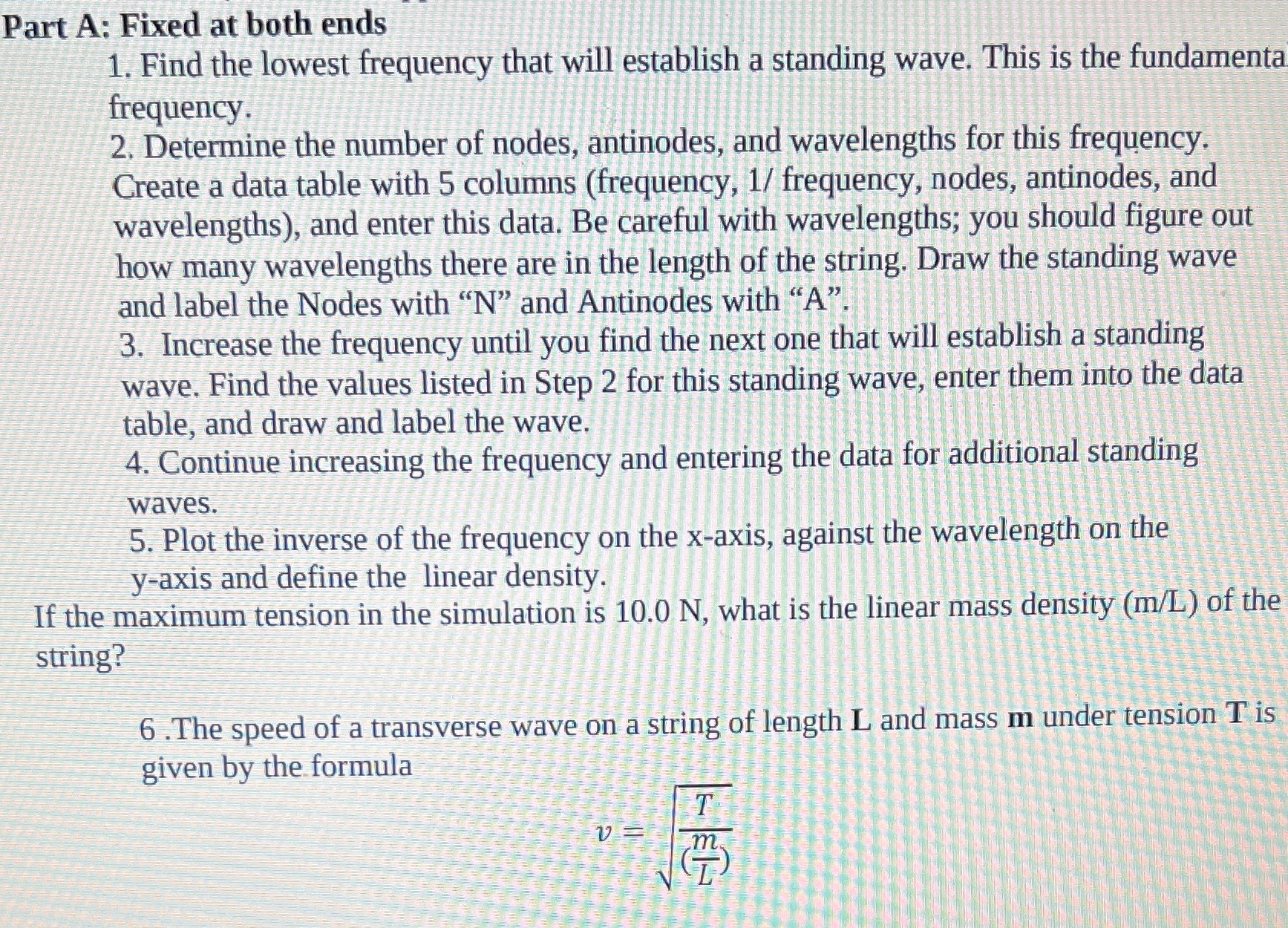
Part A: Fixed at both ends 1. Find the lowest frequency that will establish a standing wave. This is the fundamenta frequency. 2. Determine the number of nodes, antinodes, and wavelengths for this frequency. Create a data table with 5 columns (frequency, 1/ frequency, nodes, antinodes, and wavelengths), and enter this data. Be careful with wavelengths; you should figure out how many wavelengths there are in the length of the string. Draw the standing wave and label the Nodes with "N" and Antinodes with "A". 3. Increase the frequency until you find the next one that will establish a standing wave. Find the values listed in Step 2 for this standing wave, enter them into the data table, and draw and label the wave. 4. Continue increasing the frequency and entering the data for additional standing waves. 5. Plot the inverse of the frequency on the x-axis, against the wavelength on the y-axis and define the linear density. If the maximum tension in the simulation is 10.0 N, what is the linear mass density (m/L) of the string? 6. The speed of a transverse wave on a string of length L and mass m under tension T is given by the formula
Step by Step Solution
There are 3 Steps involved in it

Get step-by-step solutions from verified subject matter experts