







Question: Part A. From-) For each state ment below, circle T, if the statement is true, otherwise circle F, if it is false. Each correct choice
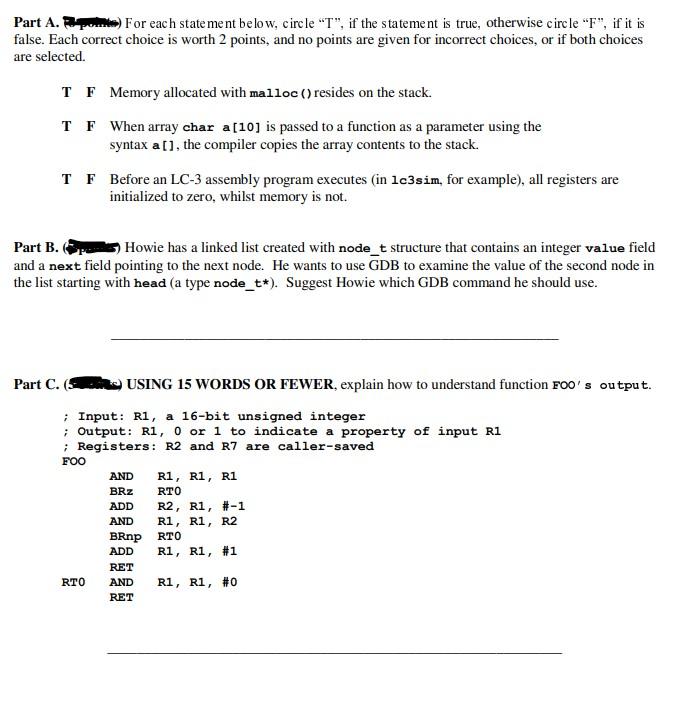
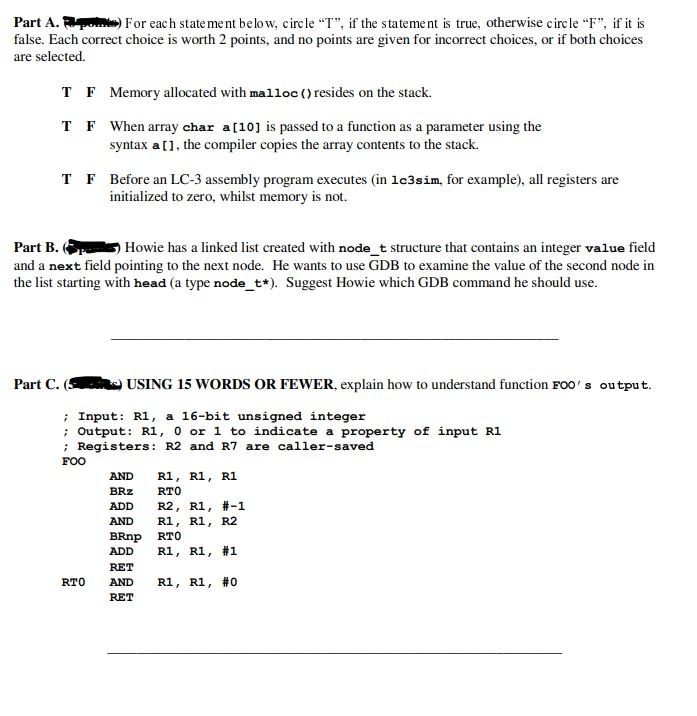
Part A. From-) For each state ment below, circle "T", if the statement is true, otherwise circle "F", if it is false. Each correct choice is worth 2 points, and no points are given for incorrect choices, or if both choices are selected. T F Memory allocated with malloc () resides on the stack. T F When array char a [10] is passed to a function as a parameter using the syntax a [], the compiler copies the array contents to the stack. T F Before an LC-3 assembly program executes (in 1c3sim, for example), all registers are initialized to zero, whilst memory is not. and a next field pointing to the next node. He wants to use GDB to examine the value of the second node in the list starting with head (a type node_t*). Suggest Howie which GDB command he should use. Part C. (5 Is) USING 15 WORDS OR FEWER, explain how to understand function Foo's ou tput. Part A. From-) For each state ment below, circle "T", if the statement is true, otherwise circle "F", if it is false. Each correct choice is worth 2 points, and no points are given for incorrect choices, or if both choices are selected. T F Memory allocated with malloc () resides on the stack. T F When array char a [10] is passed to a function as a parameter using the syntax a [], the compiler copies the array contents to the stack. T F Before an LC-3 assembly program executes (in 1c3sim, for example), all registers are initialized to zero, whilst memory is not. and a next field pointing to the next node. He wants to use GDB to examine the value of the second node in the list starting with head (a type node_t*). Suggest Howie which GDB command he should use. Part C. (5 Is) USING 15 WORDS OR FEWER, explain how to understand function Foo's ou tput
Step by Step Solution
There are 3 Steps involved in it

Get step-by-step solutions from verified subject matter experts
 Study Help