







Question: FINAL ASSESSMENT MULTIPLE CHOICE (10 marks) Circle the alternative that best completes the statement or answers the question. 1) Conflict and negotiation are patterned responses
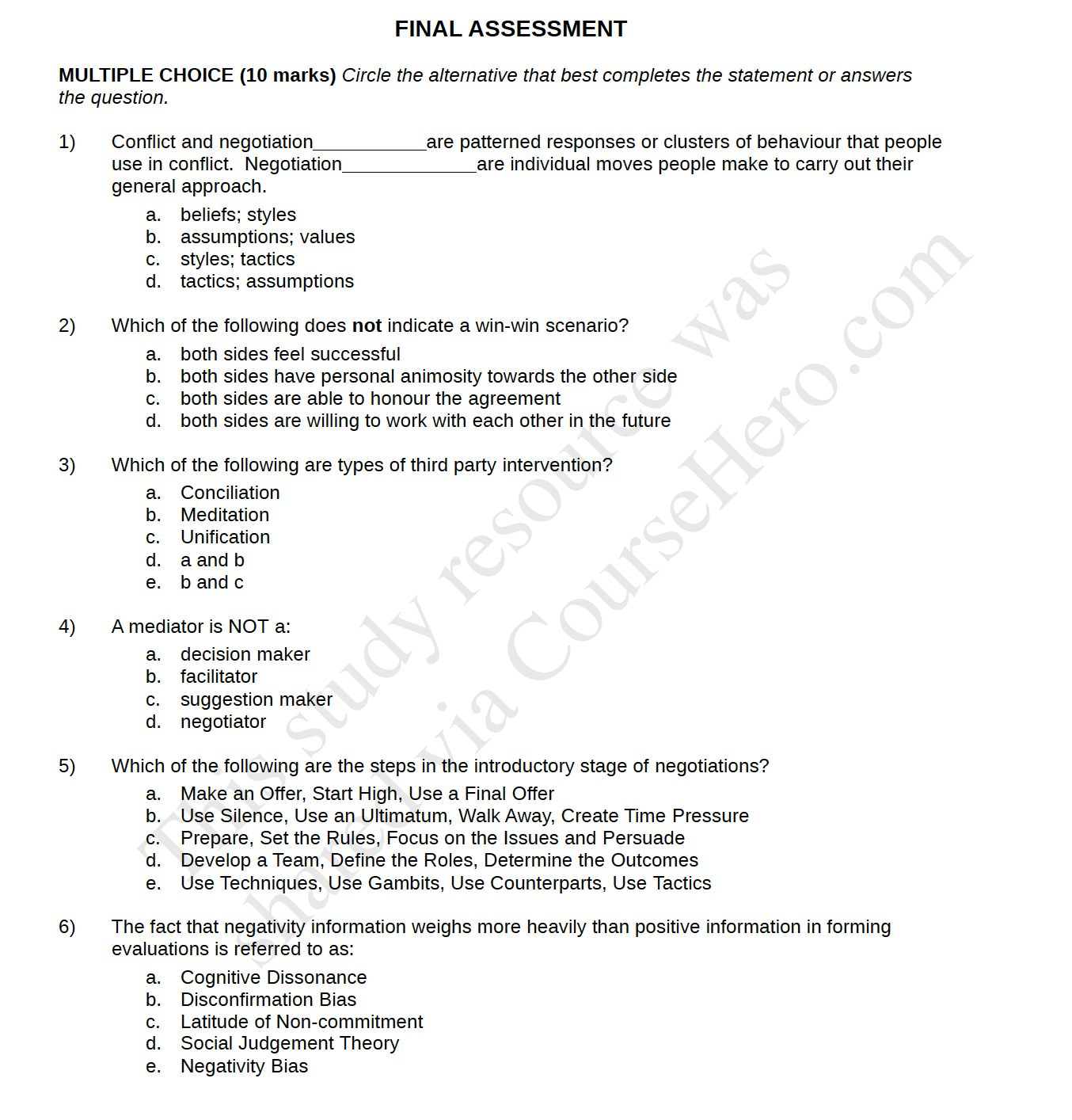
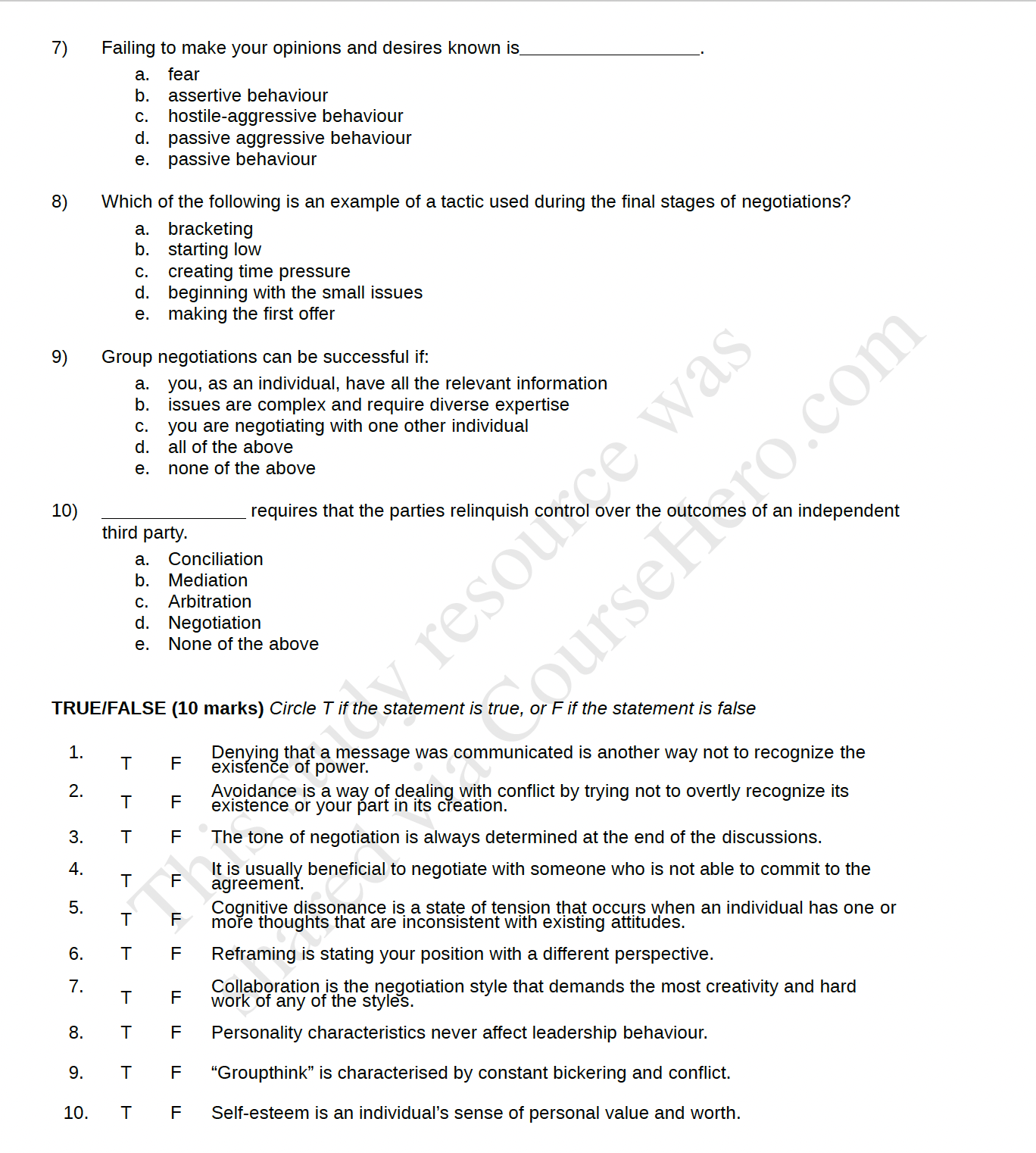
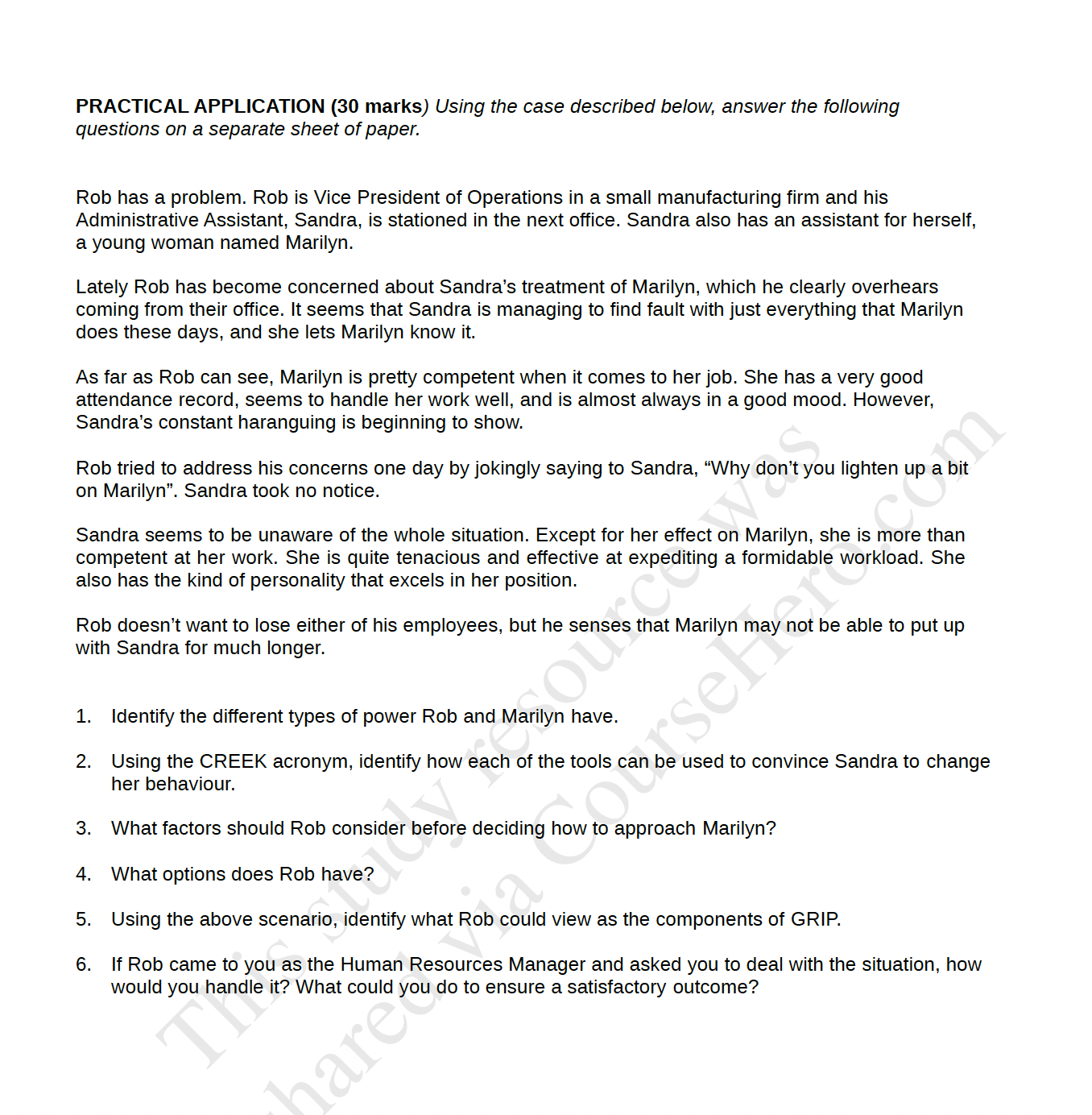
FINAL ASSESSMENT MULTIPLE CHOICE (10 marks) Circle the alternative that best completes the statement or answers the question. 1) Conflict and negotiation are patterned responses or clusters of behaviour that people use in conflict. Negotiation are individual moves people make to carry out their general approach. beliefs; styles assumptions; values styles; tactics tactics; assumptions PPP'P 2) Which of the following does not indicate a win-win scenario? a. both sides feel successful b. both sides have personal animosity towards the other side c. both sides are able to honour the agreement d. both sides are willing to work with each other in the future 3) Which of the following are types of third party intervention? a. Conciliation b. Meditation c. Unification d. a and b e. b and c 4) A mediator is NOT a: a. decision maker b. facilitator c. suggestion maker d. negotiator 5) Which of the following are the steps in the introductory stage of negotiations? Make an Offer, Start High. Use a Final Offer Use Silence, Use an Ultimatum, Walk Away, Create Time Pressure Prepare, Set the Rules, Focus on the Issues and Persuade Develop a Team, Define the Roles. Determine the Outcomes Use Techniques, Use Gambits. Use Counterparts, Use Tactics EDP-99'!\" 6) The fact that negativity information weighs more heavily than positive information in forming evaluations is referred to as: Cognitive Dissonance Disconfirmation Bias Latitude of Noncommitment Social Judgement Theory Negativity Bias 99.0259: 7) Failing to make your opinions and desires known is a. fear b. assertive behaviour C. hostile-aggressive behaviour d. passive aggressive behaviour e. passive behaviour 8) Which of the following is an example of a tactic used during the final stages of negotiations? a. bracketing b. starting low C. creating time pressure d. beginning with the small issues e. making the first offer 9) Group negotiations can be successful if: a. you, as an individual, have all the relevant information b. issues are complex and require diverse expertise e was o.com c. you are negotiating with one other individual d. all of the above e. none of the above 10) requires that the parties relinquish control over the outcomes of an independent third party. a. Conciliation b. Mediation C. Arbitration resou ursel d. Negotiation e. None of the above TRUE/FALSE (10 marks) Circle T if the statement is true, or F if the statement is false 1. T F Denying that a message was communicated is another way not to recognize the existence of power. 2. T F Avoidance is a way of dealing with conflict by trying not to overtly recognize its existence or your part in its creation. 3. T F The tone of negotiation is always determined at the end of the discussions. 4. It is usually beneficial to negotiate with someone who is not able to commit to the T F agreement. 5. T F Cognitive dissonance is a state of tension that occurs when an individual has one or more thoughts that are inconsistent with existing attitudes. 6. T F Reframing is stating your position with a different perspective. 7 T F Collaboration is the negotiation style that demands the most creativity and hard work of any of the styles. 8. T F Personality characteristics never affect leadership behaviour. 9. T F "Groupthink" is characterised by constant bickering and conflict. 10. T F Self-esteem is an individual's sense of personal value and worth.PRACTICAL APPLICATION (30 marks) Using the case described below, answer the following questions on a separate sheet of paper. Rob has a problem. Rob is Vice President of Operations in a small manufacturing firm and his Administrative Assistant, Sandra, is stationed in the next office. Sandra also has an assistant for herself, a young woman named Marilyn. Lately Rob has become concerned about Sandra's treatment of Marilyn, which he clearly overhears coming from their office. It seems that Sandra is managing to find fault with just everything that Marilyn does these days, and she lets Marilyn know it. As far as Rob can see, Marilyn is pretty competent when it comes to her job. She has a very good attendance record, seems to handle her work well, and is almost always in a good mood. However, Sandra's constant haranguing is beginning to show. Rob tried to address his concerns one day by jokingly saying to Sandra, \"Why don't you lighten up a bit on Marilyn". Sandra took no notice. Sandra seems to be unaware of the whole situation. Except for her effect on Marilyn, she is more than competent at her work. She is quite tenacious and effective at expediting a formidable workload. She also has the kind of personality that excels in her position. Rob doesn't want to lose either of his employees, but he senses that Marilyn may not be able to put up with Sandra for much longer. 1. Identify the different types of power Rob and Marilyn have. 2. Using the CREEK acronym, identify how each of the tools can be used to convince Sandra to change her behaviour. 3. What factors should Rob consider before deciding how to approach Marilyn? 4. What options does Rob have? 5. Using the above scenario, identify what Rob could view as the components of GRIP. 6. If Rob came to you as the Human Resources Manager and asked you to deal with the situation, how would you handle it? What could you do to ensure a satisfactory outcome
Step by Step Solution
There are 3 Steps involved in it

Get step-by-step solutions from verified subject matter experts
 Study Help