







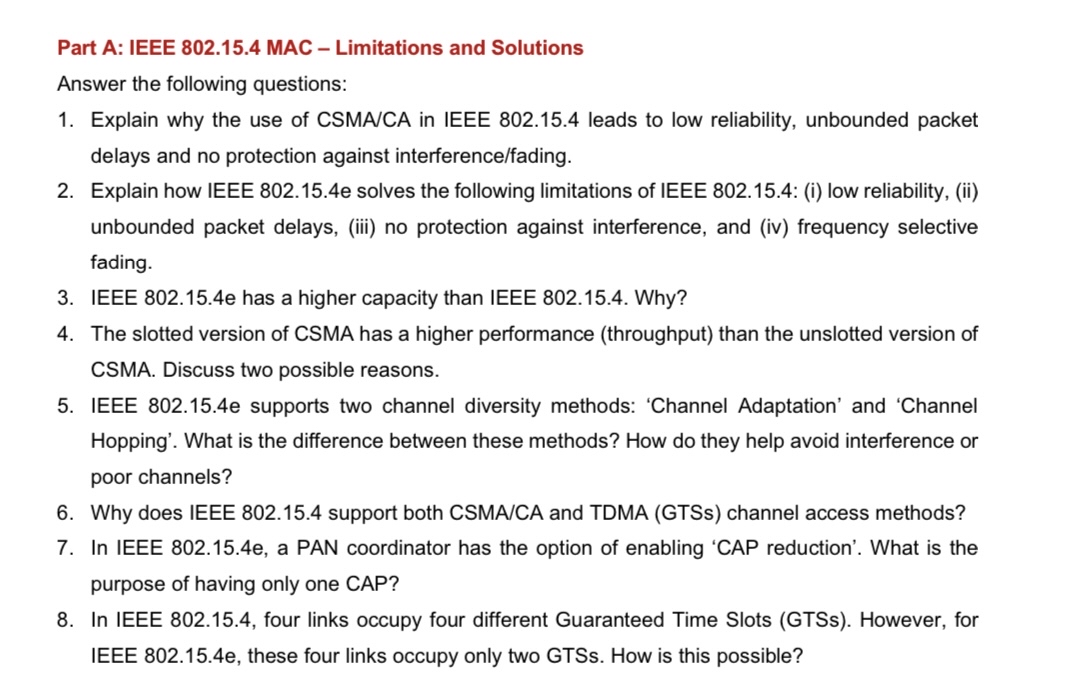
Question: Part A: IEEE 8 0 2 . 1 5 . 4 MAC - Limitations and Solutions Answer the following questions: Explain why the use of
Part A: IEEE MAC Limitations and Solutions
Answer the following questions:
Explain why the use of CSMACA in IEEE leads to low reliability, unbounded packet delays and no protection against interferencefading
Explain how IEEE e solves the following limitations of IEEE : i low reliability, ii unbounded packet delays, iii no protection against interference, and iv frequency selective fading.
IEEE e has a higher capacity than IEEE Why?
The slotted version of CSMA has a higher performance throughput than the unslotted version of CSMA. Discuss two possible reasons.
IEEE e supports two channel diversity methods: 'Channel Adaptation' and 'Channel Hopping'. What is the difference between these methods? How do they help avoid interference or poor channels?
Why does IEEE support both CSMACA and TDMA GTSs channel access methods?
In IEEE e a PAN coordinator has the option of enabling 'CAP reduction'. What is the purpose of having only one CAP?
In IEEE four links occupy four different Guaranteed Time Slots GTSs However, for IEEE e these four links occupy only two GTSs How is this possible?
Step by Step Solution
There are 3 Steps involved in it
1 Expert Approved Answer
Step: 1 Unlock

Question Has Been Solved by an Expert!
Get step-by-step solutions from verified subject matter experts
Step: 2 Unlock
Step: 3 Unlock
 Study Help