



Question: PART A: In this part your team will add a simple system call to xv6. Your new syscall should look like this: int partA(void) Your
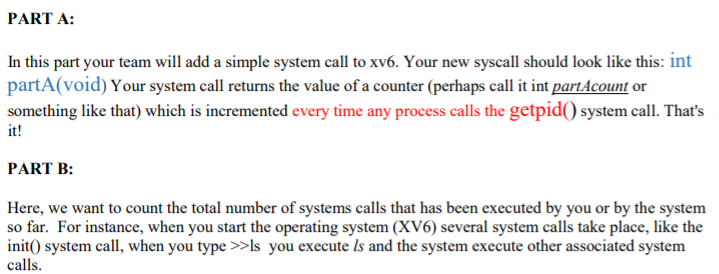
PART A: In this part your team will add a simple system call to xv6. Your new syscall should look like this: int partA(void) Your system call returns the value of a counter (perhaps call it int partAcount or something like that) which is incremented every time any process calls the getpid() system call. That's it! PART B: Here, we want to count the total number of systems calls that has been executed by you or by the system so far. For instance, when you start the operating system (XV6) several system calls take place, like the init() system call, when you type >>Is you execute ls and the system execute other associated system calls. PART A: In this part your team will add a simple system call to xv6. Your new syscall should look like this: int partA(void) Your system call returns the value of a counter (perhaps call it int partAcount or something like that) which is incremented every time any process calls the getpid() system call. That's it! PART B: Here, we want to count the total number of systems calls that has been executed by you or by the system so far. For instance, when you start the operating system (XV6) several system calls take place, like the init() system call, when you type >>Is you execute ls and the system execute other associated system calls
Step by Step Solution
There are 3 Steps involved in it

Get step-by-step solutions from verified subject matter experts