







Question: Part A Read the Case below, and answer the questions that follow with your own works in one or two paragraphs each question. Can Customer
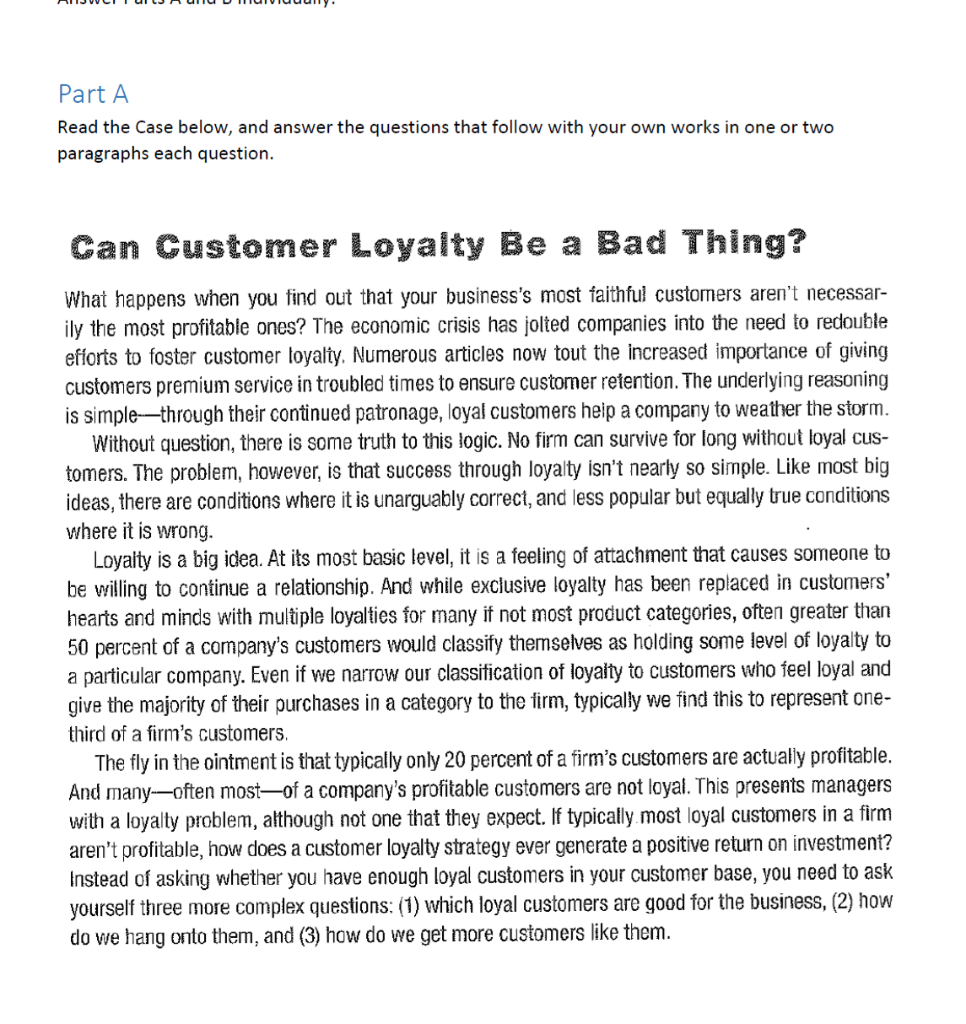
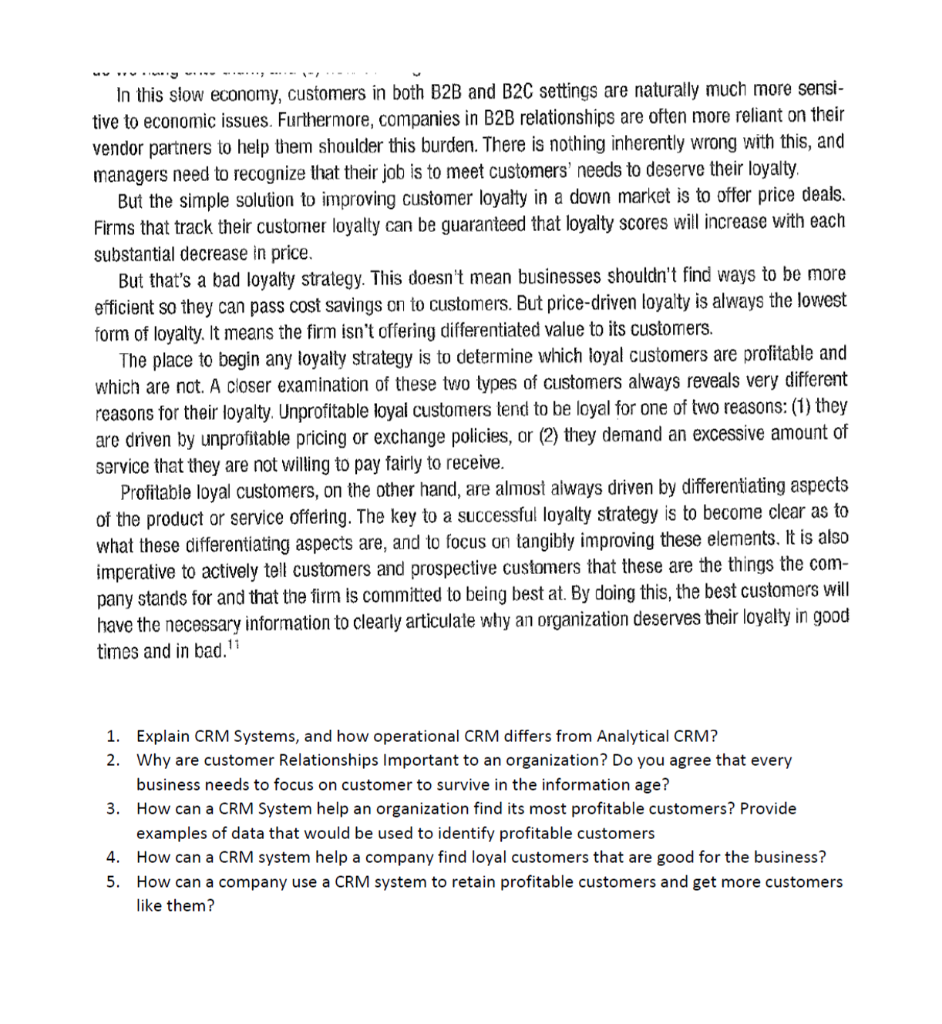
Part A Read the Case below, and answer the questions that follow with your own works in one or two paragraphs each question. Can Customer Loyalty Be a Bad Thing? What happens when you find out that your business's most faithful customers aren't necessar- ily the most profitable ones? The economic crisis has jolted companies into the need to redouble efforts to foster customer loyalty. Numerous articles now tout the increased importance of giving customers premium service in troubled times to ensure customer retention. The underlying reasoning is simple-through their continued patronage, loyal customers heip a company to weather the storm. Without question, there is some truth to this logic. No firm can survive for long without loyal cus tomers. The problem, however, is that success through loyalty isn't nearly so simple. Like most big ideas, there are conditions where it is unarguably correct, and less popular but equally true conditions where it is wrong. Loyaity is a big idea. At its most basic level, it is a feeling of attachment that causes someone to be willing to continue a relationship. And while exclusive loyalty has been replaced in customers' hearts and minds with multiple loyalties for many if not most product categories, often greater than 50 percent of a company's customers would classify themselves as holding some level of loyalty to a particular company. Even if we narrow our classitication of loyaity to customers who feel loyal and give the majority of their purchases in a category to the firm, typically we find this to represent one- third of a firm's customers The fly in the ointment is that typically only 20 percent of a firm's customers are actually profitable. And many-often mostof a company's profitable customers are not loyal. This presents managers with a loyalty problem, although not one that they expect. If typically most loyal customers in a firm aren't profitable, how does a customer loyalty strategy ever generate a positive return on investment? Instead of asking whether you have enough loyal customers in your customer base, you need to ask yourself three more complex questions: (1) which loyal customers are good for the business, (2) how do we hang onto them, and (3) how do we get more customers like them In this slow economy, customers in both B2B and B2C settings are naturally much more sensi tive to economic issues. Furthermore, companies in B2B relationships are often more reliant on their vendor partners to help them shoulder this burden. There is nothing inherently wrong with this, and managers need to recognize that their job is to meet customers' needs to deserve their loyalty But the simple solution to improving customer loyalty in a down market is to offer price deals Firms that track their customer loyalty can be guaranteed that loyalty scores will increase with each substantial decrease in price But that's a bad loyalty strategy. This doesn't mean businesses shouldn't find ways to be more efficient so they can pass cost savings on to customers. But price-driven loyalty is always the lowest form of loyalty. It means the firm isn't offering differentiated value to its customers. The place to begin any loyalty strategy is to determine which loyal customers are profitable and which are not. A closer examination of these two types of customers always reveals very different reasons for their loyalty. Unprofitable loyal customers tend to be loyal for one of two reasons: (1) they are driven by unprofitable pricing or exchange policies, or (2) they demand an excessive amount of service that they are not willing to pay fairly to receive Profitable loyal customers, on the other hand, are almost always driven by differentiating aspects of the product or service offerting. The key to a successful loyalty strategy is to become clear as to what these differentiating aspects are, and to focus on tangibly improving these elements. It is also imperative to actively tell customers and prospective customers that these are the things the com pany stands for and that the firm is committed to being best at. By doing this, the best customers will have the necessary information to clearly articulate why an organization deserves their loyalty in good times and in bad. 1. 2. Explain CRM Systems, and how operational CRM differs from Analytical CRM? Why are customer Relationships Important to an organization? Do you agree that every business needs to focus on customer to survive in the information age? How can a CRM System help an organization find its most profitable customers? Provide examples of data that would be used to identify profitable customers How can a CRM system help a company find loyal customers that are good for the business? How can a company use a CRM system to retain profitable customers and get more customers like them? 3. 4. 5
Step by Step Solution
There are 3 Steps involved in it

Get step-by-step solutions from verified subject matter experts
 Study Help