



Question: part a to d plz~ Fast inverse square root is used to estimate the reciprocal of the square root the For given quadratic function x2
part a to d plz~
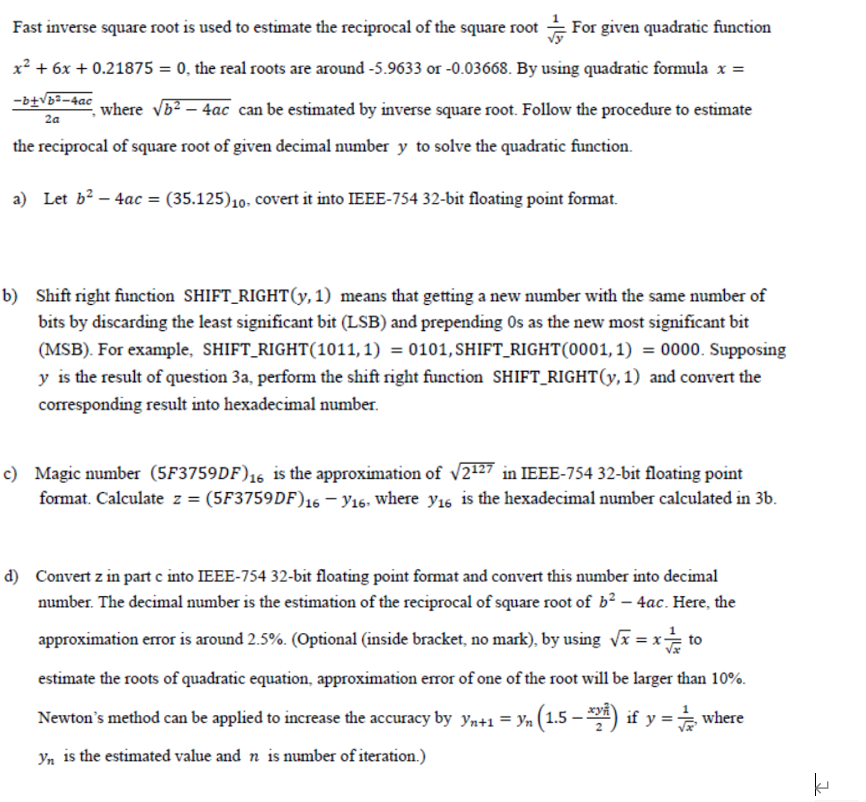
Fast inverse square root is used to estimate the reciprocal of the square root the For given quadratic function x2 + 6x +0.21875 = 0, the real roots are around -5.9633 or -0.03668. By using quadratic formula x = -D+Vb2-4ac where Vb2 - 4ac can be estimated by inverse square root. Follow the procedure to estimate 2a the reciprocal of square root of given decimal number y to solve the quadratic function. a) Let b2 - 4ac = (35.125)10, covert it into IEEE-754 32-bit floating point format. b) Shift right function SHIFT_RIGHT(y, 1) means that getting a new number with the same number of bits by discarding the least significant bit (LSB) and prepending Os as the new most significant bit (MSB). For example, SHIFT_RIGHT(1011, 1) = 0101, SHIFT_RIGHT(0001, 1) = 0000. Supposing y is the result of question 3a, perform the shift right function SHIFT_RIGHT(),1) and convert the corresponding result into hexadecimal number. c) Magic number (5F3759DF)16 is the approximation of 2127 in IEEE-754 32-bit floating point format. Calculate z = (5F3759DF)16 - 916, where y16 is the hexadecimal number calculated in 3b. d) Convert z in part c into IEEE-754 32-bit floating point format and convert this number into decimal number. The decimal number is the estimation of the reciprocal of square root of b2 - 4ac. Here, the approximation error is around 2.5%. (Optional (inside bracket, no mark), by using V = xt to estimate the roots of quadratic equation, approximation error of one of the root will be larger than 10%. Newton's method can be applied to increase the accuracy by Yn+1 = yn (1.5 ***) if y where Yn is the estimated value and n is number of iteration.) ke Fast inverse square root is used to estimate the reciprocal of the square root the For given quadratic function x2 + 6x +0.21875 = 0, the real roots are around -5.9633 or -0.03668. By using quadratic formula x = -D+Vb2-4ac where Vb2 - 4ac can be estimated by inverse square root. Follow the procedure to estimate 2a the reciprocal of square root of given decimal number y to solve the quadratic function. a) Let b2 - 4ac = (35.125)10, covert it into IEEE-754 32-bit floating point format. b) Shift right function SHIFT_RIGHT(y, 1) means that getting a new number with the same number of bits by discarding the least significant bit (LSB) and prepending Os as the new most significant bit (MSB). For example, SHIFT_RIGHT(1011, 1) = 0101, SHIFT_RIGHT(0001, 1) = 0000. Supposing y is the result of question 3a, perform the shift right function SHIFT_RIGHT(),1) and convert the corresponding result into hexadecimal number. c) Magic number (5F3759DF)16 is the approximation of 2127 in IEEE-754 32-bit floating point format. Calculate z = (5F3759DF)16 - 916, where y16 is the hexadecimal number calculated in 3b. d) Convert z in part c into IEEE-754 32-bit floating point format and convert this number into decimal number. The decimal number is the estimation of the reciprocal of square root of b2 - 4ac. Here, the approximation error is around 2.5%. (Optional (inside bracket, no mark), by using V = xt to estimate the roots of quadratic equation, approximation error of one of the root will be larger than 10%. Newton's method can be applied to increase the accuracy by Yn+1 = yn (1.5 ***) if y where Yn is the estimated value and n is number of iteration.) ke
Step by Step Solution
There are 3 Steps involved in it

Get step-by-step solutions from verified subject matter experts