







Question: Part A. True/False 1. The 2 principal risks in the import/export business are the seller will not get paid for the goods that are sold
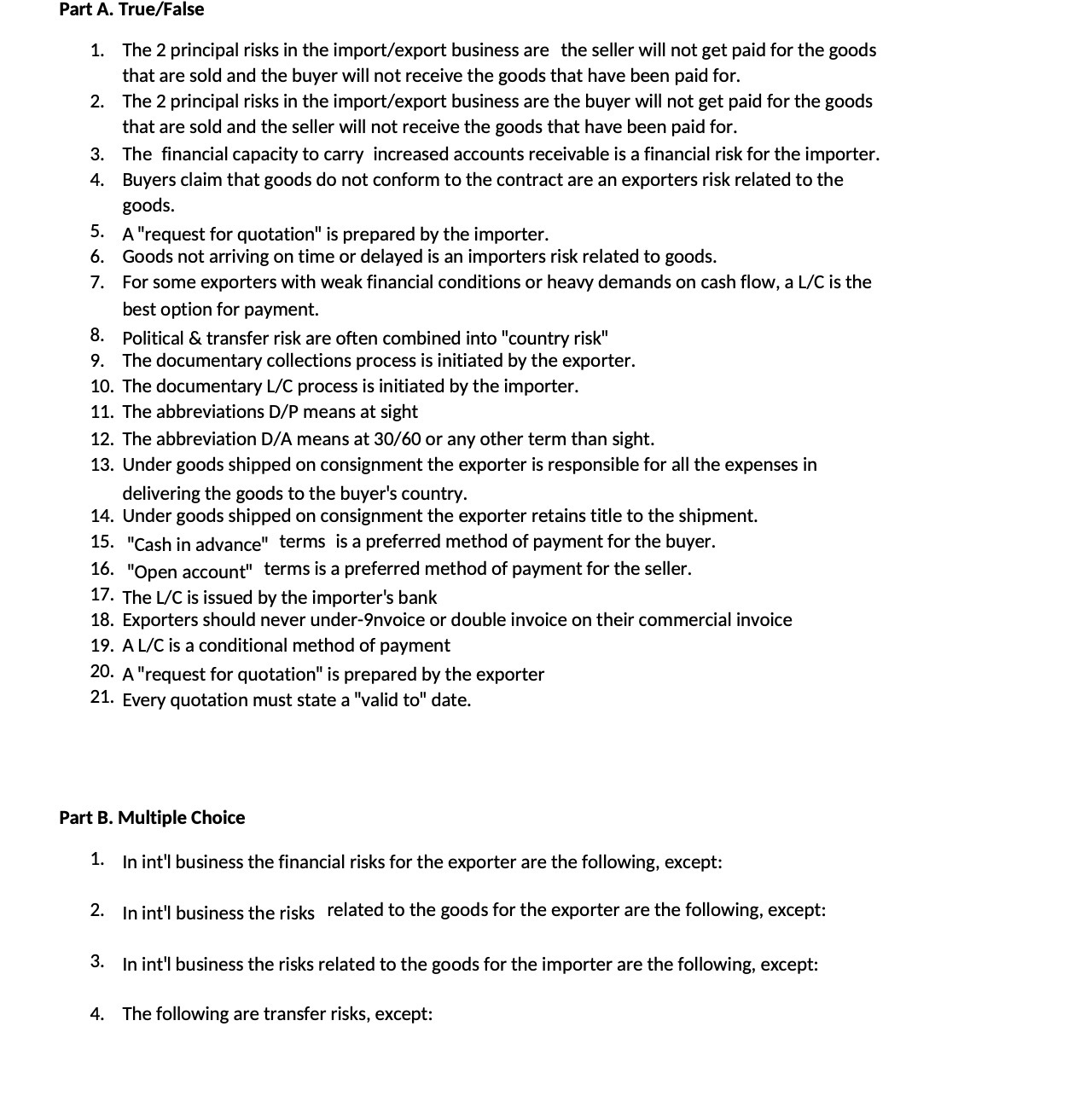
Part A. True/False 1. The 2 principal risks in the import/export business are the seller will not get paid for the goods that are sold and the buyer will not receive the goods that have been paid for. 2. The 2 principal risks in the import/export business are the buyer will not get paid for the goods that are sold and the seller will not receive the goods that have been paid for. 3. The nancial capacity to carry increased accounts receivable is a financial risk for the importer. 4. Buyers claim that goods do not conform to the contract are an exporters risk related to the goods. 5- A "request for quotation" is prepared by the importer. 6. Goods not arriving on time or delayed is an importers risk related to goods. 7. For some exporters with weak financial conditions or heavy demands on cash flow, a L/C is the best option for payment. 3- Political & transfer risk are often combined into "country risk" 9. The documentary collections process is initiated by the exporter. 10. The documentary L/C process is initiated by the importer. 11. The abbreviations D/P means at sight 12. The abbreviation D/A means at 30/60 or any other term than sight. 13. Under goods shipped on consignment the exporter is responsible for all the expenses in delivering the goods to the buyer's country. 14. Under goods shipped on consignment the exporter retains title to the shipment. 15. "Cash in advance" terms is a preferred method of payment for the buyer. 16. "Open account" terms is a preferred method of payment for the seller. 17- The UC is issued by the importer's bank 18. Exporters should never under-9nvoice or double invoice on their commercial invoice 19. A L/C is a conditional method of payment 20- A "request for quotation" is prepared by the exporter 21- Every quotation must state a "valid to\" date. Part B. Multiple Choice 1- In int'l business the nancial risks for the exporter are the following, except: 2. In int'| business the risks related to the goods for the exporter are the following, except: 3- In int'l business the risks related to the goods for the importer are the following, except: 4. The following are transfer risks, except
Step by Step Solution
There are 3 Steps involved in it

Get step-by-step solutions from verified subject matter experts
 Study Help