







Question: Part B. Answer Any Two Question (25 points each) 1. A firm is considering two mutually exclusive investment projects. The following comparative information is available:
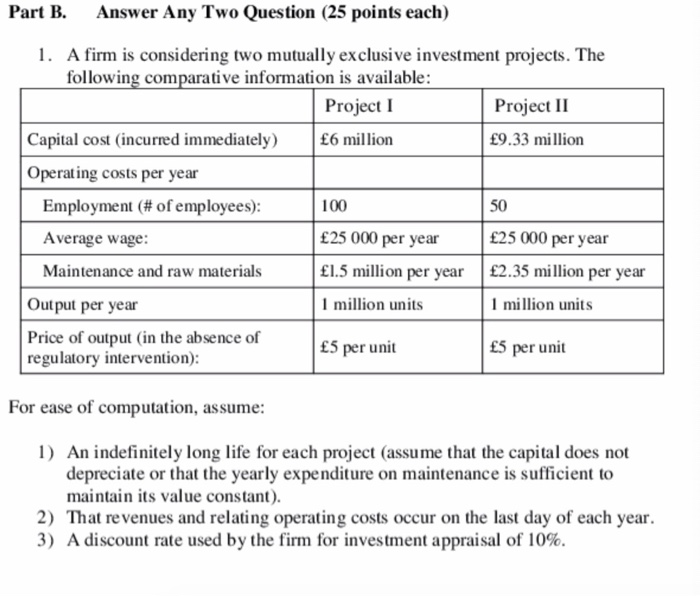
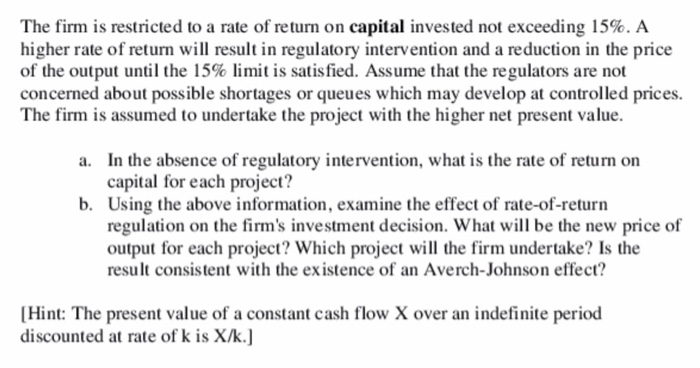
Part B. Answer Any Two Question (25 points each) 1. A firm is considering two mutually exclusive investment projects. The following comparative information is available: Project 1 Project II Capital cost incurred immediately) 6 million 9.33 million 100 50 Operating costs per year Employment (# of employees): Average wage: Maintenance and raw materials 25 000 per year 1.5 million per year 1 million units 25 000 per year 2.35 million per year 1 million units Output per year Price of output in the absence of regulatory intervention): 5 per unit 5 per unit For ease of computation, assume: 1) An indefinitely long life for each project (assume that the capital does not depreciate or that the yearly expenditure on maintenance is sufficient to maintain its value constant). 2) That revenues and relating operating costs occur on the last day of each year. 3) A discount rate used by the firm for investment appraisal of 10%. The firm is restricted to a rate of return on capital invested not exceeding 15%. A higher rate of return will result in regulatory intervention and a reduction in the price of the output until the 15% limit is satisfied. Assume that the regulators are not concerned about possible shortages or queues which may develop at controlled prices. The firm is assumed to undertake the project with the higher net present value. a. In the absence of regulatory intervention, what is the rate of return on capital for each project? b. Using the above information, examine the effect of rate-of-return regulation on the firm's investment decision. What will be the new price of output for each project? Which project will the firm undertake? Is the result consistent with the existence of an Averch-Johnson effect? (Hint: The present value of a constant cash flow X over an indefinite period discounted at rate of k is X/k.] Part B. Answer Any Two Question (25 points each) 1. A firm is considering two mutually exclusive investment projects. The following comparative information is available: Project 1 Project II Capital cost incurred immediately) 6 million 9.33 million 100 50 Operating costs per year Employment (# of employees): Average wage: Maintenance and raw materials 25 000 per year 1.5 million per year 1 million units 25 000 per year 2.35 million per year 1 million units Output per year Price of output in the absence of regulatory intervention): 5 per unit 5 per unit For ease of computation, assume: 1) An indefinitely long life for each project (assume that the capital does not depreciate or that the yearly expenditure on maintenance is sufficient to maintain its value constant). 2) That revenues and relating operating costs occur on the last day of each year. 3) A discount rate used by the firm for investment appraisal of 10%. The firm is restricted to a rate of return on capital invested not exceeding 15%. A higher rate of return will result in regulatory intervention and a reduction in the price of the output until the 15% limit is satisfied. Assume that the regulators are not concerned about possible shortages or queues which may develop at controlled prices. The firm is assumed to undertake the project with the higher net present value. a. In the absence of regulatory intervention, what is the rate of return on capital for each project? b. Using the above information, examine the effect of rate-of-return regulation on the firm's investment decision. What will be the new price of output for each project? Which project will the firm undertake? Is the result consistent with the existence of an Averch-Johnson effect? (Hint: The present value of a constant cash flow X over an indefinite period discounted at rate of k is X/k.]
Step by Step Solution
There are 3 Steps involved in it

Get step-by-step solutions from verified subject matter experts
 Study Help