







Question: Part B - Experimental results: Banding pattern predictions for each model of replication Meselson and Stahl designed an experiment that would allow them to
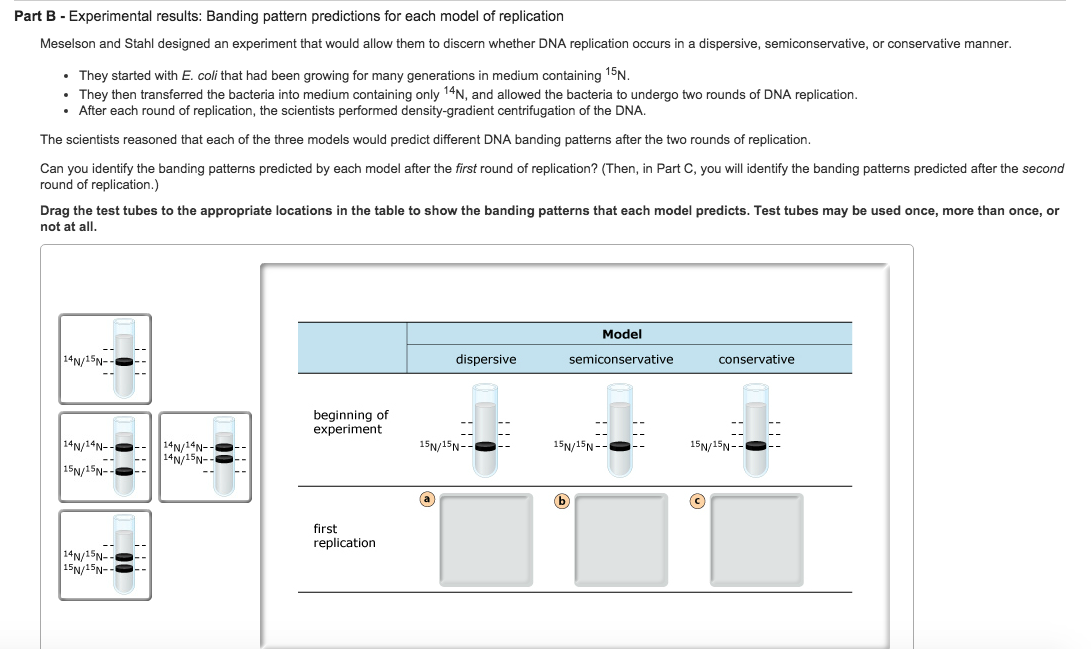
Part B - Experimental results: Banding pattern predictions for each model of replication Meselson and Stahl designed an experiment that would allow them to discern whether DNA replication occurs in a dispersive, semiconservative, or conservative manner. They started with E. coli that had been growing for many generations in medium containing 15N. They then transferred the bacteria into medium containing only 14N, and allowed the bacteria to undergo two rounds of DNA replication. After each round of replication, the scientists performed density-gradient centrifugation of the DNA. The scientists reasoned that each of the three models would predict different DNA banding patterns after the two rounds of replication. Can you identify the banding patterns predicted by each model after the first round of replication? (Then, in Part C, you will identify the banding patterns predicted after the second round of replication.) Drag the test tubes to the appropriate locations in the table to show the banding patterns that each model predicts. Test tubes may be used once, more than once, or not at all. 14N/15N-- 14N/14N-. 15N/15N-- 14N/15N---- 15N/15N-- 14N/14N-- 14N/15N-- beginning of experiment first replication dispersive 15N/15N-- Model semiconservative 15N/15N-- b) conservative 15N/15N--
Step by Step Solution
3.47 Rating (147 Votes )
There are 3 Steps involved in it
In conservative model 15N parent remain unchanged and new synthesized d... View full answer

Get step-by-step solutions from verified subject matter experts
 Study Help