Question: Part C: Human Resources (30 marks) Read the Case Study Work-Life Balance: Canadian Voices and the British Experiment. Next, read the Section Improving Work-Life Balance
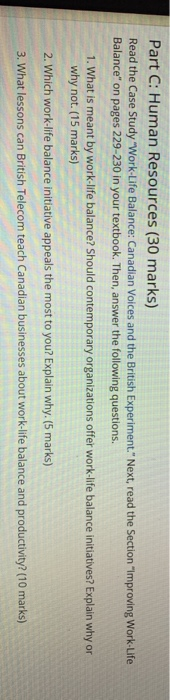
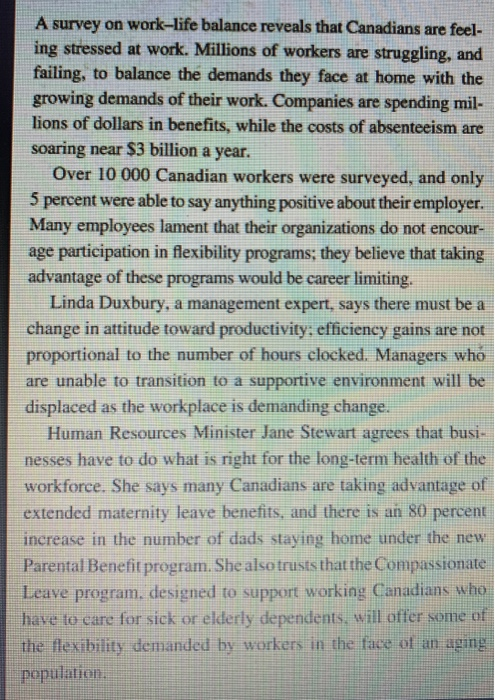
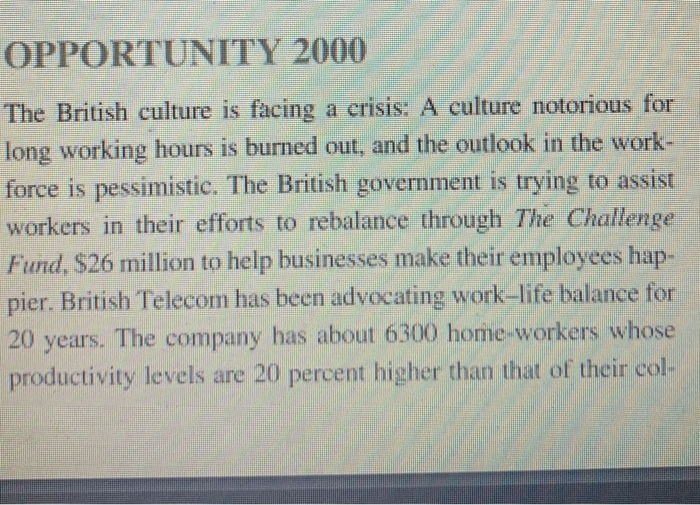
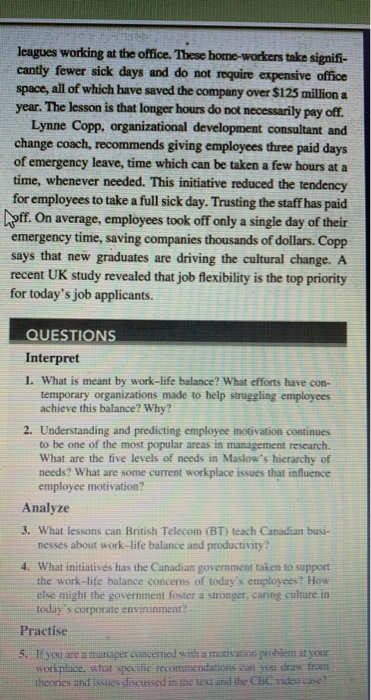
Part C: Human Resources (30 marks) Read the Case Study Work-Life Balance: Canadian Voices and the British Experiment." Next, read the Section "Improving Work-Life Balance" on pages 229-230 in your textbook. Then, answer the following questions. 1. What is meant by work-life balance? Should contemporary organizations offer work-life balance initiatives? Explain why or why not. (15 marks) 2. Which work-life balance initiative appeals the most to you? Explain why. (5 marks) 3. What lessons can British Telecom teach Canadian businesses about work-life balance and productivity? (10 marks) A survey on work-life balance reveals that Canadians are feel- ing stressed at work. Millions of workers are struggling, and failing, to balance the demands they face at home with the growing demands of their work. Companies are spending mil- lions of dollars in benefits, while the costs of absenteeism are soaring near $3 billion a year. Over 10 000 Canadian workers were surveyed, and only 5 percent were able to say anything positive about their employer. Many employees lament that their organizations do not encour- age participation in flexibility programs; they believe that taking advantage of these programs would be career limiting. Linda Duxbury, a management expert, says there must be a change in attitude toward productivity: efficiency gains are not proportional to the number of hours clocked. Managers who are unable to transition to a supportive environment will be displaced as the workplace is demanding change. Human Resources Minister Jane Stewart agrees that busi- nesses have to do what is right for the long-term health of the workforce. She says many Canadians are taking advantage of extended maternity leave benefits, and there is an 80 percent increase in the number of dads staying home under the new Parental Benefit program. She also trusts that the Compassionate Leave program, designed to support working Canadians who have to care for sick or elderly dependents, will offer some of the flexibility demanded by workers in the face of an aging populatien OPPORTUNITY 2000 The British culture is facing a crisis: A culture notorious for long working hours is burned out, and the outlook in the work- force is pessimistic. The British government is trying to assist workers in their efforts to rebalance through The Challenge Fund, $26 million to help businesses make their employees hap- pier. British Telecom has been advocating work-life balance for 20 years. The company has about 6300 home workers whose productivity levels are 20 percent higher than that of their col- leagues working at the office. These home-workers take signifi- cantly fewer sick days and do not require expensive office space, all of which have saved the company over $125 million a year. The lesson is that longer hours do not necessarily pay off. Lynne Copp, organizational development consultant and change coach, recommends giving employees three paid days of emergency leave, time which can be taken a few hours at a time, whenever needed. This initiative reduced the tendency for employees to take a full sick day. Trusting the staff has paid Doff. On average, employees took off only a single day of their emergency time, saving companies thousands of dollars. Copp says that new graduates are driving the cultural change. A recent UK study revealed that job flexibility is the top priority for today's job applicants. QUESTIONS Interpret 1. What is meant by work-life balance? What efforts have con- temporary organizations made to help struggling employees achieve this balance? Why? 2. Understanding and predicting employee motivation continues to be one of the most popular areas in management research. What are the five levels of needs in Maslow's hierarchy of needs? What are some current workplace issues that influence employee motivation? Analyze 3. What lessons can British Telecom (BT) teach Canadian busi- nesses about work-life balance and productivity? 4. What initiatives has the Canadian government taken to support the work-life balance concerns of today's employees? How cise might the government foster a stronger, caring culture in today's corporate environment? Practise 5. If you are a manager concerned with a motivation problem at your workplace. what specifie recommendations can you draw from theories and is discussed in the text and the CBC video









 Study Help