







Question: Part C: Motor Turn - on / off Timing 1 ) Build the circuit in Figure 3 with ( mathrm { V }
Part C: Motor Turnonoff Timing
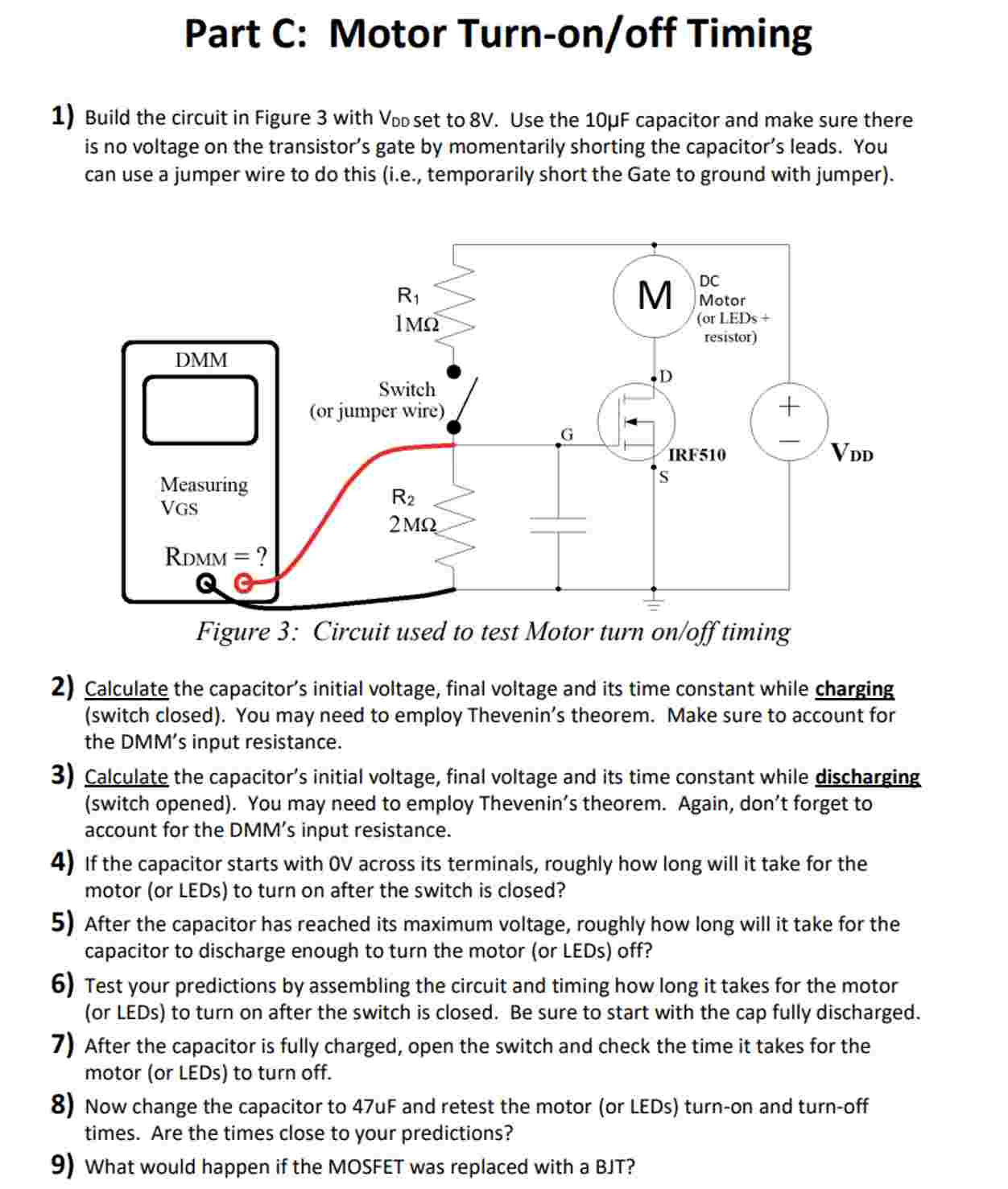
Build the circuit in Figure with mathrmVD D set to V Use the mu mathrm~F capacitor and make sure there is no voltage on the transistor's gate by momentarily shorting the capacitor's leads. You can use a jumper wire to do this ie temporarily short the Gate to ground with jumper
Figure : Circuit used to test Motor turn onoff timing
Calculate the capacitor's initial voltage, final voltage and its time constant while charging switch closed You may need to employ Thevenin's theorem. Make sure to account for the DMMs input resistance.
Calculate the capacitor's initial voltage, final voltage and its time constant while discharging switch opened You may need to employ Thevenin's theorem. Again, don't forget to account for the DMMs input resistance.
If the capacitor starts with OV across its terminals, roughly how long will it take for the motor or LEDs to turn on after the switch is closed?
After the capacitor has reached its maximum voltage, roughly how long will it take for the capacitor to discharge enough to turn the motor or LEDs off?
Test your predictions by assembling the circuit and timing how long it takes for the motor or LEDs to turn on after the switch is closed. Be sure to start with the cap fully discharged.
After the capacitor is fully charged, open the switch and check the time it takes for the motor or LEDs to turn off.
Now change the capacitor to uF and retest the motor or LEDs turnon and turnoff times. Are the times close to your predictions?
What would happen if the MOSFET was replaced with a BJT
Step by Step Solution
There are 3 Steps involved in it
1 Expert Approved Answer
Step: 1 Unlock

Question Has Been Solved by an Expert!
Get step-by-step solutions from verified subject matter experts
Step: 2 Unlock
Step: 3 Unlock
 Study Help