







Question: Part I 20 Multiple Choice Questions (I mark each question, total 20 marks) 1. An alternative name for the balance sheet is: a. Statement of
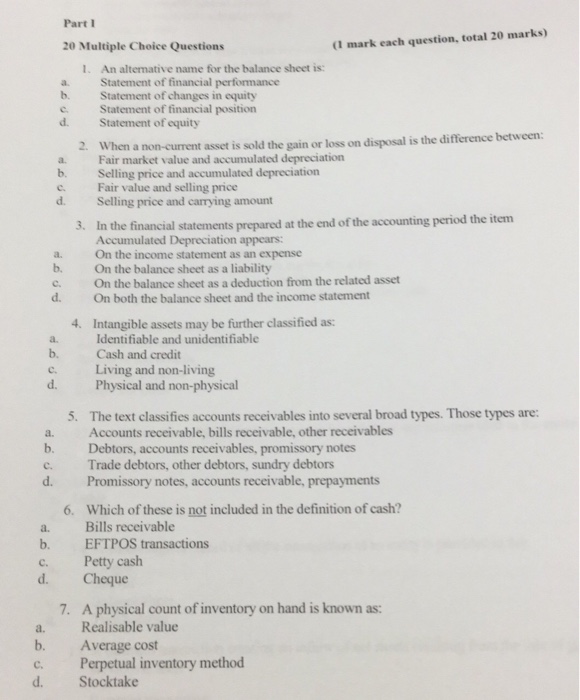
Part I 20 Multiple Choice Questions (I mark each question, total 20 marks) 1. An alternative name for the balance sheet is: a. Statement of financial performance b. Statement of changes in equity C. d. Statement of equity Statement of financial position 2. When a non-current asset is sold the gain or loss on disposal is the difference between a. Fair market value and accumulated depreciation b. Selling price and accumulated depreciation c. Fair value and selling price d. Selling price and carrying amount 3. In the financial statements prepared at the end of the accounting period the item Accumulated Depreciation appears: a. On the income statement as an expense b. On the balance sheet as a liability c. On the balance sheet as a deduction from the related asset d. On both the balance sheet and the income statement 4. Intangible assets may be further classified as: Identifiable and unidentifiable b. Cash and credit c. Living and non-living d. Physical and non-physical The text classifies accounts receivables into several broad types. Those types are: Accounts receivable, bills receivable, other receivables Debtors, accounts receivables, promissory notes Trade debtors, other debtors, sundry debtors Promissory notes, accounts receivable, prepayments 5 a. b. c. d. 6. Which of these is not included in the definition of cash? a. Bills receivable b. EFTPOS transactions c. Petty cash d. Cheque 7. A physical count of inventory on hand is known as: a. Realisable value b. Average cost c. Perpetual inventory method d. Stocktake
Step by Step Solution
There are 3 Steps involved in it

Get step-by-step solutions from verified subject matter experts
 Study Help