





Question: Part I: True /False Questions Write on the answer table below true if the statement is correct and write false if the statement is incorrect.
Part I: True /False Questions Write on the answer
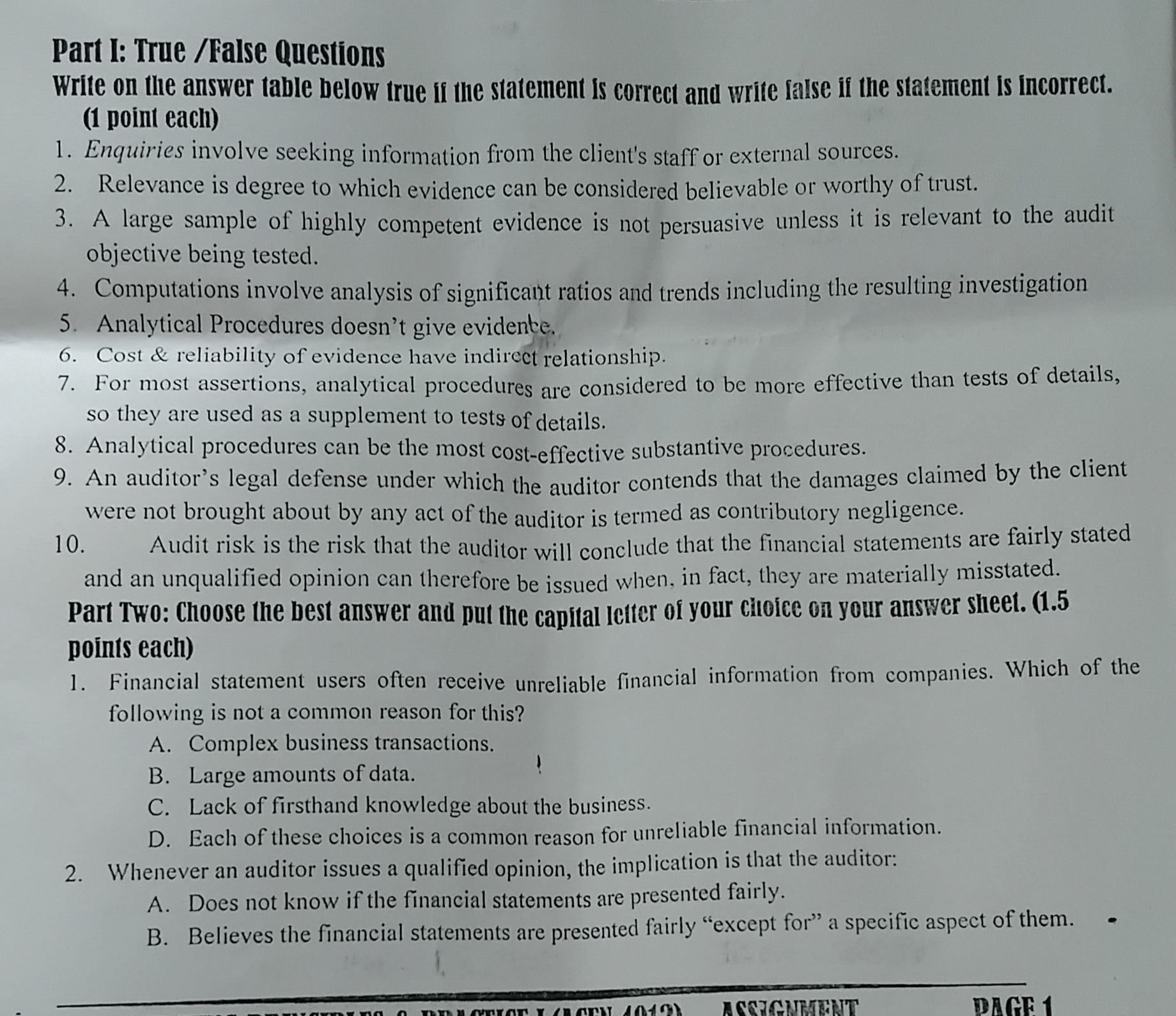
Part I: True /False Questions Write on the answer table below true if the statement is correct and write false if the statement is incorrect. (1 point each) 1. Enquiries involve seeking information from the client's staff or external sources. 2. Relevance is degree to which evidence can be considered believable or worthy of trust. 3. A large sample of highly competent evidence is not persuasive unless it is relevant to the audit objective being tested. 4. Computations involve analysis of significant ratios and trends including the resulting investigation 5. Analytical Procedures doesn't give evidence. 6. Cost & reliability of evidence have indirect relationship. 7. For most assertions, analytical procedures are considered to be more effective than tests of details, so they are used as a supplement to tests of details. 8. Analytical procedures can be the most cost-effective substantive procedures. 9. An auditor's legal defense under which the auditor contends that the damages claimed by the client were not brought about by any act of the auditor is termed as contributory negligence. 10. Audit risk is the risk that the auditor will conclude that the financial statements are fairly stated and an unqualified opinion can therefore be issued when, in fact, they are materially misstated. Part Two: Choose the best answer and put the capital letter of your choice on your answer sheet. (1.5 points each) 1. Financial statement users often receive unreliable financial information from companies. Which of the following is not a common reason for this? A. Complex business transactions. B. Large amounts of data. C. Lack of firsthand knowledge about the business. D. Each of these choices is a common reason for unreliable financial information. 2. Whenever an auditor issues a qualified opinion, the implication is that the auditor: A. Does not know if the financial statements are presented fairly. B. Believes the financial statements are presented fairly "except for" a specific aspect of them. - DAGE 1

Step by Step Solution

There are 3 Steps involved in it

1 Expert Approved Answer
Step: 1 Unlock blur-text-image

Question Has Been Solved by an Expert!

Get step-by-step solutions from verified subject matter experts

Step: 2 Unlock
Step: 3 Unlock

Students Have Also Explored These Related Accounting Questions!