







Question: Part I: Two's complement la. Convert unsigned binary 0101 1010 0001 1010 to decimal lb. Convert 16-bit two's complement 0101 1010 0001 1010 to decimal
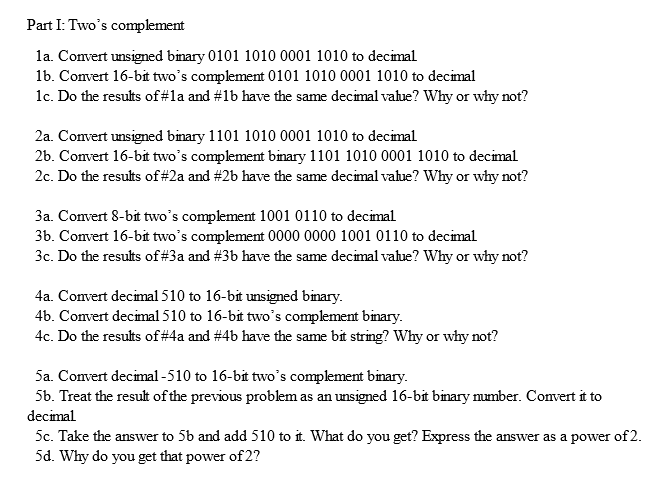
Part I: Two's complement la. Convert unsigned binary 0101 1010 0001 1010 to decimal lb. Convert 16-bit two's complement 0101 1010 0001 1010 to decimal 1c. Do the results of#1a and #1b have the same decimal value? Why or why not? 2a. Convert unsigned bmary 1101 1010 0001 1010 to decimal 2b. Convert 16-bit two's complement bimary 1101 1010 0001 1010 to decimal 2c. Do the results of#2a and #2b have the same decimal value? Why or why not? 3a. Convert 8-bit two's complement 1001 0110 to decimal 3b. Convert 16-bit two's complement 0000 0000 1001 0110 to decimal 3c. Do the results of#3a and #3b have the same decimal value? Why or why not? 4a. Convert decimal 510 to 16-bit unsigned binary 4b. Convert decimal 510 to 16-bit two's complement binary 4c. Do the results of#4a and #4b have the same bit string? Why or why not? 5a. Convert decimal -510 to 16-bit two's complement bnary 5b. Treat the result ofthe previous problem as an unsigned 16-bit bimary number. Convert it to decimal 5c. Take the answer to 5b and add 510 to it. What do you get? Express the answer as a power of2 5d. Why do you get that power of2
Step by Step Solution
There are 3 Steps involved in it

Get step-by-step solutions from verified subject matter experts
 Study Help