







Question: Part II: Electrostatics and Coulomb's Law Charged objects exert electrical forces on one another. These forces are different from gravitational forces and originate from charged
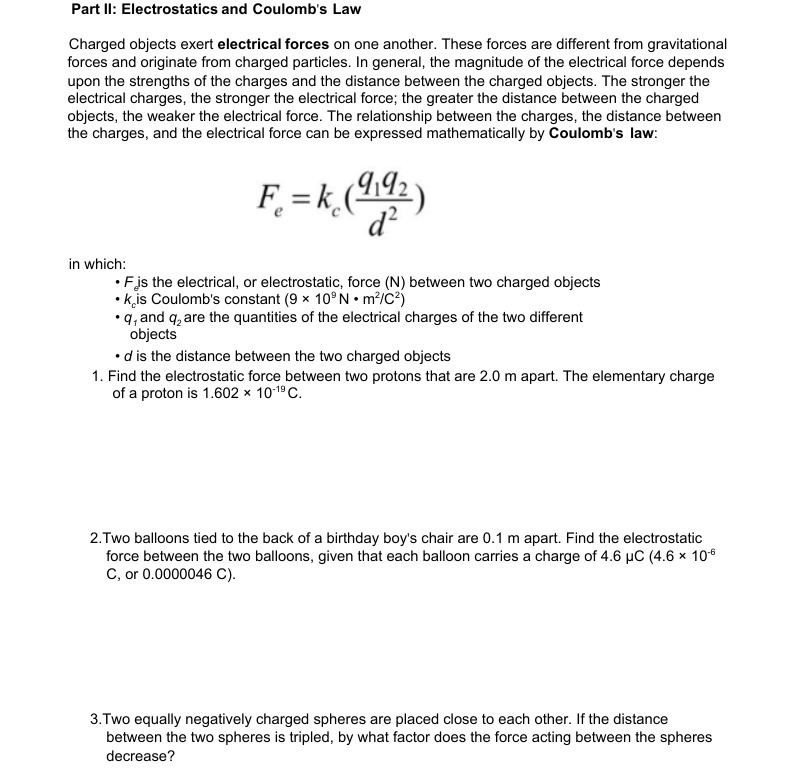
Part II: Electrostatics and Coulomb's Law Charged objects exert electrical forces on one another. These forces are different from gravitational forces and originate from charged particles. In general, the magnitude of the electrical force depends upon the strengths of the charges and the distance between the charged objects. The stronger the electrical charges, the stronger the electrical force; the greater the distance between the charged objects, the weaker the electrical force. The relationship between the charges, the distance between the charges, and the electrical force can be expressed mathematically by ll2oulomb'e law: E=k.(""ll d2 in which: - Fis the electrical, or electrostatic, force {N} between two charged objects - kcis Coulomb's constant [6 x 16\" N - mm?) - grand scare the quantities of the electrical charges of the two different objects - d is the distance between the two charged objects 1. Find the electrostatic force between two protons that are 2.6 m apart. The elementary charge ola proton is 1.662 3: 16"\"0. 2.Two baltoons tied to the back of a birthday boy's chair are 6.1 m apart. Find the electrosta6c force between the two balloons, given that each balloon carries a charge of 4.6 p0 {4.6 K 16'E C, or 66666646 C}. 3.Two equally negatively charged spheres are placed close to each other. If the distance between the two spheres is tripled. by what factor does the force acting between the spheres decrease
Step by Step Solution
There are 3 Steps involved in it

Get step-by-step solutions from verified subject matter experts
 Study Help