







Question: PART II - One Sample Z-Test (10 Points) A study conducted by the research institute of America has concluded that the mean number of hours
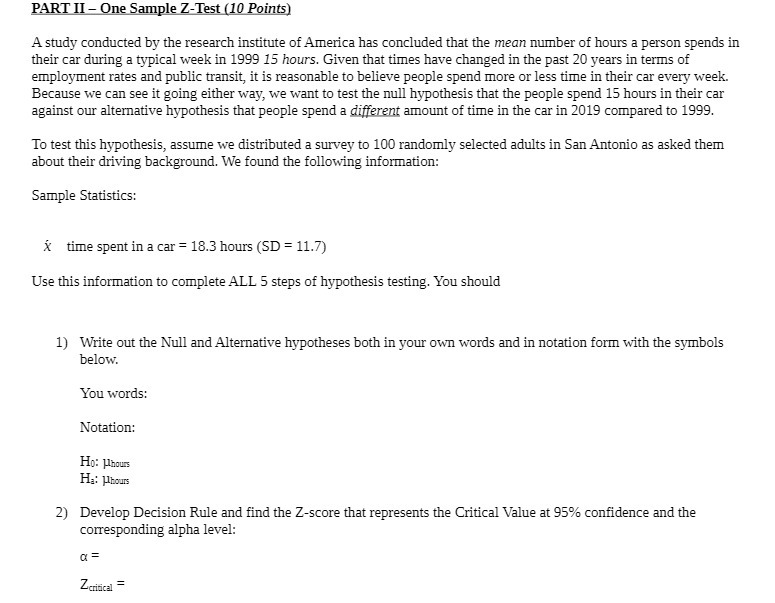
PART II - One Sample Z-Test (10 Points) A study conducted by the research institute of America has concluded that the mean number of hours a person spends in their car during a typical week in 1999 15 hours. Given that times have changed in the past 20 years in terms of employment rates and public transit, it is reasonable to believe people spend more or less time in their car every week. Because we can see it going either way, we want to test the null hypothesis that the people spend 15 hours in their car against our alternative hypothesis that people spend a different amount of time in the car in 2019 compared to 1999. To test this hypothesis, assume we distributed a survey to 100 randomly selected adults in San Antonio as asked them about their driving background. We found the following information: Sample Statistics: * time spent in a car = 18.3 hours (SD = 11.7) Use this information to complete ALL 5 steps of hypothesis testing. You should 1) Write out the Null and Alternative hypotheses both in your own words and in notation form with the symbols below. You words: Notation: Ho: Hhours Ha: Hhours 2) Develop Decision Rule and find the Z-score that represents the Critical Value at 95% confidence and the corresponding alpha level: D = Zcritical =
Step by Step Solution
There are 3 Steps involved in it

Get step-by-step solutions from verified subject matter experts
 Study Help