







Question: Part II-Computing Starbucks' Share Value Using Free Cash Flows to All Debt and Equity Stakeholders g. At the end of 2012, Starbucks had $1,263
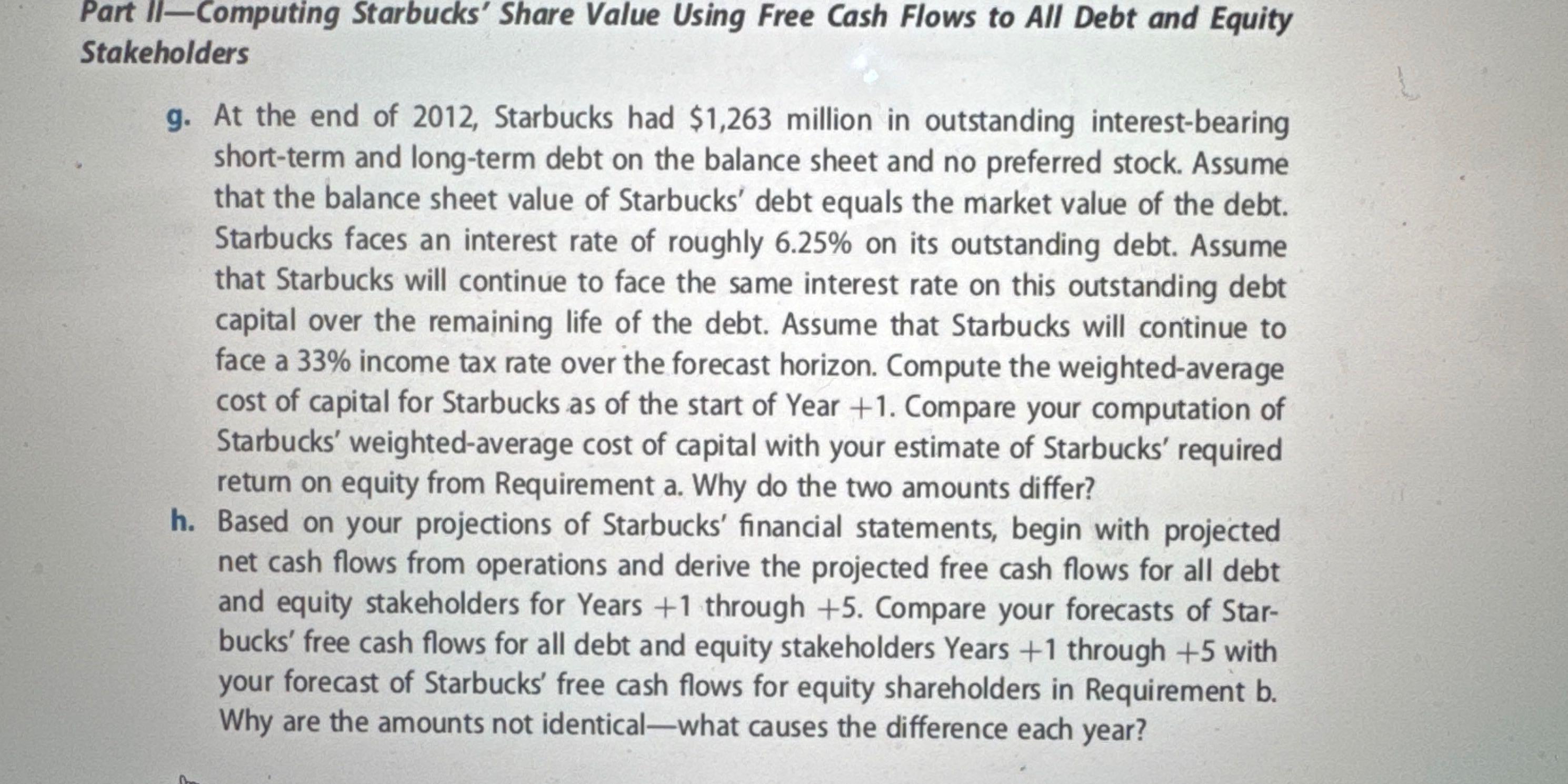
Part II-Computing Starbucks' Share Value Using Free Cash Flows to All Debt and Equity Stakeholders g. At the end of 2012, Starbucks had $1,263 million in outstanding interest-bearing short-term and long-term debt on the balance sheet and no preferred stock. Assume that the balance sheet value of Starbucks' debt equals the market value of the debt. Starbucks faces an interest rate of roughly 6.25% on its outstanding debt. Assume that Starbucks will continue to face the same interest rate on this outstanding debt capital over the remaining life of the debt. Assume that Starbucks will continue to face a 33% income tax rate over the forecast horizon. Compute the weighted-average cost of capital for Starbucks as of the start of Year +1. Compare your computation of Starbucks' weighted-average cost of capital with your estimate of Starbucks' required return on equity from Requirement a. Why do the two amounts differ? h. Based on your projections of Starbucks' financial statements, begin with projected net cash flows from operations and derive the projected free cash flows for all debt and equity stakeholders for Years +1 through +5. Compare your forecasts of Star- bucks' free cash flows for all debt and equity stakeholders Years +1 through +5 with your forecast of Starbucks' free cash flows for equity shareholders in Requirement b. Why are the amounts not identical-what causes the difference each year?
Step by Step Solution
There are 3 Steps involved in it
g To compute the weightedaverage cost of capital WACC for Starbucks we need to consider the cost of ... View full answer

Get step-by-step solutions from verified subject matter experts
 Study Help