



Question: PART III. CASE ANALYSIS. (15 Marks) Business Case: Fulton & Roark (This is an adopted business case) Fulton & Roark, a retailer of men's
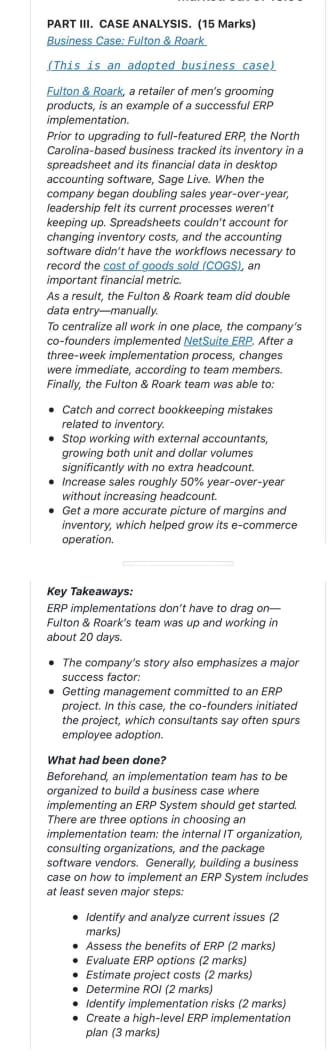
PART III. CASE ANALYSIS. (15 Marks) Business Case: Fulton & Roark (This is an adopted business case) Fulton & Roark, a retailer of men's grooming products, is an example of a successful ERP implementation. Prior to upgrading to full-featured ERP, the North Carolina-based business tracked its inventory in a spreadsheet and its financial data in desktop accounting software, Sage Live. When the company began doubling sales year-over-year, leadership felt its current processes weren't keeping up. Spreadsheets couldn't account for changing inventory costs, and the accounting software didn't have the workflows necessary to record the cost of goods sold (COGS), an important financial metric. As a result, the Fulton & Roark team did double data entry-manually. To centralize all work in one place, the company's co-founders implemented NetSuite ERP. After a three-week implementation process, changes were immediate, according to team members. Finally, the Fulton & Roark team was able to: Catch and correct bookkeeping mistakes related to inventory. Stop working with external accountants, growing both unit and dollar volumes significantly with no extra headcount. Increase sales roughly 50% year-over-year without increasing headcount. Get a more accurate picture of margins and inventory, which helped grow its e-commerce operation. Key Takeaways: ERP implementations don't have to drag on- Fulton & Roark's team was up and working in about 20 days. The company's story also emphasizes a major success factor: Getting management committed to an ERP project. In this case, the co-founders initiated the project, which consultants say often spurs employee adoption. What had been done? Beforehand, an implementation team has to be organized to build a business case where implementing an ERP System should get started. There are three options in choosing an implementation team: the internal IT organization, consulting organizations, and the package software vendors. Generally, building a business case on how to implement an ERP System includes at least seven major steps: Identify and analyze current issues (2 marks) Assess the benefits of ERP (2 marks) Evaluate ERP options (2 marks) Estimate project costs (2 marks) Determine ROI (2 marks) Identify implementation risks (2 marks) Create a high-level ERP implementation plan (3 marks)
Step by Step Solution
There are 3 Steps involved in it

Get step-by-step solutions from verified subject matter experts