







Question: Part One: Applying Coulomb's Law 1. Calculate the electrostatic force between two point-charges of +5.00 mC and +3.00 mC each if the distance between


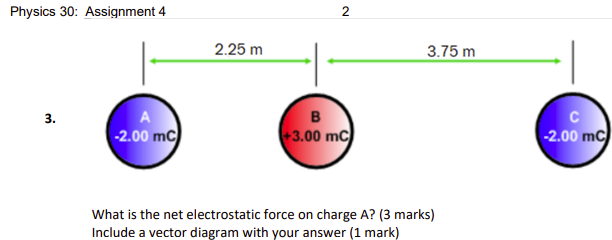
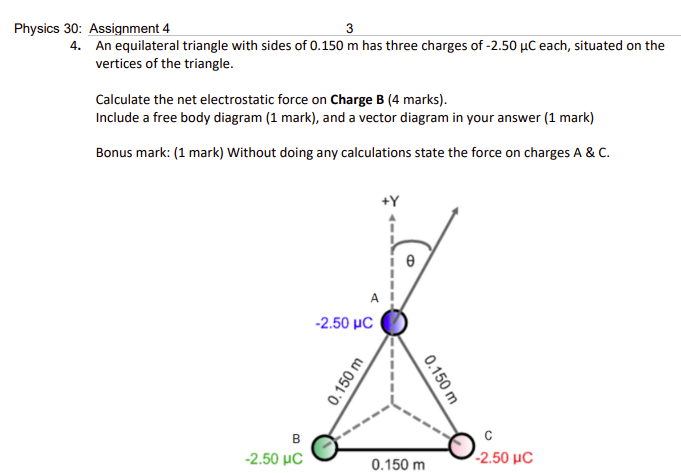



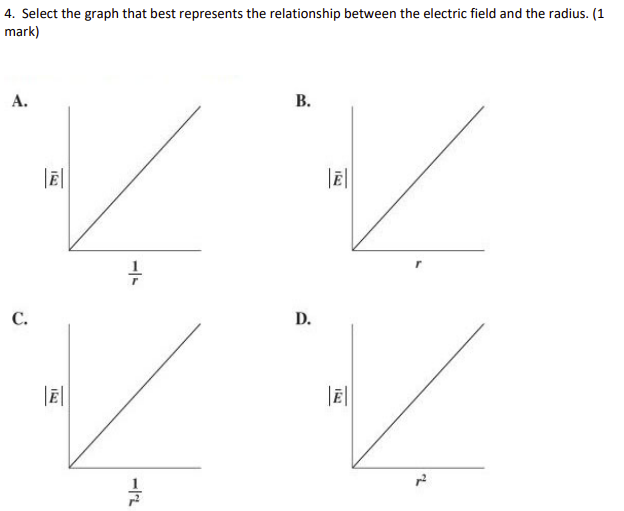

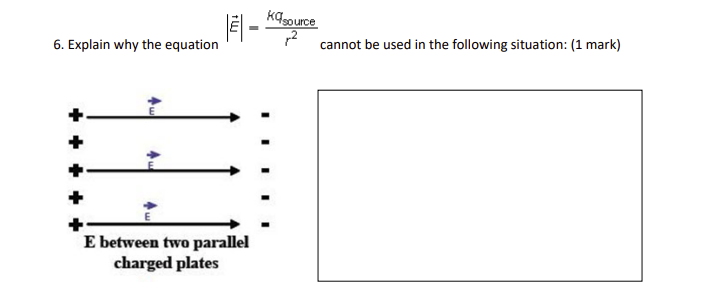
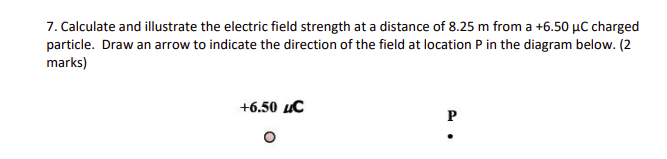

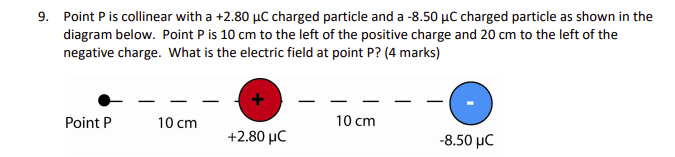
Part One: Applying Coulomb's Law 1. Calculate the electrostatic force between two point-charges of +5.00 mC and +3.00 mC each if the distance between the charges is 350 mm. (3 marks) 2. Determine the distance between two charges of - 6.00 C each if the force of electrostatic repulsion acting on them is 7.00 x 10 N. (3 marks) Physics 30: Assignment 4 2.25 m 2 3. B -2.00 mc +3.00 mc 3.75 m What is the net electrostatic force on charge A? (3 marks) Include a vector diagram with your answer (1 mark) -2.00 mc Physics 30: Assignment 4 4. 3 An equilateral triangle with sides of 0.150 m has three charges of -2.50 C each, situated on the vertices of the triangle. Calculate the net electrostatic force on Charge B (4 marks). Include a free body diagram (1 mark), and a vector diagram in your answer (1 mark) Bonus mark: (1 mark) Without doing any calculations state the force on charges A & C. -2.50 C A e 0.150 m 0.150 m B -2.50 C -2.50 C 0.150 m Part Two: Electric Fields 1. Explain how you determine the direction of an electric field. (1 mark) 2. a) Describe the differences between a uniform and a non-uniform field. (2 marks) b) Draw a diagram to represent each type of field, and clearly indicate field direction. (2 marks) 3. Explain the difference between a source charge and a test charge. (1 mark) 4. Select the graph that best represents the relationship between the electric field and the radius. (1 mark) A. C. 153 B. 153 D. 5. You have three objects: a solid, flat conducting plate, an irregularly shaped solid conducting object and a hollow conducting object. Identify the object that can accumulate the greatest amount of charge and explain why (2 marks) 6. Explain why the equation - E between two parallel charged plates KQ source +2 cannot be used in the following situation: (1 mark) 7. Calculate and illustrate the electric field strength at a distance of 8.25 m from a +6.50 C charged particle. Draw an arrow to indicate the direction of the field at location P in the diagram below. (2 marks) +6.50 uC P 8. A particle has a charge of -5.00 C. At a point near this particle, the electric field strength is 7.20 x 10' N/C. Determine the distance from this point to the charged particle. (2 marks) 9. Point P is collinear with a +2.80 C charged particle and a -8.50 C charged particle as shown in the diagram below. Point P is 10 cm to the left of the positive charge and 20 cm to the left of the negative charge. What is the electric field at point P? (4 marks) Point P 10 cm 10 cm +2.80 -8.50
Step by Step Solution
There are 3 Steps involved in it
Question 1 Electrostatic Force Between Two Charges Given Charge 1 q 1 q1 q1 500 mC 500 1 0 3 C 500 textmC 500 times 103 textC 500mC500103C Charge 2 q 2 q2 q2 300 mC 300 1 0 3 C 300 textmC 300 times 10... View full answer

Get step-by-step solutions from verified subject matter experts
 Study Help