





Question: PART TWO (40 marks) Question 1: (20 marks) Refer to this diagram to answer questions 1 through 10. 1. Which of the following best describes
PART TWO (40 marks) Question 1: (20 marks) Refer
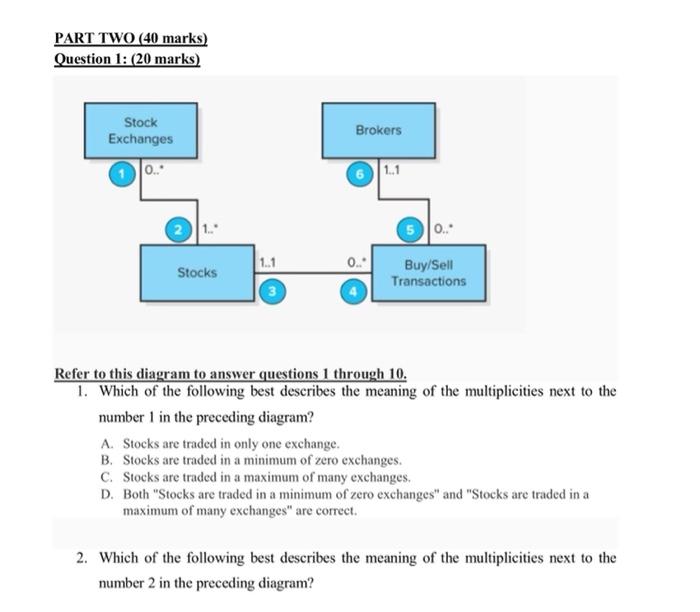
PART TWO (40 marks) Question 1: (20 marks) Refer to this diagram to answer questions 1 through 10. 1. Which of the following best describes the meaning of the multiplicities next to the number 1 in the preceding diagram? A. Stocks are traded in only one exchange. B. Stocks are traded in a minimum of zero exchanges. C. Stocks are traded in a maximum of many exchanges. D. Both "Stocks are traded in a minimum of zero exchanges" and "Stocks are traded in a maximum of many exchanges" are correct. 2. Which of the following best describes the meaning of the multiplicities next to the number 2 in the preceding diagram? A. Each exchange trades at least one stock. B. Each exchange trades a minimum of zero stocks. C. Each exchange trades a maximum of many stocks. D. Both "Each exchange trades at least one stock" and "Each exchange trades a maximum of many stocks" are correct. 3. Which of the following is true to implement the Stock Exchanges and Stocks classes and the association between them in the preceding UML class diagram in a database? A. The primary key of Stocks is a foreign key in Stock Exchanges. B. The primary key of Stock Exchanges is a foreign key in Stocks. C. The association berween Stocks and Stock Exchanges is implemented as a linking table. D. Both "The primary key of Stocks is a foreign key in Stock Exchanges" and "The primary key of Stock Exchanges is a foreign key in Stocks" are true. E. None of these is true. 4. Which of the following best describes the meaning of the multiplicities next to the number 3 in the preceding diagram? A. Each transaction involves at least one stock. B. Each transaction involves only one stock. C. Each transaction involves a minimum of zero stocks. D. Each transaction involves a maximum of many stocks. E. Both "Each transaction involves at least one stock" and "Each transaction involves only one stock" are correct. 5. Which of the following best describes the meaning of the multiplicities next to the number 4 in the preceding diagram? A. Each stock is bought/sold at least once. B. Each stock is bought/sold only once. C. Each stock is bought/sold a maximum of many times. D. Each stock is bought/sold a minimum of many times. E. Both "Each stock is bought/sold at least once" and "Each stock is bought/sold a maximum of many times" are correct. 6. Which of the following is true to implement the Buy/Sell Transactions and Stocks classes and the association between them in the preceding UML class diagram in a database? A. The primary key of Stocks is a foreign key in Buy/Sell Transactions. B. The primary key of Buy/Sell Transactions is a foreign key in Stocks. C. The association between Stocks and Buy/Sell Transactions is implemented as a linking table. D. Both "The primary key of Stocks is a foreign key in Buy/Sell Transactions" and "The primary key of Buy/Sell Transactions is a foreign key in Stocks" are true. E. None of these is true. 7. Which of the following best describes the meaning of the multiplicities next to the number 5 in the preceding diagram? A. Each Broker is involved in one Buy/Sell Transaction. B. Each Broker is involved in many Buy/Sell Transactions. C. Each Broker is involved in a minimum of one Buy/Sell Transaction. D. Each Broker is involved in a minimum of zero Buy/Sell Transactions. E. Both "Each Broker is involved in a maximum of many Buy/Sell Transactions" and "Each Broker is involved in a minimum of zero Buy/Sell Transactions" are correct. 8. Which of the following best describes the meaning of the multiplicities next to the number 6 in the preceding diagram? A. Each Buy/Sell Transaction involves one Broker. B. Each Buy/Sell Transaction involves many Brokers. C. Each Buy/Sell Transaction involves a minimum of zero Brokers. D. Each Buy/Sell Transaction involves a maximum of many Brokers. E. Both "Each Buy/Sell Transaction involves one Broker" and "Each Buy/Sell Transaction involves a maximum of many Brokers" are correct. 9. Which of the following is true to implement the Buy/Sell Transactions and Brokers classes and the association between them in the preceding UML class diagram in a database? A. The primary key of Brokers is a foreign key in Buy/Sell Transactions. B. The primary key of Buy/Sell Transactions is a foreign key in Brokers. C. The association between Brokers and Buy/Sell Transactions is implemented as a linking table. D. Both "The primary key of Brokers is a foreign key in Buy/Sell Transactions" and "The primary key of Buy/Sell Transactions is a foreign key in Brokers" are true. E. None of these is true. 10. Which of the following is true to implement the Stock Exchanges and Brokers classes in the preceding UML class diagram in a database? A. The primary key of Brokers is a foreign key in Stock Exchanges. B. The primary key of Stock Exchanges is a foreign key in Brokers. C. The association between Brokers and Stock Exchanges is implemented as a linking table. D. Both "The primary key of Brokers is a foreign key in Stock Exchanges" and "The primary key of Stock Exchanges is a foreign key in Brokers" are true. E. None of these is true
Step by Step Solution

There are 3 Steps involved in it

1 Expert Approved Answer
Step: 1 Unlock blur-text-image

Question Has Been Solved by an Expert!

Get step-by-step solutions from verified subject matter experts

Step: 2 Unlock
Step: 3 Unlock

Students Have Also Explored These Related General Management Questions!