







Question: Part VI. The Demand for Pollution We will use setups like the following to illustrate the benefits of market based mechanisms. In this setup,
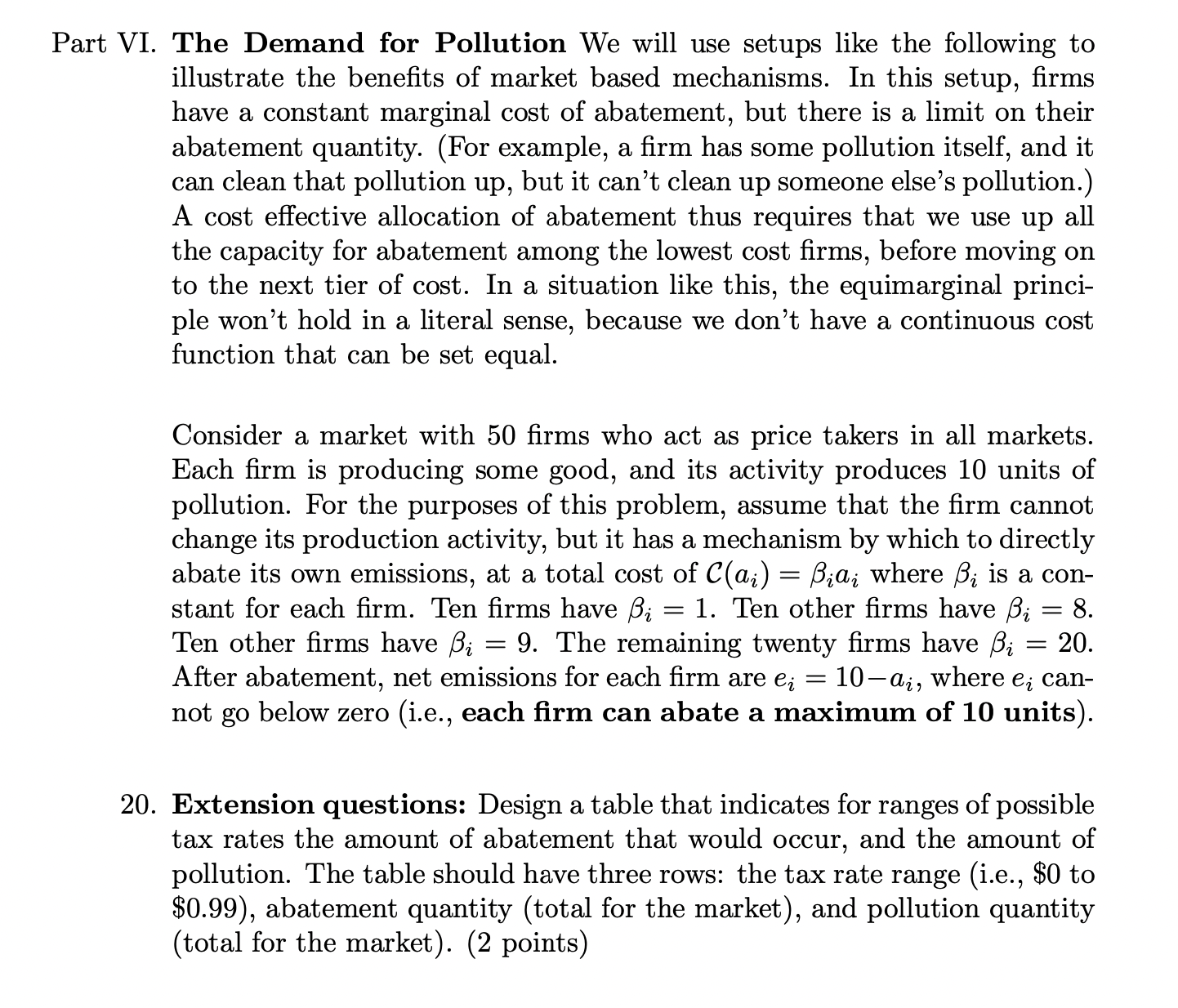
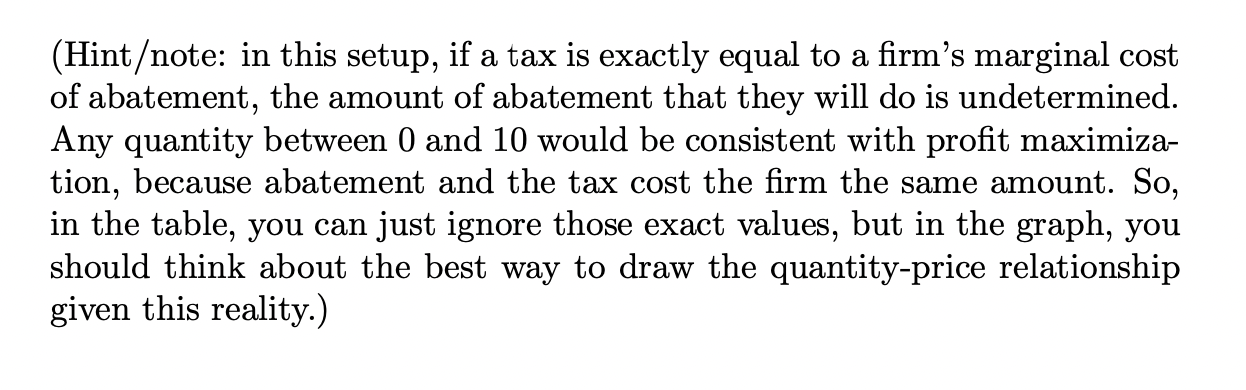
Part VI. The Demand for Pollution We will use setups like the following to illustrate the benefits of market based mechanisms. In this setup, firms have a constant marginal cost of abatement, but there is a limit on their abatement quantity. (For example, a firm has some pollution itself, and it can clean that pollution up, but it can't clean up someone else's pollution.) A cost effective allocation of abatement thus requires that we use up all the capacity for abatement among the lowest cost firms, before moving on to the next tier of cost. In a situation like this, the equimarginal princi- ple won't hold in a literal sense, because we don't have a continuous cost function that can be set equal. Consider a market with 50 firms who act as price takers in all markets. Each firm is producing some good, and its activity produces 10 units of pollution. For the purposes of this problem, assume that the firm cannot change its production activity, but it has a mechanism by which to directly abate its own emissions, at a total cost of C(ai) = ia; where i is a con- stant for each firm. Ten firms have i 1. Ten other firms have Bi = 8. Ten other firms have i = 9. The remaining twenty firms have i = 20. After abatement, net emissions for each firm are e = 10-ai, where ei can- not go below zero (i.e., each firm can abate a maximum of 10 units). = 20. Extension questions: Design a table that indicates for ranges of possible tax rates the amount of abatement that would occur, and the amount of pollution. The table should have three rows: the tax rate range (i.e., $0 to $0.99), abatement quantity (total for the market), and pollution quantity (total for the market). (2 points) (Hint/note: in this setup, if a tax is exactly equal to a firm's marginal cost of abatement, the amount of abatement that they will do is undetermined. Any quantity between 0 and 10 would be consistent with profit maximiza- tion, because abatement and the tax cost the firm the same amount. So, in the table, you can just ignore those exact values, but in the graph, you should think about the best way to draw the quantity-price relationship given this reality.)
Step by Step Solution
There are 3 Steps involved in it

Get step-by-step solutions from verified subject matter experts
 Study Help