







Question: Partial differential equations The topic in this question is the Fourier transform. 5. In this exercise we show that the Fourier transform preserves the L2-norm.
Partial differential equations The topic in this question is the Fourier transform.
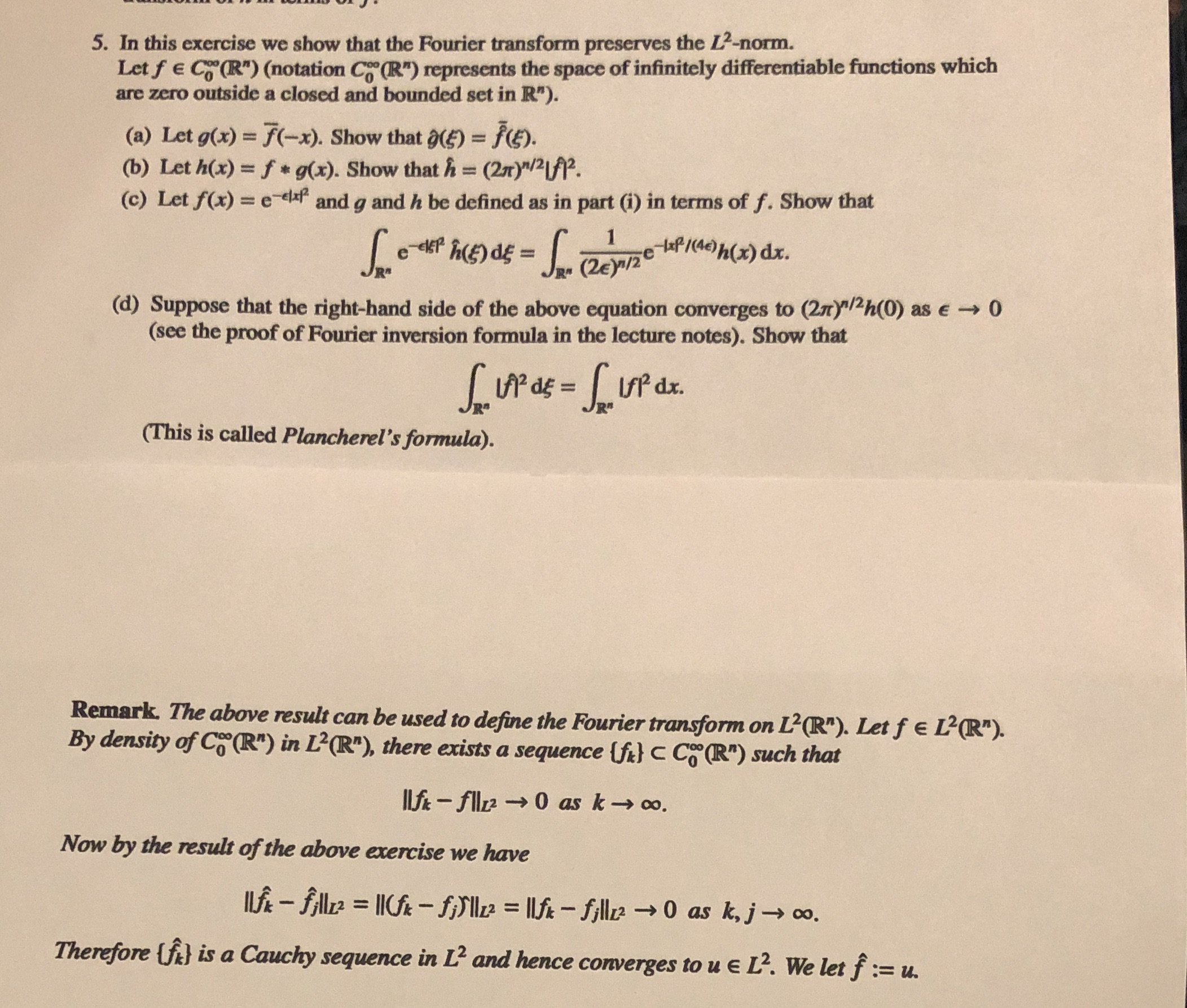
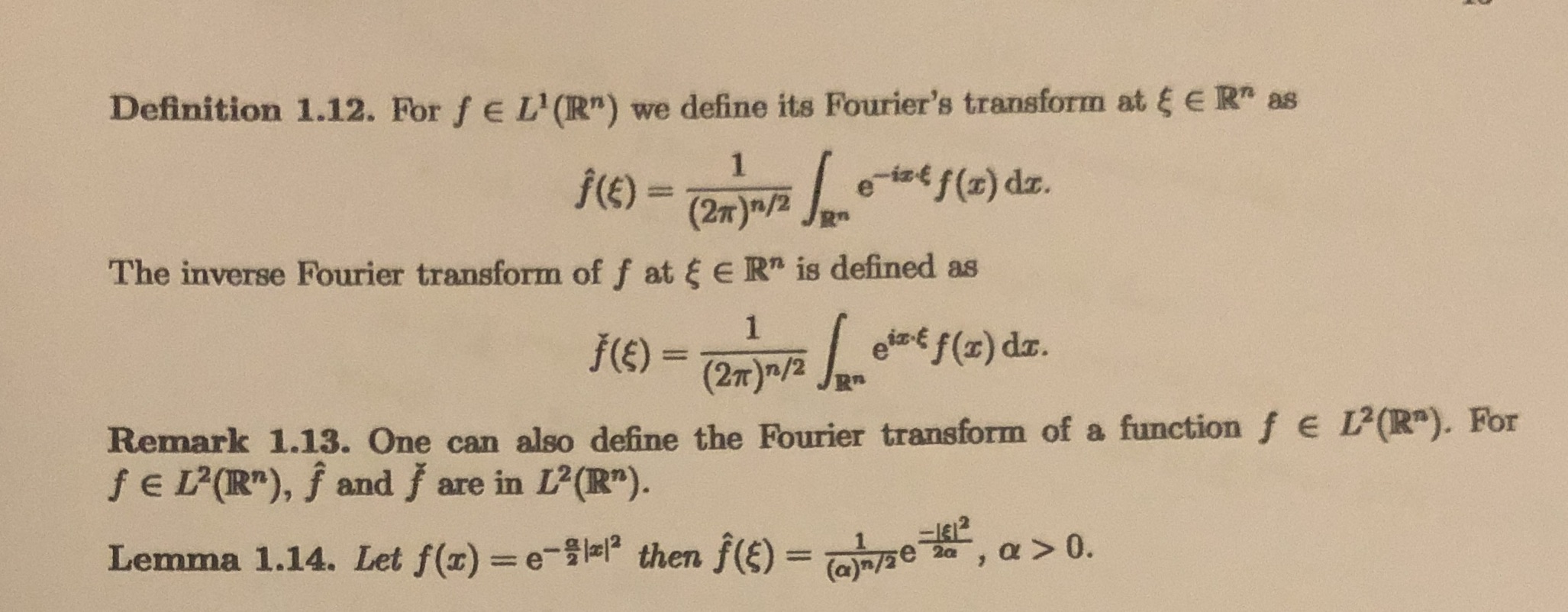
5. In this exercise we show that the Fourier transform preserves the L2-norm. Let f E Co (R") (notation Co.(R") represents the space of infinitely differentiable functions which are zero outside a closed and bounded set in R"). (a) Let g(x) = f(-x). Show that a(5) = P(5). (b) Let h(x) = f * g(x). Show that h = (27)"/21fp. (c) Let f(x) = e-kx and g and h be defined as in part (i) in terms of f. Show that (d) Suppose that the right-hand side of the above equation converges to (27)"/2h(0) as e - 0 (see the proof of Fourier inversion formula in the lecture notes). Show that [. UP as = [ UP dx. (This is called Plancherel's formula). Remark. The above result can be used to define the Fourier transform on L?(R"). Let f E 12(R"). By density of Co(R") in L2(R"), there exists a sequence (fx} C Co (R") such that lift - fllzz - 0 as k - co. Now by the result of the above exercise we have life - fillzz = (1(fx - fillzz = lift - fillzz - 0 as k, j - co. Therefore (fe) is a Cauchy sequence in L2 and hence converges to u E 12. We let f := u.Definition 1.12. For f E L' (R" ) we define its Fourier's transform at { E R" as 1 f(E) = (27 ) 12/2 Jam erize f(x) dr. The inverse Fourier transform of f at & E R" is defined as 1 F(E) = (27) 72/2 JB eiref(x) dr. Remark 1.13. One can also define the Fourier transform of a function f E L'(R"). For f E L?(R"), f and f are in L?(R"). Lemma 1.14. Let f(x) = e-ikal then f({) = =1612 (a)n/ze 20 , a > 0
Step by Step Solution
There are 3 Steps involved in it

Get step-by-step solutions from verified subject matter experts
 Study Help