





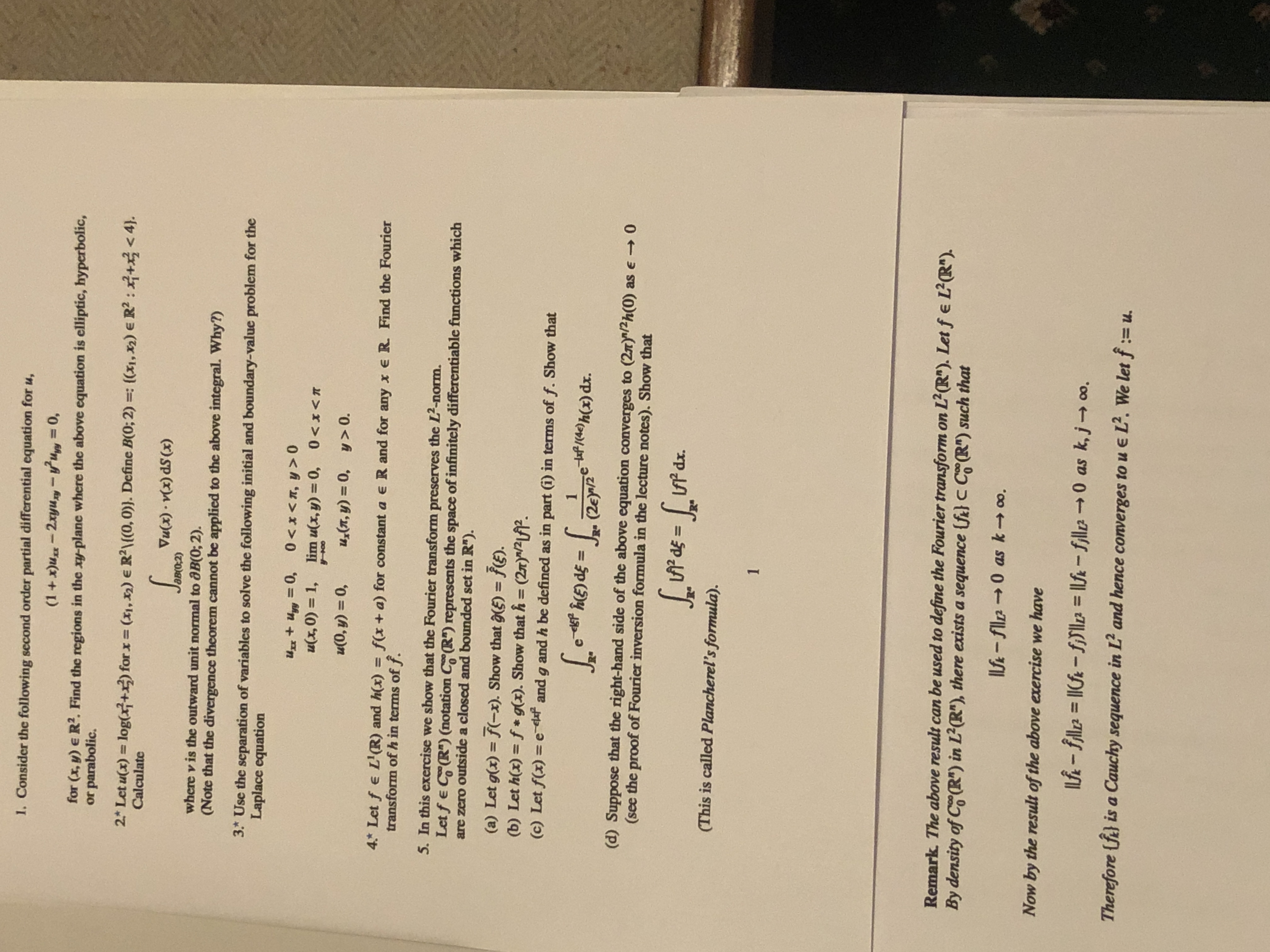
Question: 1. Consider the following second order partial differential equation for u, (1+ x)1xx - 2xylly - bury = 0, for (x, y) E R?. Find
1. Consider the following second order partial
1. Consider the following second order partial differential equation for u, (1+ x)1xx - 2xylly - bury = 0, for (x, y) E R?. Find the regions in the xy-plane where the above equation is elliptic, hyperbolic, or parabolic. 2* Let u(x) = log(x,+x) for x = (x1, x2) E R2\\((0, 0)]. Define B(0; 2) =: ((X1, x2) E R2 : x7+x3 0 u(x, 0) = 1, lim u(x, y) = 0, 0 o. 4.* Let f E L'(R) and h(x) = f(x + a) for constant a E R and for any x E R. Find the Fourier transform of h in terms of f. 5. In this exercise we show that the Fourier transform preserves the L2-norm. Let f E Co (R") (notation Co (R") represents the space of infinitely differentiable functions which are zero outside a closed and bounded set in R"). (a) Let g(x) = f(-x). Show that 9(5) = f(). (b) Let h(x) = f * g(x). Show that h = (27)" /2LA2. (c) Let f(x) = e ek and g and h be defined as in part (i) in terms of f. Show that (d) Suppose that the right-hand side of the above equation converges to (2:)"/2h(0) as E - 0 (see the proof of Fourier inversion formula in the lecture notes). Show that S UP as = SUP ax. (This is called Plancherel's formula). Remark. The above result can be used to define the Fourier transform on L2(R"). Let f E L?(R"). By density of Co(R") in L?(R"), there exists a sequence (fil C Co (R") such that lift - file - 0 as k -co. Now by the result of the above exercise we have lift - fill = 1(ft - fillz = lift - fillz - 0 as k, j - co. Therefore (fil is a Cauchy sequence in 12 and hence converges to u E 12. We let f := u

Step by Step Solution

There are 3 Steps involved in it

1 Expert Approved Answer
Step: 1 Unlock blur-text-image

Question Has Been Solved by an Expert!

Get step-by-step solutions from verified subject matter experts

Step: 2 Unlock
Step: 3 Unlock

Students Have Also Explored These Related Mathematics Questions!