



Question: Parts a and b in MATLAB please 3. Design Problem (open-ended problem): The design objective is to determine optimal values of the spring and/or damping
Parts a and b in MATLAB please
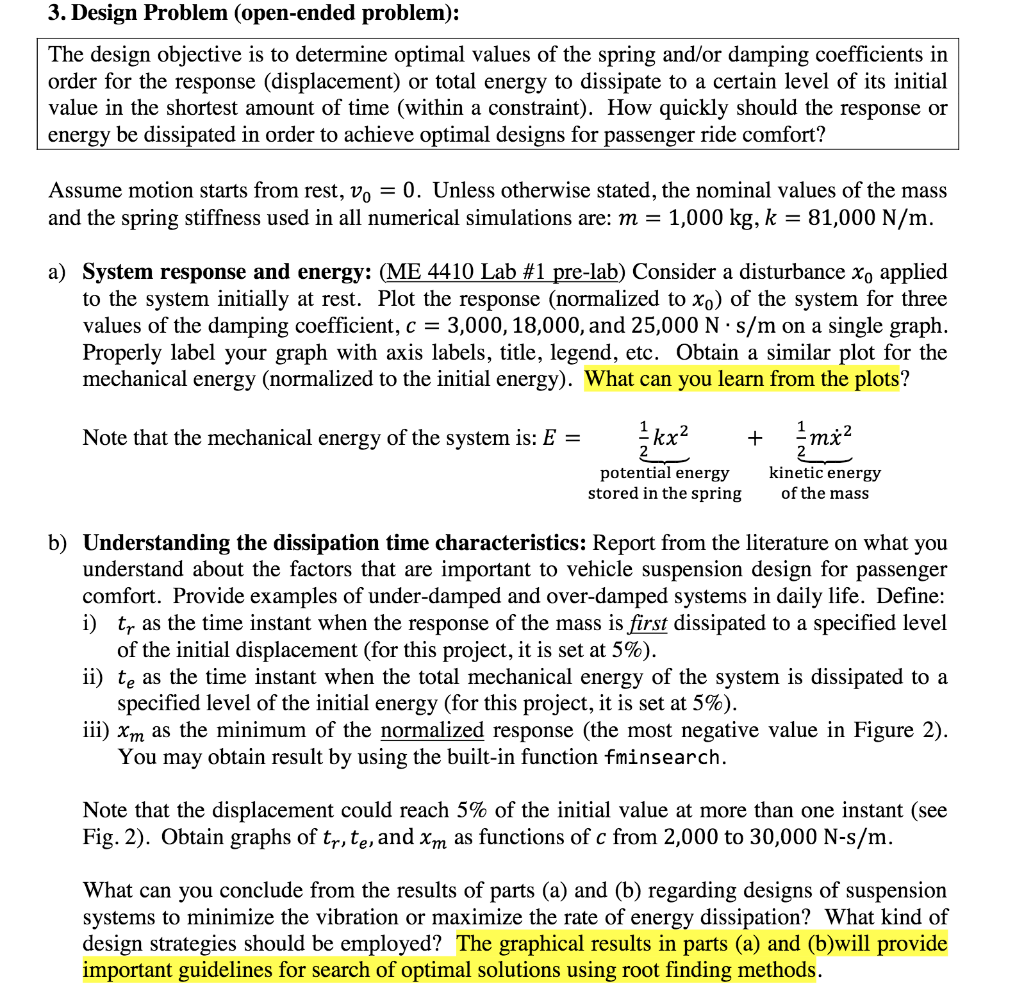
3. Design Problem (open-ended problem): The design objective is to determine optimal values of the spring and/or damping coefficients in order for the response (displacement) or total energy to dissipate to a certain level of its initial value in the shortest amount of time (within a constraint). How quickly should the response or energy be dissipated in order to achieve optimal designs for passenger ride comfort? Assume motion starts from rest, Vo = 0. Unless otherwise stated, the nominal values of the mass and the spring stiffness used in all numerical simulations are: m = 1,000 kg, k = 81,000 N/m. a) System response and energy: (ME 4410 Lab #1 pre-lab) Consider a disturbance to applied to the system initially at rest. Plot the response (normalized to xo) of the system for three values of the damping coefficient, c = 3,000, 18,000, and 25,000 N s/m on a single graph. Properly label your graph with axis labels, title, legend, etc. Obtain a similar plot for the mechanical energy (normalized to the initial energy). What can you learn from the plots? 1 kx Note that the mechanical energy of the system is: E = + mx2 2 2 potential energy kinetic energy stored in the spring of the mass b) Understanding the dissipation time characteristics: Report from the literature on what you understand about the factors that are important to vehicle suspension design for passenger comfort. Provide examples of under-damped and over-damped systems in daily life. Define: i) tr as the time instant when the response of the mass is first dissipated to a specified level of the initial displacement (for this project, it is set at 5%). ii) te as the time instant when the total mechanical energy of the system is dissipated to a specified level of the initial energy (for this project, it is set at 5%). iii) xm as the minimum of the normalized response (the most negative value in Figure 2). You may obtain result by using the built-in function fminsearch. Note that the displacement could reach 5% of the initial value at more than one instant (see Fig. 2). Obtain graphs of tr, te, and Xm as functions of c from 2,000 to 30,000 N-s/m. What can you conclude from the results of parts (a) and (b) regarding designs of suspension systems to minimize the vibration or maximize the rate of energy dissipation? What kind of design strategies should be employed? The graphical results in parts (a) and (b)will provide important guidelines for search of optimal solutions using root finding methods
Step by Step Solution
There are 3 Steps involved in it

Get step-by-step solutions from verified subject matter experts