







Question: parts (a) through (d) below. The following data represent the muzzle velocity (in feet per second) of rounds fired from a 155-mm gun. For each
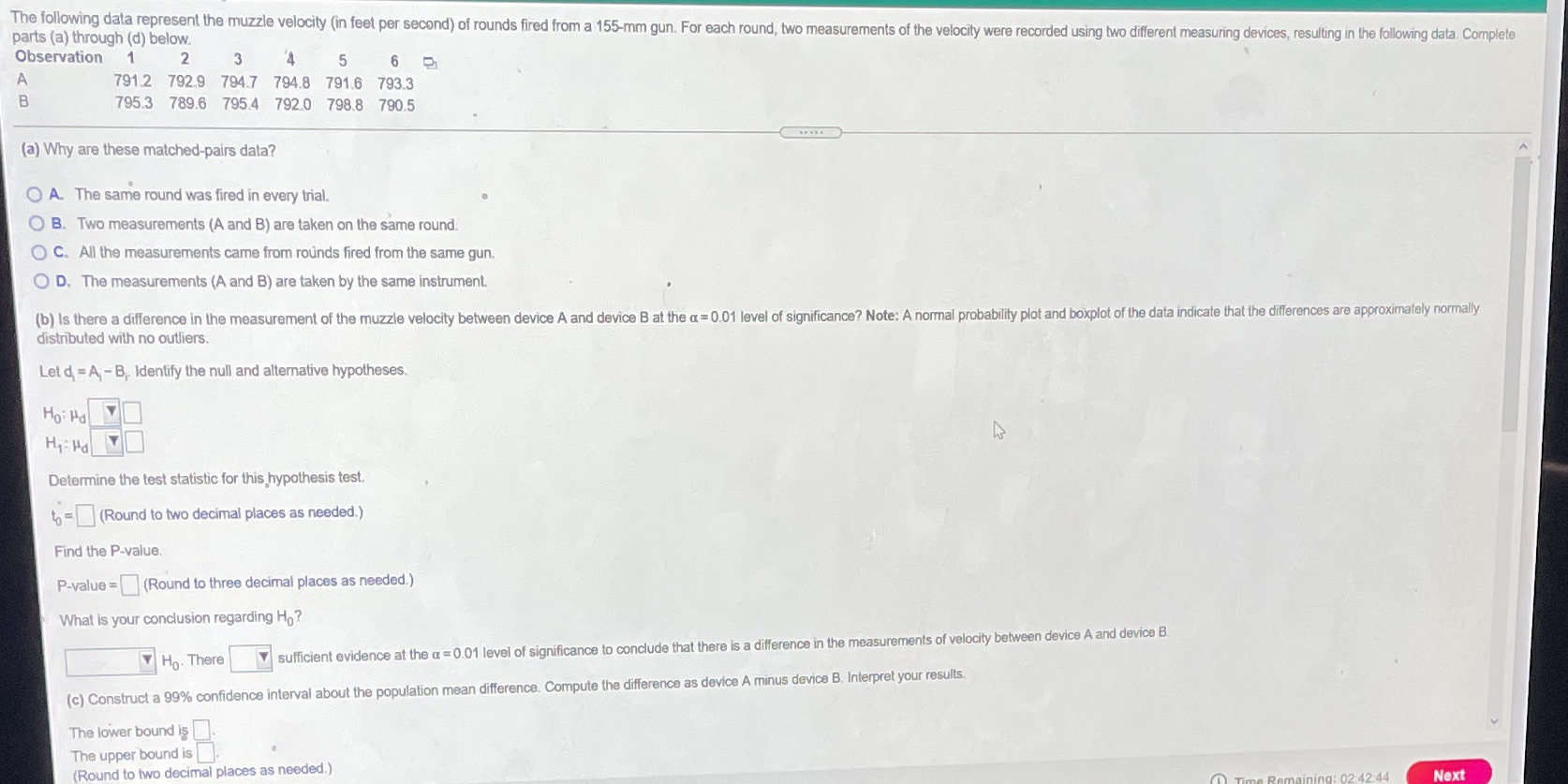
parts (a) through (d) below. The following data represent the muzzle velocity (in feet per second) of rounds fired from a 155-mm gun. For each round, two measurements of the velocity were recorded using two different measuring devices, resulting in the following data, Complete Observation 1 2 3 '4 5 6 3 A 791.2 792.9 794.7 794.8 791.6 793.3 B 795.3 789.6 795.4 792.0 798.8 790.5 (a) Why are these matched-pairs data? O A. The same round was fired in every trial. O B. Two measurements (A and B) are taken on the same round. O C. All the measurements came from rounds fired from the same gun. O D. The measurements (A and B) are taken by the same instrument. (b) Is there a difference in the measurement of the muzzle velocity between device A and device B at the a = 0.01 level of significance? Note: A normal probability plot and boxplot of the data indicate that the differences are approximately normally distributed with no outliers. Let d = A - B, Identify the null and alternative hypotheses. Hold Determine the test statistic for this hypothesis test. to =(Round to two decimal places as needed.) Find the P-value. P-value = (Round to three decimal places as needed.) What is your conclusion regarding Ho? sufficient evidence at the a = 0.01 level of significance to conclude that there is a difference in the measurements of velocity between device A and device B Ho. There (c) Construct a 99% confidence interval about the population mean difference. Compute the difference as device A minus device B. Interpret your results. The lower bound is The upper bound is (Round to two decimal places as needed.) 02:42:44 Next
Step by Step Solution
There are 3 Steps involved in it

Get step-by-step solutions from verified subject matter experts
 Study Help