Question: Pease et al. Chapter 9 Question 26 (3 points) Match the Model name to the left with the description or application on the right Mostly
Pease et al. Chapter 9 Question 26 (3 points)Pease et al. Chapter 9 Question 26 (3 points)Pease et al. Chapter 9 Question 26 (3 points)Pease et al. Chapter 9 Question 26 (3 points)Pease et al. Chapter 9 Question 26 (3 points)

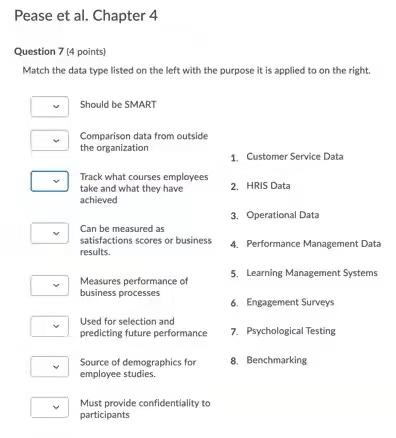
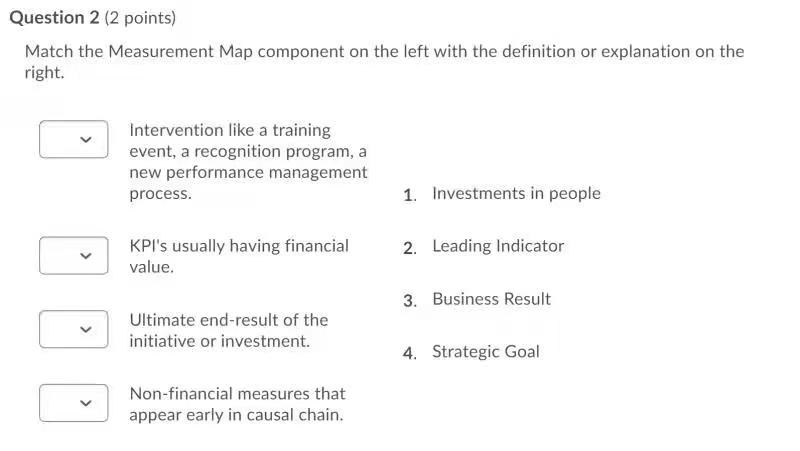
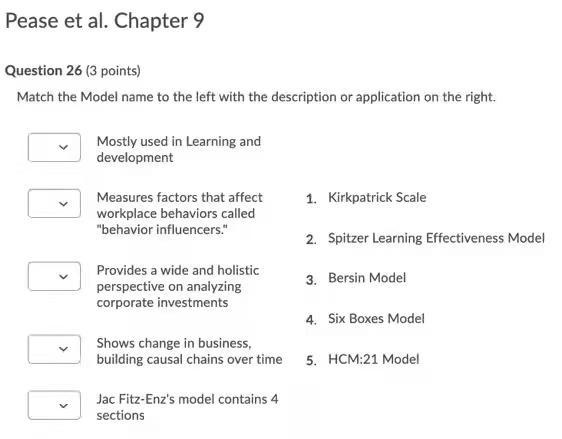
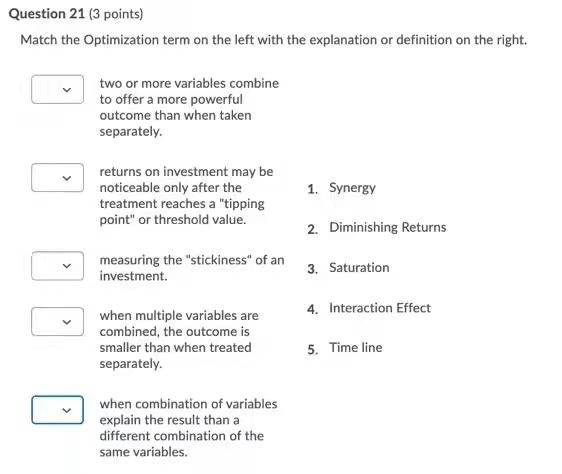
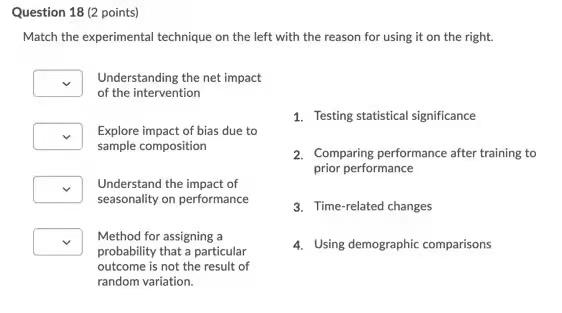
Pease et al. Chapter 9 Question 26 (3 points) Match the Model name to the left with the description or application on the right Mostly used in Learning and development > Measures factors that affect 1. Kirkpatrick Scale workplace behaviors called "behavior influencers." 2. Spitzer Learning Effectiveness Model Provides a wide and holistic perspective on analyzing 3. Bersin Model corporate investments 4. Six Boxes Model Shows change in business, building causal chains over time 5. HCM:21 Model Jac Fitz-Enz's model contains 4 sections Question 21 (3 points) Match the Optimization term on the left with the explanation or definition on the right. two or more variables combine to offer a more powerful outcome than when taken separately. returns on investment may be noticeable only after the treatment reaches a "tipping point" or threshold value. 1. Synergy 2. Diminishing Returns measuring the "stickiness of an investment. 3. Saturation 4. Interaction Effect when multiple variables are combined, the outcome is smaller than when treated separately. 5. Timeline when combination of variables explain the result than a different combination of the same variables. Question 18 (2 points) Match the experimental technique on the left with the reason for using it on the right. Understanding the net impact of the intervention 1. Testing statistical significance Explore impact of bias due to sample composition 2. Comparing performance after training to prior performance 4. Using demographic comparisons Method for assigning a probability that a particular outcome is not the result of random variation Pease et al. Chapter 4 Question 7 (4 points) Match the data type listed on the left with the purpose it is applied to on the right Should be SMART Comparison data from outside the organization 1. Customer Service Data Track what courses employees take and what they have achieved 2. HRIS Data 3. Operational Data Can be measured as satisfactions scores or business results. 4. Performance Management Data 5. Learning Management Systems > Measures performance of business processes 6. Engagement Surveys Used for selection and predicting future performance 7. Psychological Testing 8. Benchmarking Source of demographics for employee studies. Must provide confidentiality to participants Question 2 (2 points) Match the Measurement Map component on the left with the definition or explanation on the right. Intervention like a training event, a recognition program, a new performance management process. 1. Investments in people 2. Leading Indicator KPI's usually having financial value. > 3. Business Result Ultimate end-result of the initiative or investment. 4. Strategic Goal Non-financial measures that appear early in causal chain
Step by Step Solution

There are 3 Steps involved in it

1 Expert Approved Answer
Step: 1 Unlock blur-text-image

Question Has Been Solved by an Expert!

Get step-by-step solutions from verified subject matter experts

Step: 2 Unlock
Step: 3 Unlock

Students Have Also Explored These Related General Management Questions!