







Question: Perform the requested steps, and display your work in a clear and comprehensive manner. Provide details in the following order: - Standard title page -
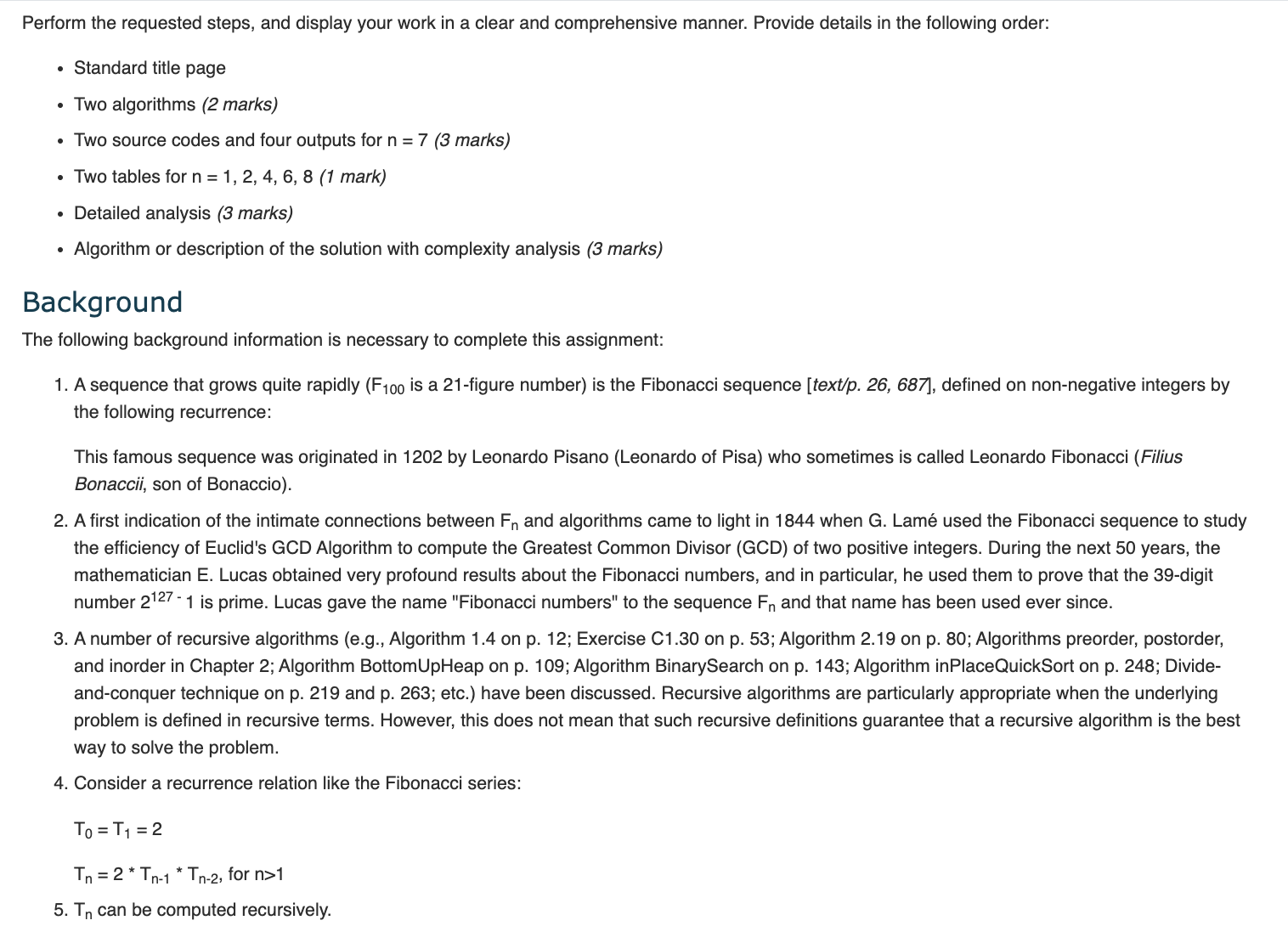
Perform the requested steps, and display your work in a clear and comprehensive manner. Provide details in the following order:
Standard title page
Two algorithms marks
Two source codes and four outputs for mathrmn marks
Two tables for mathrmn mark
Detailed analysis marks
Algorithm or description of the solution with complexity analysis marks
Background
The following background information is necessary to complete this assignment:
A sequence that grows quite rapidly F is a figure number is the Fibonacci sequence textp defined on nonnegative integers by the following recurrence:
This famous sequence was originated in by Leonardo Pisano Leonardo of Pisa who sometimes is called Leonardo Fibonacci Filius Bonaccii, son of Bonaccio
A first indication of the intimate connections between Fn and algorithms came to light in when G Lam used the Fibonacci sequence to study the efficiency of Euclid's GCD Algorithm to compute the Greatest Common Divisor GCD of two positive integers. During the next years, the mathematician E Lucas obtained very profound results about the Fibonacci numbers, and in particular, he used them to prove that the digit number is prime. Lucas gave the name "Fibonacci numbers" to the sequence Fn and that name has been used ever since.
A number of recursive algorithms eg Algorithm on p; Exercise C on p; Algorithm on p; Algorithms preorder, postorder, and inorder in Chapter ; Algorithm BottomUpHeap on p; Algorithm BinarySearch on p; Algorithm inPlaceQuickSort on p; Divideandconquer technique on p and p; etc. have been discussed. Recursive algorithms are particularly appropriate when the underlying problem is defined in recursive terms. However, this does not mean that such recursive definitions guarantee that a recursive algorithm is the best way to solve the problem.
Consider a recurrence relation like the Fibonacci series:
mathrmTmathrmT
Tn Tn Tn for n
Tn can be computed recursively. Requested Steps
Write recursive and dynamic programming algorithms to compute mathrmTmathrmn Call them Algorithm Recur and Algorithm Recur
Convert these algorithms to properly documented, professional quality programs. Call the programs RecurP and RecurP respectively. In the heading documentationin addition to your name, student ID number, and course codeclearly state the language, editor, compiler, operating system, and computer used.
By executing programs RecurP and RecurP print Numbers mathrmT to mathrmT to demonstrate that both programs produce correct results. Generate properlylabelled outputs. Remember that mathrmTmathrmT
Try running both programs for n You will start to notice something important from the viewpoint of computing science. Keep in mind the largest possible integer that can be represented on a bit and bit computer system. Use the internal clock to record the time to run each case.
Tabulate your resultsspecifically, n versus result versus timefrom the previous step into two tables: one for RecurP and the other for RecurP
Analyze your algorithms and results, making sure to provide a detailed critical evaluation, from the viewpoint of "algorithm design and analysis" based on the above table. Include comments on the accuracy of your results. Use graphs or any other enhancements to support your analysis.
Assume an integer array A contains n positive and negative numbers. Using dynamic programing, write an algorithm for finding a contiguous subset of numbers Aildots Aji
Step by Step Solution
There are 3 Steps involved in it
1 Expert Approved Answer
Step: 1 Unlock

Question Has Been Solved by an Expert!
Get step-by-step solutions from verified subject matter experts
Step: 2 Unlock
Step: 3 Unlock
 Study Help