





Question: Perpendicular Distance to Plane A hyperplane in n dimensions is a n 1 dimensional subspace. For instance, a hyperplane in 2dimensional space can be any

Perpendicular Distance to Plane
Perpendicular Distance to Plane A hyperplane in nPerpendicular Distance to Plane A hyperplane in nPerpendicular Distance to Plane A hyperplane in n
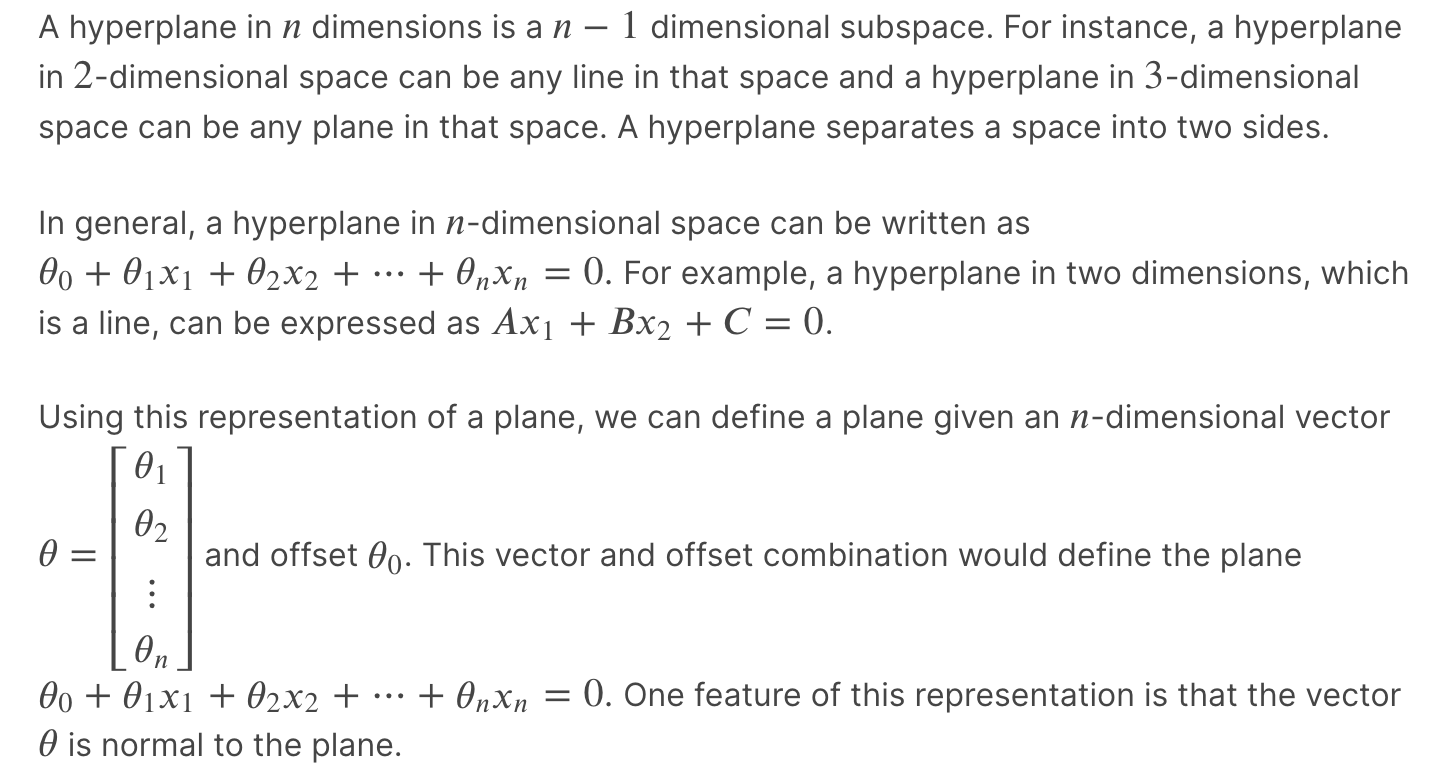
A hyperplane in n dimensions is a n 1 dimensional subspace. For instance, a hyperplane in 2dimensional space can be any line in that space and a hyperplane in 3dimensional space can be any plane in that space. A hyperplane separates a space into two sides. In general, a hyperplane in ndimensional space can be written as 90 + 91x1 + 92x2 + + '9an = 0. For example, a hyperplane in two dimensions, which is a line, can be expressed as Axl + Bx; + C = 0. Using this representation of a plane, we can define a plane given an ndimensional vector 91 92 . . . . 6 = and offset 60. This vector and offset combination would define the plane 9n 90 + (91x1 + 92x2 + + (9an = 0. One feature of this representation is that the vector 6 is normal to the plane. Given a point x in ndimensional space and a hyperplane described by 6 and 60, find the signed distance between the hyperplane and x. This is equal to the perpendicular distance between the hyperplane and x, and is positive when x is on the same side of the plane as 9 points and negative when x is on the opposite side. Use * to denote the dot product of two vectors, e.g. enter v*w for the dot product v . w of the vectors u and w. )

Step by Step Solution

There are 3 Steps involved in it

1 Expert Approved Answer
Step: 1 Unlock blur-text-image

Question Has Been Solved by an Expert!

Get step-by-step solutions from verified subject matter experts

Step: 2 Unlock
Step: 3 Unlock

Students Have Also Explored These Related Mathematics Questions!

