Question: Peter Griffin visited a Super-Mart store. While waddling down a busy isle near the food court, Peter slipped and fell, when he stepped in some
Peter Griffin visited a Super-Mart store. While waddling down a busy isle near the food court, Peter slipped and fell, when he stepped in some macaroni & cheese, which had apparently come from the food court. Peter sued Super-Mart for his injuries. At trial Peter testified that the macaroni appeared "to have a lot of dirt and footprints on it", suggesting that the spilled macaroni had been on the floor for some time.
- What duty does a business have to protect its customers from dangerous conditions ?
- What does Peter need to prove, in order to recover damages from Super-Mart?
- What Defenses might Super-Mart raise?
- Should Super-Mart be liable to Peter ? Why or why not ?
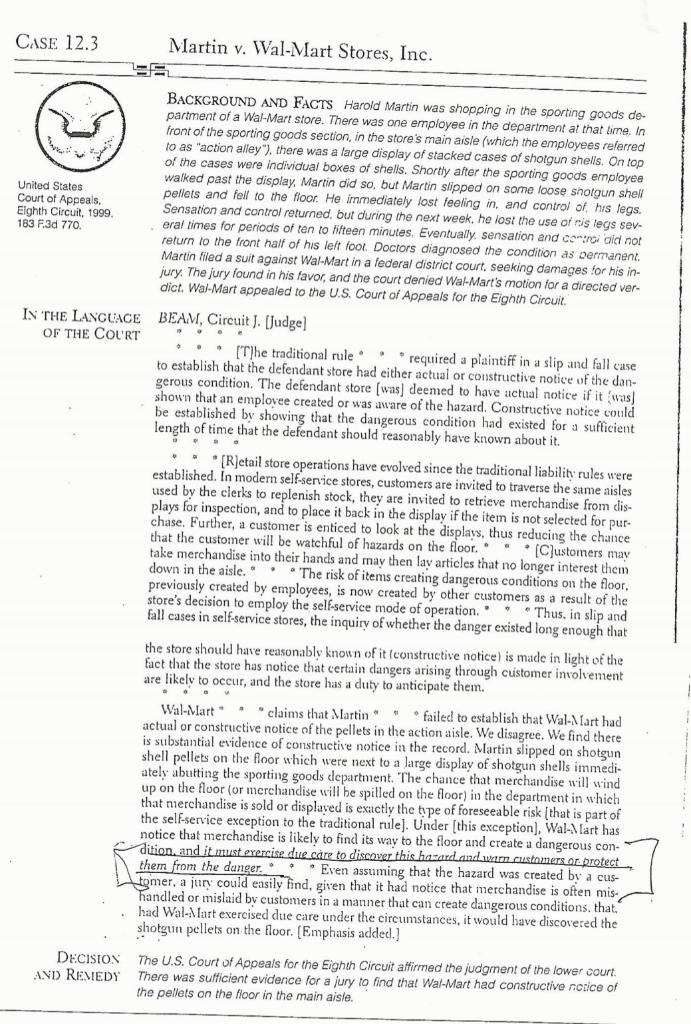
CASE 12.3 Martin v. Wal-Mart Stores, Inc. Su BACKGROUND AND FACTS Harold Martin was shopping in the sporting goods de partment of a Wal-Mart store. There was one employee in the department at that time. In front of the sporting goods section, in the store's main aisle (which the employees referred to as "action alley"), there was a large display of stacked cases of shotgun shells. On top of the cases were individual boxes of shells. Shortly after the sporting goods employee walked past the display, Martin did so, but Martin Slipped on some loose shotgun shell United States Court of Appeals. pellets and fell to the floor. He immediately lost feeling in, and control of his legs. Elghth Circuit, 1999 Sensation and control returned, but during the next week, he lost the use of ris legs sev. 183 F.3d 770 eral times for periods of ten to fifteen minutes. Eventually , sensation and contro did not return to the front half of his left foot. Doctors diagnosed the condition as permanent Martin filed a suit against Wal-Mart in a federal district court, seeking damages for his in- jury. The jury found in his favor, and the court denied Wal-Mart's motion for a directed ver- dict. Wal-Mart appealed to the U.S. Court of Appeals for the Eighth Circuit IN THE LANCUACE BEAM, Circuit J. (Judge] OF THE COURT [T]he traditional rule. * required a plaintiff in a slip and fall case to establish that the defendant store had either actual or constructive notice of the dan- gerous condition. The defendant store (was deemed to have actual notice if it was shown that an emplovee created or was aware of the hazard. Constructive notice could be established by showing that the dangerous condition had existed for a sufficient length of time that the defendant should reasonably have known about it. Retail store operations have evolved since the traditional liability rules were established. In modern self-service stores, customers are invited to traverse the same aisles used by the clerks to replenish stock, they are invited to retrieve merchandise from dis- plays for inspection, and to place it back in the display if the item is not selected for pur- chase. Further, a customer is enticed to look at the displays, thus reducing the chance take merchandise into their hands and may then lav articles that no longer interest them down in the aisle. previously created eated by employees, is now created by other customers as a result of the store's decision to employ the self-service mode of operation. Thus, in slip and fall cases in self-service stores, the inquiry of whether the danger existed long enough that the store should have reasonably known of it (constructive notice) is made in light of the fact that the store has notice that certain dangers arising through customer involvement are likely to occur, and the store has a duty to anticipate them. . claims that Martin failed to establish that Wal-Mart had or constructive notice of the pellets in the action aisle. We disagree. We find there is substantial evidence of constructive notice in the record. Martin slipped on shell pellets on the floor which were next to a large display of shotgun shells immedi- ately abutting the sporting goods department. The chance that merchandise will wind that e is sold or displayed is exactly the type of foreseeable risk (that is part of the self-service exception to the traditional rule]. Under (this exception), Wala la that merchandise is likely to find its way to the floor and create a dangerous con- dition, and it must exercise due care to discover this hazard and warm customers, or protect them from the danger. Even assuming that the hazard was created by a cus- tymer, a jury could easily find, given that it had notice that merchandise is often mis- handled or mislaid by customers in a manner that can create dangerous conditions, that, had Wal-Mart exercised due care under the circumstances, it would have discovered the shotgun pellets on the floor. (Emphasis added.] DECISION The U.S. Court of Appeals for the Eighth Circuit affirmed the judgment of the lower court. AND REMEDY There was sufficient evidence for a jury to find that Wal-Mart had constructive notice of the pellets on the floor in the main aisle. Wal-Mart actual shotgun merchandise









 Study Help