



Question: pg 169 1. Was it a good idea for the school board to name one of its members as the official media spokesperson to deal
pg 169
1. Was it a good idea for the school board to name one of its members as the official media spokesperson to deal with the scandal? Why or why not? It was a smart idea to appoint someone who will be responsible for administering public information.
2. Evaluate the Principles decision to urge the faculty to remain silent. Would you have done this? Why or why not?
5. By refusing to comment about the scandal, did school officials encourage or discourage journalists from pursuing related stories?
6. What actions could the superintendent or principle have taken to communicate with stakeholders about the scandal immediately after it became public?
7. Why were many residents in the school district angry about the employment of private investigator?
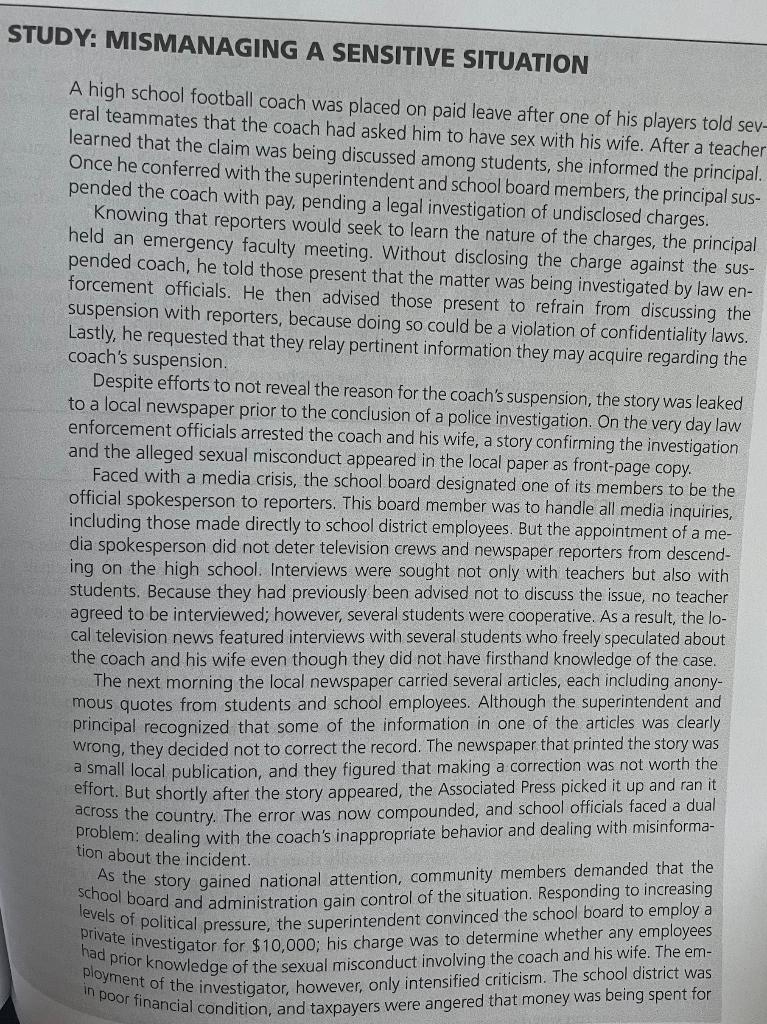
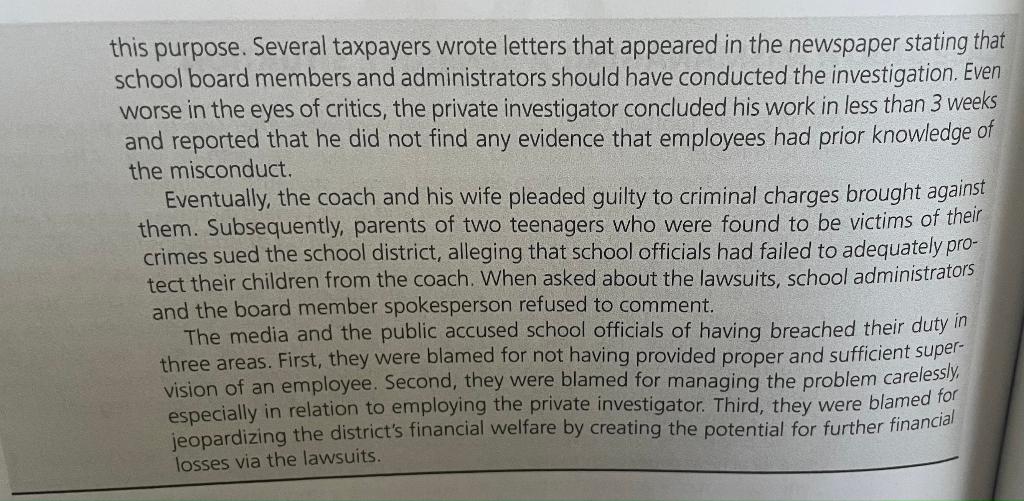
STUDY: MISMANAGING A SENSITIVE SITUATION A high school football coach was placed on paid leave after one of his players told sev- eral teammates that the coach had asked him to have sex with his wife. After a teacher learned that the claim was being discussed among students, she informed the principal. Once he conferred with the superintendent and school board members, the principal sus- pended the coach with pay, pending a legal investigation of undisclosed charges. Knowing that reporters would seek to learn the nature of the charges, the principal held an emergency faculty meeting. Without disclosing the charge against the sus- pended coach, he told those present that the matter was being investigated by law en- forcement officials. He then advised those present to refrain from discussing the suspension with reporters, because doing so could be a violation of confidentiality laws. Lastly, he requested that they relay pertinent information they may acquire regarding the coach's suspension Despite efforts to not reveal the reason for the coach's suspension, the story was leaked to a local newspaper prior to the conclusion of a police investigation. On the very day law enforcement officials arrested the coach and his wife, a story confirming the investigation and the alleged sexual misconduct appeared in the local paper as front-page copy. Faced with a media crisis, the school board designated one of its members to be the official spokesperson to reporters. This board member was to handle all media inquiries, including those made directly to school district employees. But the appointment of a me- dia spokesperson did not deter television crews and newspaper reporters from descend- ing on the high school. Interviews were sought not only with teachers but also with students. Because they had previously been advised not to discuss the issue, no teacher agreed to be interviewed; however, several students were cooperative. As a result, the lo- cal television news featured interviews with several students who freely speculated about the coach and his wife even though they did not have firsthand knowledge of the case. The next morning the local newspaper carried several articles, each including anony- mous quotes from students and school employees. Although the superintendent and principal recognized that some of the information in one of the articles was clearly wrong, they decided not to correct the record. The newspaper that printed the story was a small local publication, and they figured that making a correction was not worth the effort. But shortly after the story appeared, the Associated Press picked it up and ran it across the country. The error was now compounded, and school officials faced a dual problem: dealing with the coach's inappropriate behavior and dealing with misinforma- tion about the incident. the story gained national attention, community members demanded that the School board and administration gain control of the situation. Responding to increasing levels of political pressure, the superintendent convinced the school board to employ a private investigator for $10,000; his charge was to determine whether any employees had prior knowledge of the sexual misconduct involving the coach and his wife. The em- in poor financial condition, and taxpayers were angered that money was being spent for ployment of the investigator, however, only intensified criticism. The school district was this purpose. Several taxpayers wrote letters that appeared in the newspaper stating that school board members and administrators should have conducted the investigation. Even worse in the eyes of critics, the private investigator concluded his work in less than 3 weeks and reported that he did not find any evidence that employees had prior knowledge of the misconduct. Eventually, the coach and his wife pleaded guilty to criminal charges brought against them. Subsequently, parents of two teenagers who were found to be victims of their crimes sued the school district, alleging that school officials had failed to adequately pro- tect their children from the coach. When asked about the lawsuits, school administrators and the board member spokesperson refused to comment. The media and the public accused school officials of having breached their duty in three areas. First, they were blamed for not having provided proper and sufficient super- vision of an employee. Second, they were blamed for managing the problem carelessly, especially in relation to employing the private investigator. Third, they were blamed for jeopardizing the district's financial welfare by creating the potential for further financial losses via the lawsuitsStep by Step Solution
There are 3 Steps involved in it

Get step-by-step solutions from verified subject matter experts