







Question: PhET: Forces and Motion Basics Link to sim: https://phet.colorado.edu/en/simulation/forces-and-motion-basics Open the simulation and press the arrow to start. Newton's 1st Law is also known as
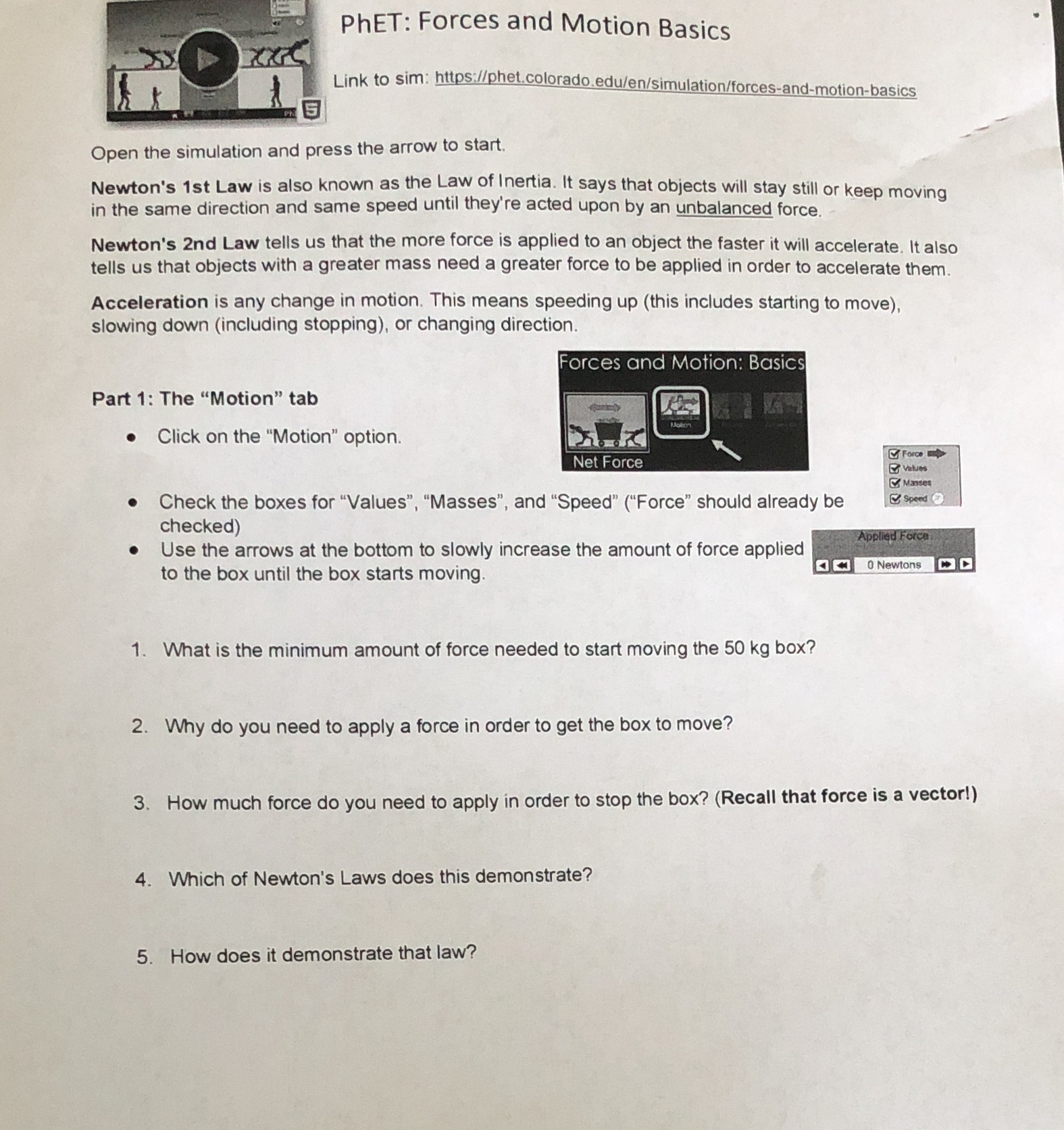
PhET: Forces and Motion Basics Link to sim: https://phet.colorado.edu/en/simulation/forces-and-motion-basics Open the simulation and press the arrow to start. Newton's 1st Law is also known as the Law of Inertia. It says that objects will stay still or keep moving in the same direction and same speed until they're acted upon by an unbalanced force. Newton's 2nd Law tells us that the more force is applied to an object the faster it will accelerate. It also tells us that objects with a greater mass need a greater force to be applied in order to accelerate them. Acceleration is any change in motion. This means speeding up (this includes starting to move), slowing down (including stopping), or changing direction. Forces and Motion: Basics Part 1: The "Motion" tab . Click on the "Motion" option. Net Force Force values Masses Check the boxes for "Values", "Masses", and "Speed" ("Force" should already be Speed checked) Applied Force Use the arrows at the bottom to slowly increase the amount of force applied to the box until the box starts moving.
Step by Step Solution
There are 3 Steps involved in it

Get step-by-step solutions from verified subject matter experts
 Study Help