







Question: PhET Interactive Simulation Projectile Motion Lab An object thrown horizontally near the surface of the Earth will move both horizontally and vertically at the same
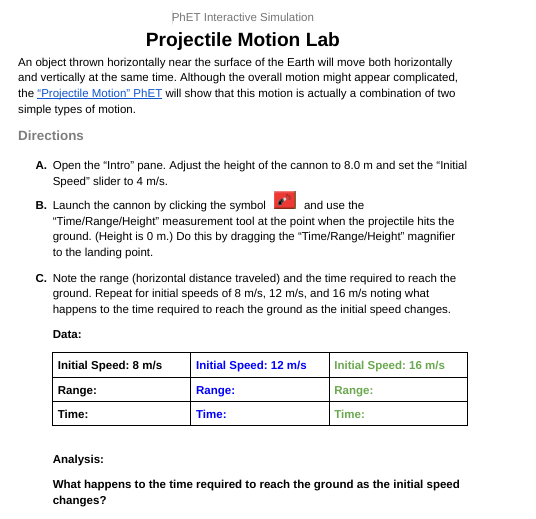
PhET Interactive Simulation Projectile Motion Lab An object thrown horizontally near the surface of the Earth will move both horizontally and vertically at the same time. Although the overall motion might appear complicated, the "Projectile Motion" PhET will show that this motion is actually a combination of two simple types of motion. Directions A. Open the "Intro" pane. Adjust the height of the cannon to 8.0 m and set the "Initial Speed" slider to 4 m/s. B. Launch the cannon by clicking the symbol and use the 'Time/Range/Height" measurement tool at the point when the projectile hits the ground. (Height is 0 m.) Do this by dragging the "Time/Range/Height" magnifier to the landing point. C. Note the range (horizontal distance traveled) and the time required to reach the ground. Repeat for initial speeds of 8 m/s, 12 m/s, and 16 m/s noting what happens to the time required to reach the ground as the initial speed changes. Data: Initial Speed: 8 m/s Initial Speed: 12 m/s Initial Speed: 16 m/s Range: Range: Range: Time: Time: Time: Analysis: What happens to the time required to reach the ground as the initial speed changes?Develop and Use Your Model 1. SEP Develop Models Draw a graph of the range (vertical axis) vs. initial speed (horizontal axis). Use your graph to predict where the target should be placed for an initial speed of 10 m/s and verify your prediction with the simulation.NAME DATE CLASS 2. SEP Conduct an Investigation Choose a height of at least 10 m and an initial speed of at least 20 m/s adjustings, if necessary, to display the entire trajectory on the screen. Use the measurement tool to note the time, range, and height data for each point along the curve traced by the projectile. Draw graphs of range vs. time and height vs. time. Use your data to determine the acceleration for the horizontal motion and the acceleration for the vertical motion
Step by Step Solution
There are 3 Steps involved in it

Get step-by-step solutions from verified subject matter experts
 Study Help