Question: Photos include for ease of reference 2. Several negotiation issues have arisen regarding the probable-cause testing process and the use of test results. a. What
Photos include for ease of reference
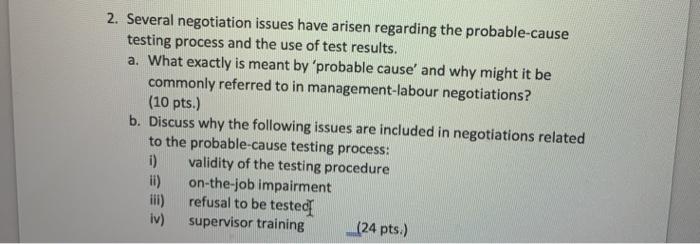
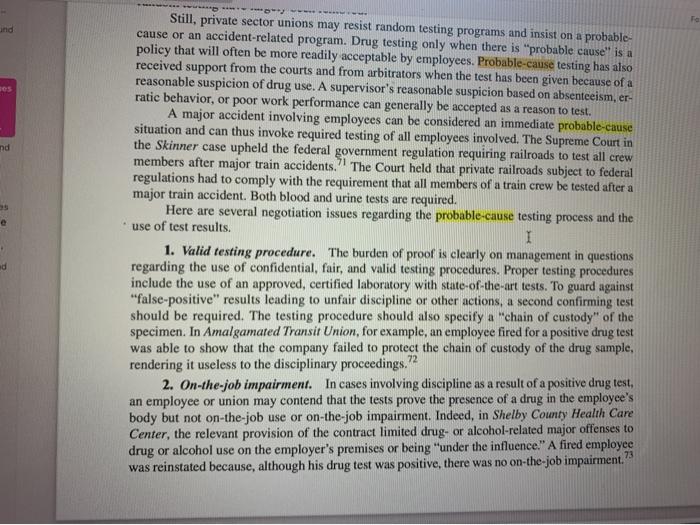
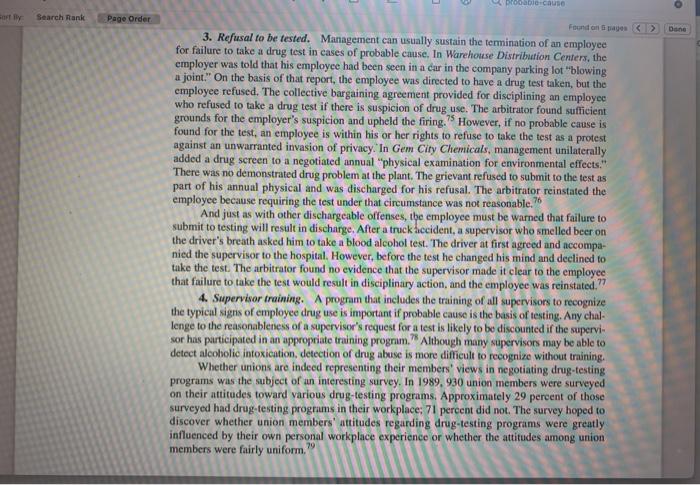
2. Several negotiation issues have arisen regarding the probable-cause testing process and the use of test results. a. What exactly is meant by 'probable cause' and why might it be commonly referred to in management-labour negotiations? (10 pts.) b. Discuss why the following issues are included in negotiations related to the probable-cause testing process: i) validity of the testing procedure ii) on-the-job impairment iii) refusal to be tested iv) supervisor training (24 pts.) To ind nd Still, private sector unions may resist random testing programs and insist on a probable- cause or an accident-related program. Drug testing only when there is probable cause" is a policy that will often be more readily acceptable by employees. Probable-cause testing has also received support from the courts and from arbitrators when the test has been given because of a reasonable suspicion of drug use. A supervisor's reasonable suspicion based on absenteeism, er- ratic behavior, or poor work performance can generally be accepted as a reason to test. A major accident involving employees can be considered an immediate probable-cause situation and can thus invoke required testing of all employees involved. The Supreme Court in the Skinner case upheld the federal government regulation requiring railroads to test all crew members after major train accidents. The Court held that private railroads subject to federal regulations had to comply with the requirement that all members of a train crew be tested after a major train accident. Both blood and urine tests are required. Here are several negotiation issues regarding the probable-cause testing process and the use of test results. I 1. Valid testing procedure. The burden of proof is clearly on management in questions regarding the use of confidential, fair, and valid testing procedures. Proper testing procedures include the use of an approved, certified laboratory with state-of-the-art tests. To guard against "false-positive results leading to unfair discipline or other actions, a second confirming test should be required. The testing procedure should also specify a chain of custody" of the specimen. In Amalgamated Transit Union, for example, an employee fired for a positive drug test was able to show that the company failed to protect the chain of custody of the drug sample, rendering it useless to the disciplinary proceedings.? 2. On-the-job impairment. In cases involving discipline as a result of a positive drug test, an employee or union may contend that the tests prove the presence of a drug in the employee's body but not on-the-job use or on-the-job impairment. Indeed, in Shelby County Health Care Center, the relevant provision of the contract limited drug- or alcohol-related major offenses to drug or alcohol use on the employer's premises or being "under the influence." A fired employee was reinstated because, although his drug test was positive, there was no on-the-job impairment. ed poble cause o off lly Search Rank Page Order Dane Found on es 3. Refusal to be tested. Management can usually sustain the termination of an employee for failure to take a drug test in cases of probable cause. In Warehouse Distribution Centers, the employer was told that his employee had been seen in a car in the company parking lot "blowing a joint." On the basis of that report, the employee was directed to have a drug test taken, but the employee refused. The collective bargaining agreement provided for disciplining an employee who refused to take a drug test if there is suspicion of drug use. The arbitrator found sufficient grounds for the employer's suspicion and upheld the firing. However, if no probable cause is found for the test, an employee is within his or her rights to refuse to take the test as a protest against an unwarranted invasion of privacy. In Gem City Chemicals, management unilaterally added a drug screen to a negotiated annual physical examination for environmental effects." There was no demonstrated drug problem at the plant. The grievant refused to submit to the test as part of his annual physical and was discharged for his refusal. The arbitrator reinstated the employee because requiring the test under that circumstance was not reasonable." And just as with other dischargeable offenses, the employee must be warned that failure to submit to testing will result in discharge. After a truck hecident, a supervisor who smelled beer on the driver's breath asked him to take a blood alcohol test. The driver at first agreed and accompa- nied the supervisor to the hospital. However, before the test he changed his mind and declined to take the test. The arbitrator found no evidence that the supervisor made it clear to the employee that failure to take the test would result in disciplinary action, and the employee was reinstated." 4. Supervisor training. A program that includes the training of all supervisors to recognize the typical signs of employee drug use is important if probable cause is the basis of testing. Any chal- lenge to the reasonableness of a supervisor's request for a test is likely to be discounted if the supervi- sor has participated in an appropriate training program. Although many supervisors may be able to detect alcoholic intoxication, detection of drug abuse is more difficult to recognize without training. Whether unions are indeed representing their members' views in negotiating drug-testing programs was the subject of an interesting survey. In 1989.930 union members were surveyed on their attitudes toward various drug-testing programs. Approximately 29 percent of those surveyed had drug testing programs in their workplace: 71 percent did not. The survey hoped to discover whether union members' attitudes regarding drug testing programs were greatly influenced by their own personal workplace experience or whether the attitudes among union members were fairly uniform









 Study Help