







Question: Physical Basis for Linear Elasticity d . The temperature dependence of elastic modulus in ceramics can be described using the following equation ( equation 2
Physical Basis for Linear Elasticity d The temperature dependence of elastic modulus in ceramics can be described using the following
equation equation Mechanical Behavior of Engineering Materials" by Roesler, Harders and
Baeker:
where is the elastic modulus for a specific element at K and is the melting
temperature of the material. All temperature values should be considered in Kelvin.
Using this equation and similar equation provided for metals in question c qualitatively describe
how you would expect the elastic modulus of a ceramic to change relative to a metal if both
materials were heated to a temperature of
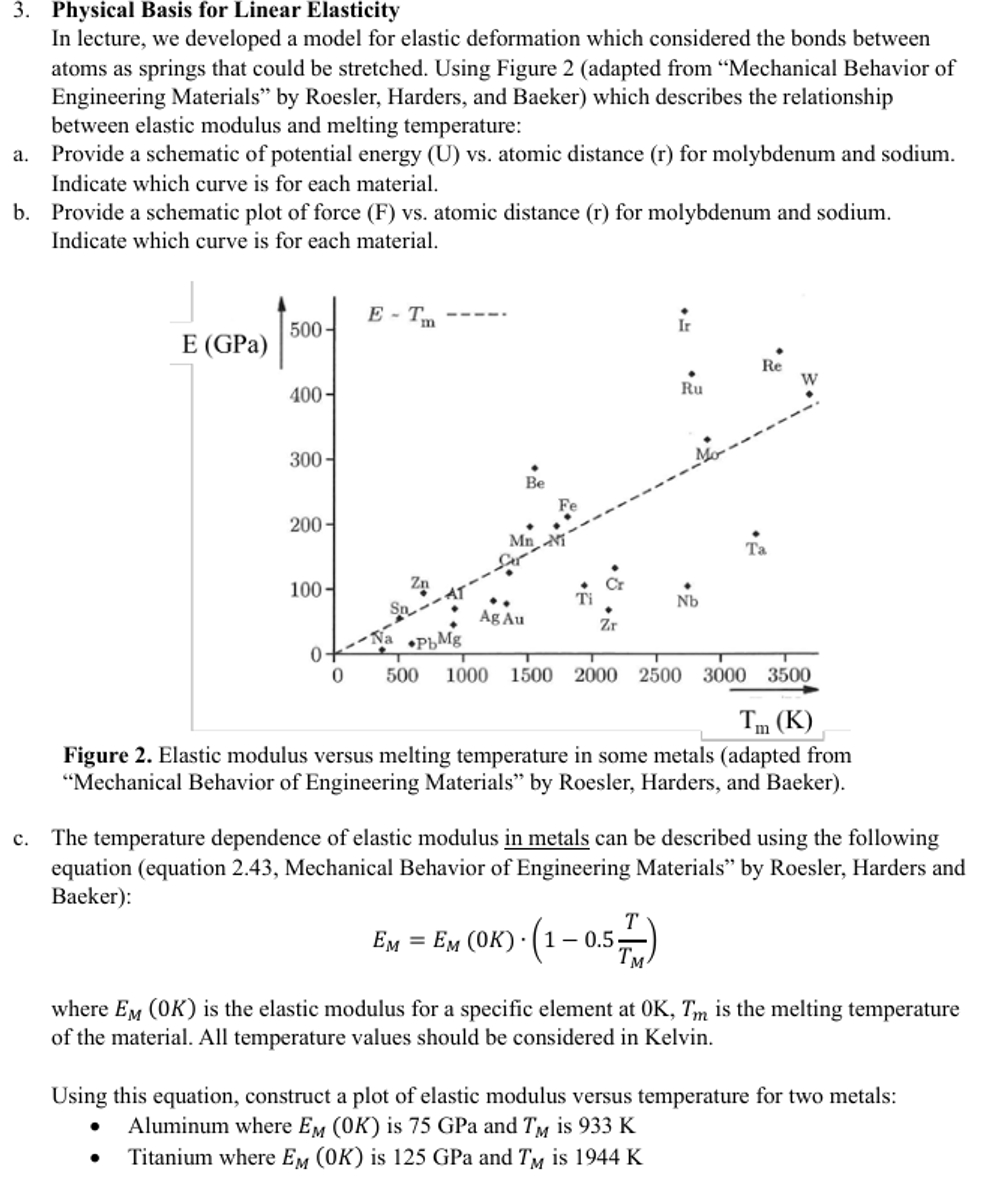
In lecture, we developed a model for elastic deformation which considered the bonds between
atoms as springs that could be stretched. Using Figure adapted from "Mechanical Behavior of
Engineering Materials" by Roesler, Harders, and Baeker which describes the relationship
between elastic modulus and melting temperature:
a Provide a schematic of potential energy U vs atomic distance r for molybdenum and sodium.
Indicate which curve is for each material.
b Provide a schematic plot of force F vs atomic distance r for molybdenum and sodium.
Indicate which curve is for each material.
Figure Elastic modulus versus melting temperature in some metals adapted from
"Mechanical Behavior of Engineering Materials" by Roesler, Harders, and Baeker
c The temperature dependence of elastic modulus in metals can be described using the following
equation equation Mechanical Behavior of Engineering Materials" by Roesler, Harders and
Baeker:
where is the elastic modulus for a specific element at is the melting temperature
of the material. All temperature values should be considered in Kelvin.
Using this equation, construct a plot of elastic modulus versus temperature for two metals:
Aluminum where is GPa and is K
Titanium where is GPa and is K
Step by Step Solution
There are 3 Steps involved in it
1 Expert Approved Answer
Step: 1 Unlock

Question Has Been Solved by an Expert!
Get step-by-step solutions from verified subject matter experts
Step: 2 Unlock
Step: 3 Unlock
 Study Help