







Question: Physical Layer The physical layer is concerned with transmitting raw bits over a communi- cation channel. The design issues have to do with making sure
Physical Layer The physical layer is concerned with transmitting raw bits over a communi- cation channel. The design issues have to do with making sure that when one side sends a 1 bit it is received by the other side as a 1 bit, not as a 0 bit. Typical ques- tions here are what electrical signals should be used to represent a 1 and a 0, how many nanoseconds a bit lasts, whether transmission may proceed simultaneously in both directions, how the initial connection is established, how it is torn down when both sides are finished, how many pins the network connector has, and what each pin is used for. These design issues largely deal with mechanical, electrical, and timing interfaces, as well as the physical transmission medium, which lies below the physical layer. The Data Link Layer The main task of the data link layer is to transform a raw transmission facil- ity into a line that appears free of undetected transmission errors. It does so by masking the real errors so the network layer does not see them. It accomplishes this task by having the sender break up the input data into data frames (typically a few hundred or a few thousand bytes) and transmit the frames sequentially. If the service is reliable, the receiver confirms correct receipt of each frame by send- ing back an acknowledgement frame. Another issue that arises in the data link layer (and most of the higher layers as well) is how to keep a fast transmitter from drowning a slow receiver in data. Some traffic regulation mechanism may be needed to let the transmitter know when the receiver can accept more data. Broadcast networks have an additional issue in the data link layer: how to control access to the shared channel. A special sublayer of the data link layer, the medium access control sublayer, deals with this problem. The Network Layer The network layer controls the operation of the subnet. A key design issue is determining how packets are routed from source to destination. Routes can be based on static tables that are ''wired into'' the network and rarely changed, or more often they can be updated automatically to avoid failed components. They can also be determined at the start of each conversation, for example, a terminal session, such as a login to a remote machine. Finally, they can be highly dynam- ic, being determined anew for each packet to reflect the current network load. If too many packets are present in the subnet at the same time, they will get in

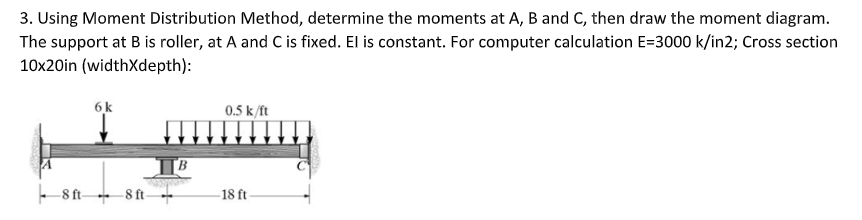
\f3. Using Moment Distribution Method, determine the moments at A, B and C, then draw the moment diagram. The support at B is roller, at A and C is fixed. El is constant. For computer calculation E=3000 k/in2; Cross section 10x20in (widthXdepth): 6 k 0.5 k/ft B 8 ft- 8 ft 18 ft
Step by Step Solution
There are 3 Steps involved in it

Get step-by-step solutions from verified subject matter experts
 Study Help