







Question: Physics 151 - Homework #3 - 17 points possible Instructions: Write your full solutions on separate paper, then scan and upload them in the submission
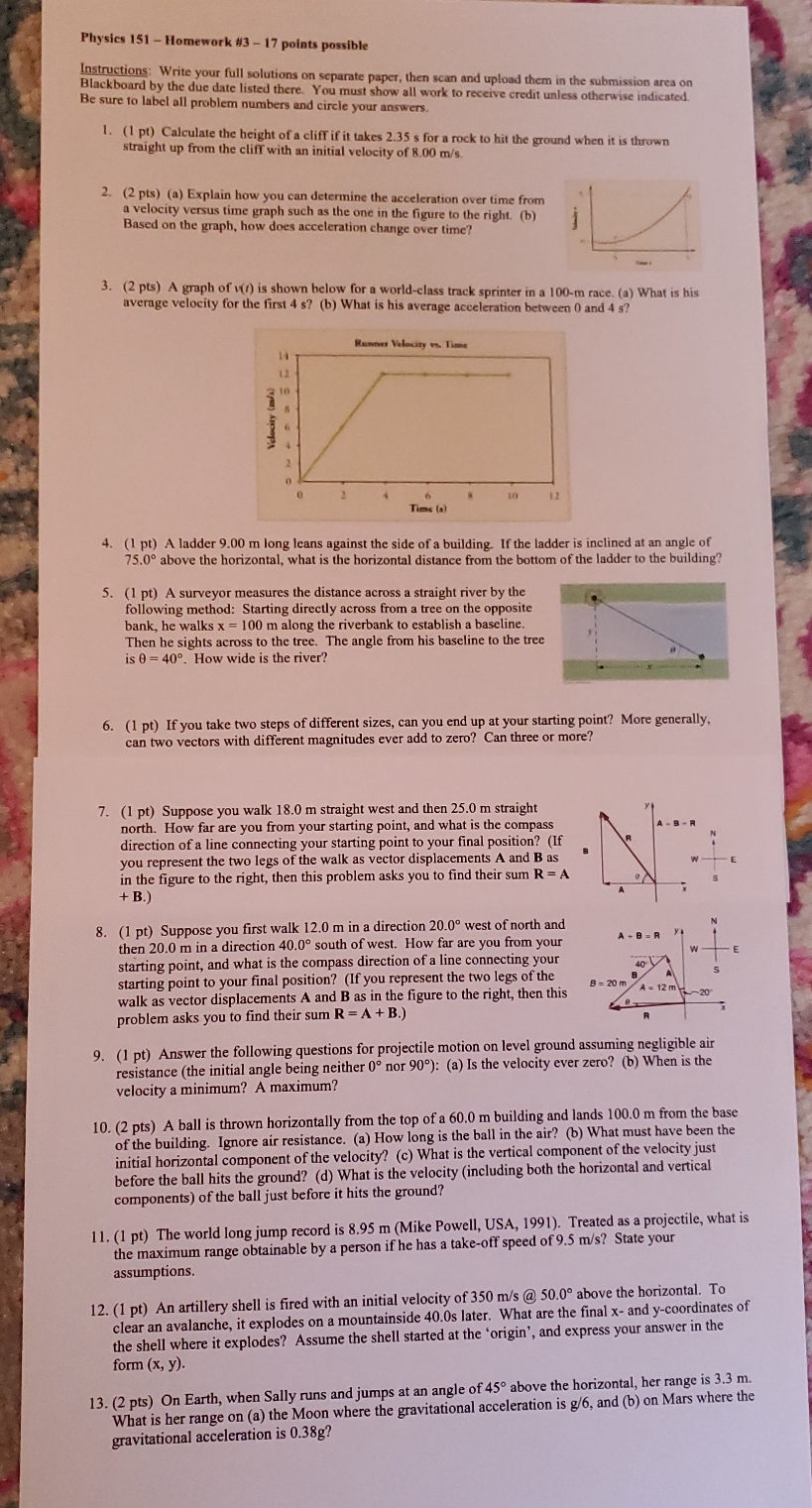
Physics 151 - Homework #3 - 17 points possible Instructions: Write your full solutions on separate paper, then scan and upload them in the submission area on Blackboard by the due date listed there. You must show all work to receive credit unless otherwise indicated. Be sure to label all problem numbers and circle your answers. 1. (1 pt) Calculate the height of a cliff if it takes 2.35 s for a rock to hit the ground when it is thrown straight up from the cliff with an initial velocity of 8.00 m/s. 2. (2 pts) (a) Explain how you can determine the acceleration over time from a velocity versus time graph such as the one in the figure to the right. (b) Based on the graph, how does acceleration change over time? 3. (2 pts) A graph of w/) is shown below for a world-class track sprinter in a 100-m race. (a) What is his average velocity for the first 4 s? (b) What is his average acceleration between 0 and 4 s? Runner Velocity vs. Time 14 10 Velocity (m/A) Time () 4. (1 pt) A ladder 9.00 m long leans against the side of a building. If the ladder is inclined at an angle of 75.0 above the horizontal, what is the horizontal distance from the bottom of the ladder to the building? 5. (1 pt) A surveyor measures the distance across a straight river by the following method: Starting directly across from a tree on the opposite bank, he walks x = 100 m along the riverbank to establish a baseline. Then he sights across to the tree. The angle from his baseline to the tree is 0 = 409. How wide is the river? 6. (1 pt) If you take two steps of different sizes, can you end up at your starting point? More generally, can two vectors with different magnitudes ever add to zero? Can three or more? 7. (1 pt) Suppose you walk 18.0 m straight west and then 25.0 m straight north. How far are you from your starting point, and what is the compass direction of a line connecting your starting point to your final position? (If you represent the two legs of the walk as vector displacements A and B as in the figure to the right, then this problem asks you to find their sum R = A + B.) 8. (1 pt) Suppose you first walk 12.0 m in a direction 20.0 west of north and then 20.0 m in a direction 40.0 south of west. How far are you from your A + B= R XI w - starting point, and what is the compass direction of a line connecting your 40 starting point to your final position? (If you represent the two legs of the B = 20 m walk as vector displacements A and B as in the figure to the right, then this A - 12 m -20' problem asks you to find their sum R = A + B.) 9. (1 pt) Answer the following questions for projectile motion on level ground assuming negligible air resistance (the initial angle being neither 0 nor 90): (a) Is the velocity ever zero? (b) When is the velocity a minimum? A maximum? 10. (2 pts) A ball is thrown horizontally from the top of a 60.0 m building and lands 100.0 m from the base of the building. Ignore air resistance. (a) How long is the ball in the air? (b) What must have been the initial horizontal component of the velocity? (c) What is the vertical component of the velocity just before the ball hits the ground? (d) What is the velocity (including both the horizontal and vertical components) of the ball just before it hits the ground? 11. (1 pt) The world long jump record is 8.95 m (Mike Powell, USA, 1991). Treated as a projectile, what is the maximum range obtainable by a person if he has a take-off speed of 9.5 m/s? State your assumptions. 12. (1 pt) An artillery shell is fired with an initial velocity of 350 m/s @ 50.0 above the horizontal. To clear an avalanche, it explodes on a mountainside 40.0s later. What are the final x- and y-coordinates of the shell where it explodes? Assume the shell started at the 'origin', and express your answer in the form (x, y). 13. (2 pts) On Earth, when Sally runs and jumps at an angle of 450 above the horizontal, her range is 3.3 m. What is her range on (a) the Moon where the gravitational acceleration is g/6, and (b) on Mars where the gravitational acceleration is 0.38g
Step by Step Solution
There are 3 Steps involved in it

Get step-by-step solutions from verified subject matter experts
 Study Help