







Question: Phyton programming: Make a program that takes bets on horse races. There will be four types of bets described below. The horse race result is
Phyton programming:
Make a program that takes bets on horse races. There will be four types of bets described below. The horse race result is generated by a function (or class) called Race that simply scrambles the horses into random order as a psuedo/simulated horse race and that tells you the race results. You can use one of the free shuffle algorithms we will be covering in class (code will be provided) to scramble the horses/run the simulated race.
we assume four horses run in a race, and we assume the horses are named by numbers 1-4. Advanced students if you feel adventurous you can (but are not obligated to) give the horses more creative names and make the number of horses running in the race programmable rather than fixed to four.
Lets say the horses are initially in the order 1 2 3 4. You are going to write a method that randomly shuffles the horses called Readysetgo. If we call Readysetgo to randomly shuffle them (thats our pseudo-race) we might get a race result of 2 1 4 3 for example, which means: horse #2 came in first, horses #1 came in second, horse #4 came in third and horse # 3 came in fourth.
The user starts out with 200 dollars. Betting costs are as follows: An Exacta bet costs 10 dollars, and an Exactabox bet costing 5 dollars, a Trifecta bet costs 25 dollars, and a Trifectabox bet costs 20 dollars. Advanced students you can (but are not obligated to) make this bet cost programmable, ie some students allow the user to decide how much they want to bet on the race, and some even let the user borrow money and get more in debt if they keep on losing and run out their 200 dollars)
We need our program to allow the user to place any of the four types of bets. The user is given a USD (US dollars) cash balance of 200 dollars for betting. The menu options allow the user to place any of the four bets, run the race, see the result, see what their cash balance is, and exit the program. Advanced students if you wanted to, you could save a history of the bets they placed so they could also ask for their betting history.
There are two easy ways to implement the user interface for this, one is going to be with a simple text based menu, and one is going to be with a simple string/command-line based menu. A text menu is where you give the user a choice of options and tell them
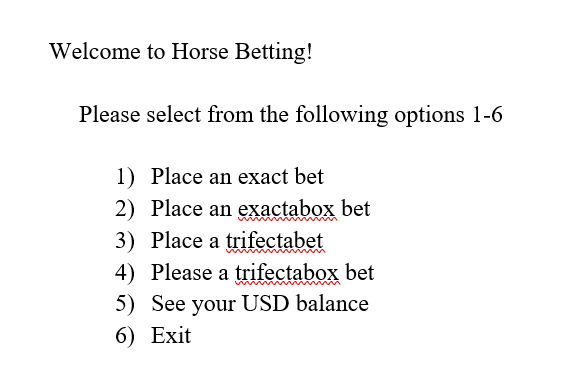
They then choose the option they want and then you ask them what horses they pick as the winners, get their pick, run the race, see if they won, etc. A text based menu is going to be the better choice to implement if you are a beginner. A string based menu is a slightly different input style, where the input is more of a command-line driven sentence that gets parsed into components in the program to determine what they want, for example, if the user inputs the command line sentence
the program will read that in, divide that up into the components and figure out that they are placing an exacta bet with horse 1 and 2 as the picks.
You can choose whatever way you want to create the interface. I am going to be giving a lecture on both approaches with examples of both, to show you how to make such a user interface. I am also going to explain all of this in more detail over several lectures and I will give many hints and working examples to the beginners to help them set all of this up to work. Lets talk about what the four bets mean (I will also be showing you some intro horse betting videos to help you understand how exacta and trifecta betting works if you have never been to the racetrack).
EXACTA bets cost 10 dollars to place but you win 100 dollars if you guess the exact winning order of the top two horses.
An EXACTABOX bet costs 5 dollars to place but you win 50 if you guess the top two horses in any order.
TRIFECTA bets cost 25 dollars to place but you win 200 dollars if you guess the exact winning order of the top three horses.
An TRIFECTABOX bet costs 20 dollars to place but you win 150 if you guess the top three horses in any order.
OK here are some betting examples explained (as what it would look like in a string based menu interface)
Example Input:
EXACTA 1 3
EXACTA 1 3 means that we are betting that the winner and second place will be exactly in that order (ie; the bet is betting that horse #1 will come in first place, and horse #3 will come in second place)
EXACTABOX 1 4
EXACTABOX 1 4 means that we are betting that the winning two horses will be 1 and 4 in any order. So if the race comes in as 4 1 2 3, you still win the bet since horse number 1 and 4 are still in the top two places.
And also two more types of bet
TRIFECTA 1 3 2
TRIFECTA 1 3 2 means that we are betting that the winners will be exactly in that order (ie; the bet is saying that horse #1 will come in first place/win, horse #3 will come in second place/place, and that horse #2 will come into third place/show.
TRIFECTABOX 1 4 2
TRIFECTABOX 1 4 2 means that we are betting that the winning three horses will be 1, 4, and 2 in any order. So if the race comes in as 1 2 4 3, you still win the bet because horse number 1, 2, and 4 are in the top three places.
Welcome to Horse Betting! Please select from the following options 1-6 1) Place an exact bet 2) Place an exactabox bet 3) Place a trifectabet 4) Please a trifectabox bet 5) See your USD balance 6) Exit
Step by Step Solution
There are 3 Steps involved in it

Get step-by-step solutions from verified subject matter experts
 Study Help