







Question: Step 1: Pick a matrix and find nul(A). Pick a matrix A of size no smaller than 35 (to get a good feel for
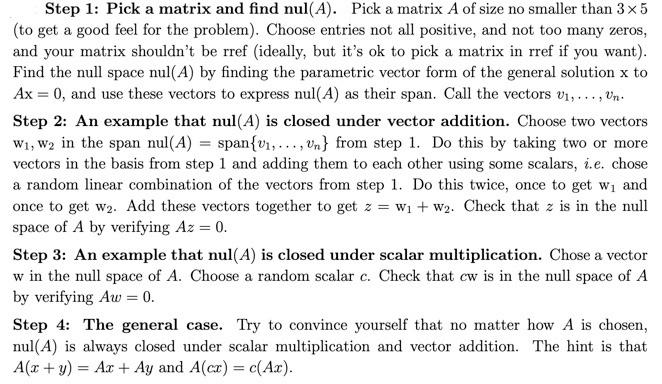
Step 1: Pick a matrix and find nul(A). Pick a matrix A of size no smaller than 35 (to get a good feel for the problem). Choose entries not all positive, and not too many zeros, and your matrix shouldn't be rref (ideally, but it's ok to pick a matrix in rref if you want). Find the null space nul(A) by finding the parametric vector form of the general solution x to Ax = 0, and use these vectors to express nul(A) as their span. Call the vectors U,..., Un. Step 2: An example that nul(A) is closed under vector addition. Choose two vectors W, W in the span nul(A) = span{,...,Un} from step 1. Do this by taking two or more vectors in the basis from step 1 and adding them to each other using some scalars, i.e. chose a random linear combination of the vectors from step 1. Do this twice, once to get w and once to get w. Add these vectors together to get z = W + W2. Check that z is in the null space of A by verifying Az = 0. Step 3: An example that nul(A) is closed under scalar multiplication. Chose a vector w in the null space of A. Choose a random scalar c. Check that cw is in the null space of A by verifying Aw = 0. Step 4: The general case. Try to convince yourself that no matter how A is chosen, nul(A) is always closed under scalar multiplication and vector addition. The hint is that A(x + y) = Ax + Ay and A(cr) = c(Ax).
Step by Step Solution
3.39 Rating (152 Votes )
There are 3 Steps involved in it

Get step-by-step solutions from verified subject matter experts
 Study Help