





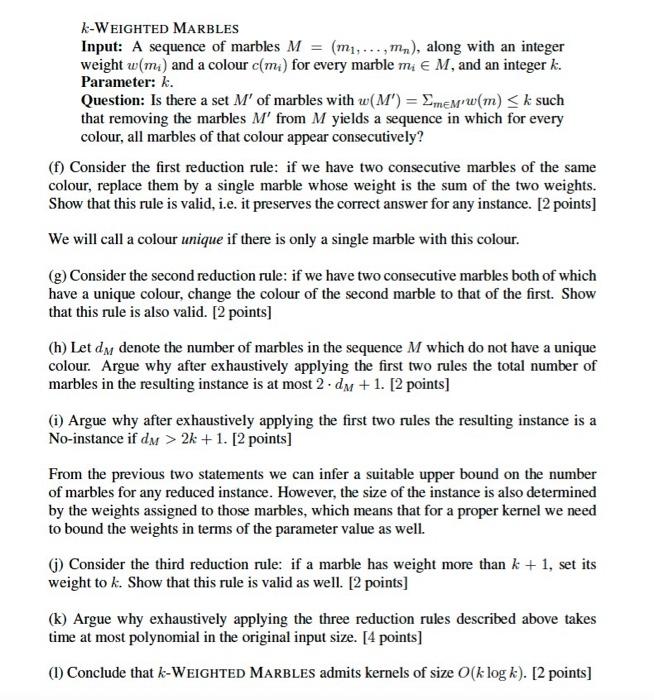
Question: picture shows kernelisation for the k-WEIGHTED MARBLES problem, which is presented below k-WEIGHTED MARBLES Input: A sequence of marbles M = (m,...,mn), along with an
picture shows kernelisation for the k-WEIGHTED MARBLES problem, which is presented below
 picture shows kernelisation for the k-WEIGHTED MARBLES problem, which is presented

k-WEIGHTED MARBLES Input: A sequence of marbles M = (m,...,mn), along with an integer weight w(m) and a colour c(mi) for every marble mi e M, and an integer k. Parameter: k. Question: Is there a set M' of marbles with w(M') = Imepw(m) 2k +1. [2 points] From the previous two statements we can infer a suitable upper bound on the number of marbles for any reduced instance. However, the size of the instance is also determined by the weights assigned to those marbles, which means that for a proper kernel we need to bound the weights in terms of the parameter value as well. (1) Consider the third reduction rule: if a marble has weight more than k + 1, set its weight to k. Show that this rule is valid as well. [2 points] (k) Argue why exhaustively applying the three reduction rules described above takes time at most polynomial in the original input size. [4 points) (1) Conclude that k-WEIGHTED MARBLEs admits kernels of size (k log k). [2 points] k-WEIGHTED MARBLES Input: A sequence of marbles M = (m,...,mn), along with an integer weight w(m) and a colour c(mi) for every marble mi e M, and an integer k. Parameter: k. Question: Is there a set M' of marbles with w(M') = Imepw(m) 2k +1. [2 points] From the previous two statements we can infer a suitable upper bound on the number of marbles for any reduced instance. However, the size of the instance is also determined by the weights assigned to those marbles, which means that for a proper kernel we need to bound the weights in terms of the parameter value as well. (1) Consider the third reduction rule: if a marble has weight more than k + 1, set its weight to k. Show that this rule is valid as well. [2 points] (k) Argue why exhaustively applying the three reduction rules described above takes time at most polynomial in the original input size. [4 points) (1) Conclude that k-WEIGHTED MARBLEs admits kernels of size (k log k). [2 points]

Step by Step Solution

There are 3 Steps involved in it

1 Expert Approved Answer
Step: 1 Unlock blur-text-image
Question Has Been Solved by an Expert!

Get step-by-step solutions from verified subject matter experts

Step: 2 Unlock
Step: 3 Unlock

Students Have Also Explored These Related Finance Questions!