







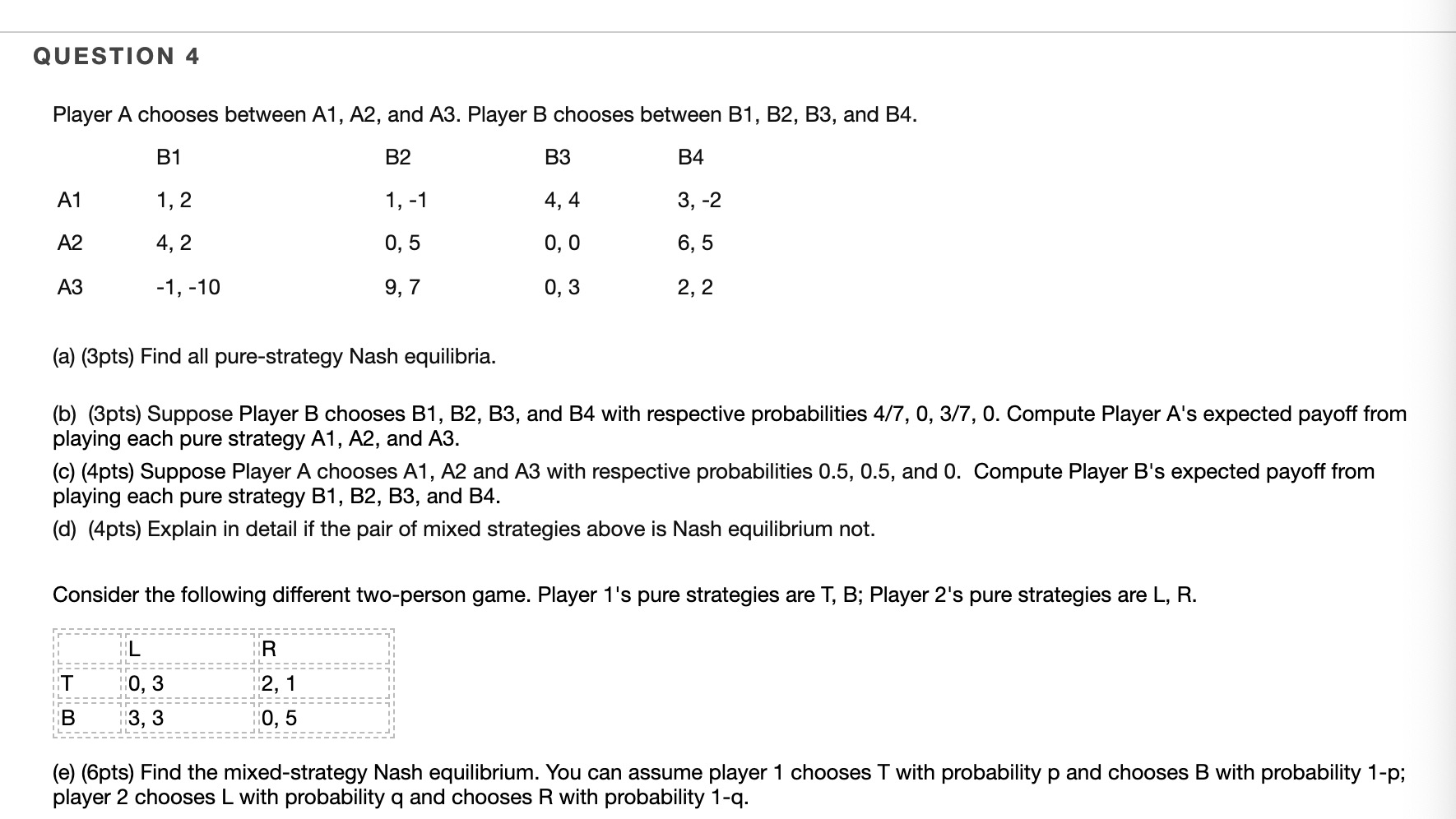
Question: Player A chooses between A1, A2, and A3. Player B chooses between B1, B2, B3, and B4. B1B2B3B4A11, 21, -14, 43, -2A24, 20, 50, 06,
Player A chooses between A1, A2, and A3. Player B chooses between B1, B2, B3, and B4.
B1B2B3B4A11, 21, -14, 43, -2A24, 20, 50, 06, 5A3-1, -109, 70, 32, 2
(a) (3pts) Find all pure-strategy Nash equilibria.
(b)(3pts) SupposePlayer B chooses B1, B2, B3, and B4 with respective probabilities 4/7, 0, 3/7, 0.Compute Player A's expected payoff from playing each pure strategy A1, A2, and A3.
(c) (4pts) Suppose Player A chooses A1, A2 and A3 with respective probabilities 0.5, 0.5, and 0.Compute Player B's expected payoff from playing each pure strategy B1, B2, B3, and B4.
(d)(4pts)Explain in detail if the pair of mixed strategies above is Nash equilibrium not.
Consider the following different two-person game. Player 1's pure strategies are T, B; Player 2's pure strategies are L, R.
LRT0, 32, 1B3, 30, 5(e) (6pts) Find the mixed-strategy Nash equilibrium. You can assume player 1 chooses T with probability p and chooses B with probability 1-p; player 2 chooses L with probability q and chooses R with probability 1-q.
QUESTION 4 Player A chooses between A1, A2, and A3. Player B chooses between B1, B2, B3, and B4. B1 B2 B3 B4 A1 1, 2 1, -1 4, 4 3, -2 A2 4, 2 0, 5 0, 0 6, 5 A3 -1, -10 9, 7 0, 3 2, 2 (a) (3pts) Find all pure-strategy Nash equilibria. (b) (3pts) Suppose Player B chooses B1, B2, B3, and B4 with respective probabilities 4/7, 0, 3/7, 0. Compute Player A's expected payoff from playing each pure strategy A1, A2, and A3. (c) (4pts) Suppose Player A chooses A1, A2 and A3 with respective probabilities 0.5, 0.5, and 0. Compute Player B's expected payoff from playing each pure strategy B1, B2, B3, and B4. (d) (4pts) Explain in detail if the pair of mixed strategies above is Nash equilibrium not. Consider the following different two-person game. Player 1's pure strategies are T, B; Player 2's pure strategies are L, R. R T 10, 3 2, 1 B 13, 3 0, 5 (e) (6pts) Find the mixed-strategy Nash equilibrium. You can assume player 1 chooses T with probability p and chooses B with probability 1-p; player 2 chooses L with probability q and chooses R with probability 1
Step by Step Solution
There are 3 Steps involved in it

Get step-by-step solutions from verified subject matter experts
 Study Help