







Question: Pleae do not use an OLS command in R, rather use the OLS formula! Also, you need to summarize id discuss your results, and perform
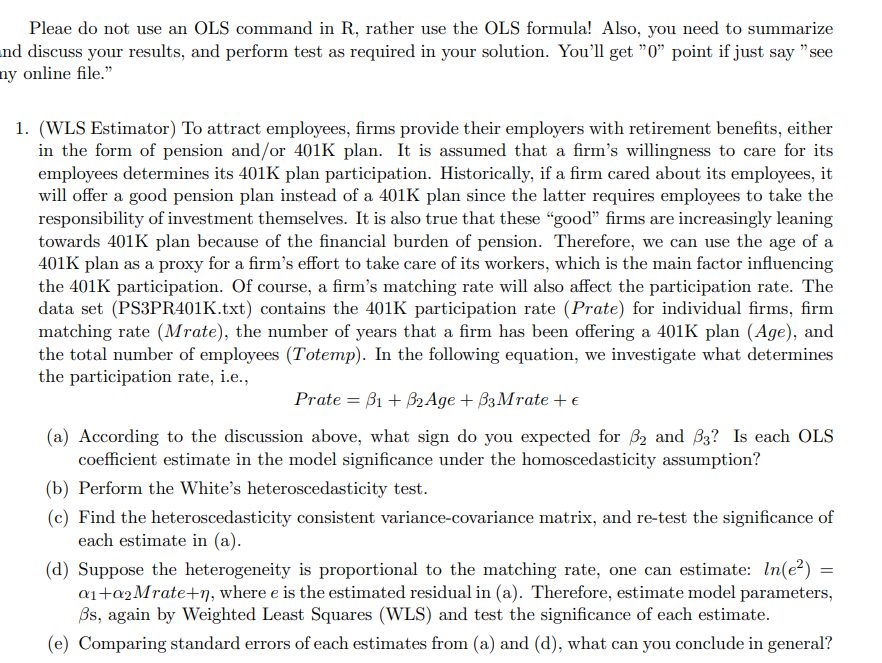
Pleae do not use an OLS command in R, rather use the OLS formula! Also, you need to summarize id discuss your results, and perform test as required in your solution. You'll get "0" point if just say "see y online file." 1. (WLS Estimator) To attract employees, firms provide their employers with retirement benefits, either in the form of pension and/or 401K plan. It is assumed that a firm's willingness to care for its employees determines its 401K plan participation. Historically, if a firm cared about its employees, it will offer a good pension plan instead of a 401K plan since the latter requires employees to take the responsibility of investment themselves. It is also true that these "good" firms are increasingly leaning towards 401K plan because of the financial burden of pension. Therefore, we can use the age of a 401K plan as a proxy for a firm's effort to take care of its workers, which is the main factor influencing the 401K participation. Of course, a firm's matching rate will also affect the participation rate. The data set (PS3PR401K.txt) contains the 401K participation rate (Prate) for individual firms, firm matching rate (Mrate), the number of years that a firm has been offering a 401K plan (Age), and the total number of employees (Totemp). In the following equation, we investigate what determines the participation rate, i.e., Prate=1+2Age+3Mrate+ (a) According to the discussion above, what sign do you expected for 2 and 3 ? Is each OLS coefficient estimate in the model significance under the homoscedasticity assumption? (b) Perform the White's heteroscedasticity test. (c) Find the heteroscedasticity consistent variance-covariance matrix, and re-test the significance of each estimate in (a). (d) Suppose the heterogeneity is proportional to the matching rate, one can estimate: ln(e2)= 1+2 Mrate +, where e is the estimated residual in (a). Therefore, estimate model parameters, s, again by Weighted Least Squares (WLS) and test the significance of each estimate. (e) Comparing standard errors of each estimates from (a) and (d), what can you conclude in general? Pleae do not use an OLS command in R, rather use the OLS formula! Also, you need to summarize id discuss your results, and perform test as required in your solution. You'll get "0" point if just say "see y online file." 1. (WLS Estimator) To attract employees, firms provide their employers with retirement benefits, either in the form of pension and/or 401K plan. It is assumed that a firm's willingness to care for its employees determines its 401K plan participation. Historically, if a firm cared about its employees, it will offer a good pension plan instead of a 401K plan since the latter requires employees to take the responsibility of investment themselves. It is also true that these "good" firms are increasingly leaning towards 401K plan because of the financial burden of pension. Therefore, we can use the age of a 401K plan as a proxy for a firm's effort to take care of its workers, which is the main factor influencing the 401K participation. Of course, a firm's matching rate will also affect the participation rate. The data set (PS3PR401K.txt) contains the 401K participation rate (Prate) for individual firms, firm matching rate (Mrate), the number of years that a firm has been offering a 401K plan (Age), and the total number of employees (Totemp). In the following equation, we investigate what determines the participation rate, i.e., Prate=1+2Age+3Mrate+ (a) According to the discussion above, what sign do you expected for 2 and 3 ? Is each OLS coefficient estimate in the model significance under the homoscedasticity assumption? (b) Perform the White's heteroscedasticity test. (c) Find the heteroscedasticity consistent variance-covariance matrix, and re-test the significance of each estimate in (a). (d) Suppose the heterogeneity is proportional to the matching rate, one can estimate: ln(e2)= 1+2 Mrate +, where e is the estimated residual in (a). Therefore, estimate model parameters, s, again by Weighted Least Squares (WLS) and test the significance of each estimate. (e) Comparing standard errors of each estimates from (a) and (d), what can you conclude in general
Step by Step Solution
There are 3 Steps involved in it

Get step-by-step solutions from verified subject matter experts
 Study Help