







Question: Please also offer a Julia coding file and copying and pasting into PDF format both. Thank you. For Julia, this is a programming language. I
 Please also offer a Julia coding file and copying and pasting into PDF format both. Thank you.
For Julia, this is a programming language. I think the question needs me to code in Julia and get the answer.
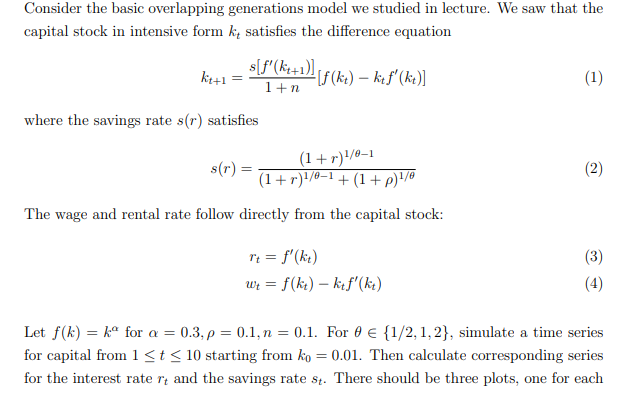
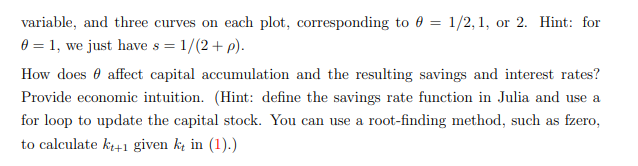
Consider the basic overlapping generations model we studied in lecture. We saw that the capital stock in intensive form kt satisfies the difference equation kt+1=1+ns[f(kt+1)][f(kt)ktf(kt)] where the savings rate s(r) satisfies s(r)=(1+r)1/1+(1+)1/(1+r)1/1 The wage and rental rate follow directly from the capital stock: rtwt=f(kt)=f(kt)ktf(kt) Let f(k)=k for =0.3,=0.1,n=0.1. For {1/2,1,2}, simulate a time series for capital from 1t10 starting from k0=0.01. Then calculate corresponding series for the interest rate rt and the savings rate st. There should be three plots, one for each variable, and three curves on each plot, corresponding to =1/2,1, or 2 . Hint: for =1, we just have s=1/(2+). How does affect capital accumulation and the resulting savings and interest rates? Provide economic intuition. (Hint: define the savings rate function in Julia and use a for loop to update the capital stock. You can use a root-finding method, such as fzero, to calculate kt+1 given kt in (1).) Consider the basic overlapping generations model we studied in lecture. We saw that the capital stock in intensive form kt satisfies the difference equation kt+1=1+ns[f(kt+1)][f(kt)ktf(kt)] where the savings rate s(r) satisfies s(r)=(1+r)1/1+(1+)1/(1+r)1/1 The wage and rental rate follow directly from the capital stock: rtwt=f(kt)=f(kt)ktf(kt) Let f(k)=k for =0.3,=0.1,n=0.1. For {1/2,1,2}, simulate a time series for capital from 1t10 starting from k0=0.01. Then calculate corresponding series for the interest rate rt and the savings rate st. There should be three plots, one for each variable, and three curves on each plot, corresponding to =1/2,1, or 2 . Hint: for =1, we just have s=1/(2+). How does affect capital accumulation and the resulting savings and interest rates? Provide economic intuition. (Hint: define the savings rate function in Julia and use a for loop to update the capital stock. You can use a root-finding method, such as fzero, to calculate kt+1 given kt in (1).)
Step by Step Solution
There are 3 Steps involved in it

Get step-by-step solutions from verified subject matter experts
 Study Help