







Question: please also provide graphs for parts d, e and g C=500+0.8(YT)I=50010rPM=0.1Y35rG=800T=200M=1000P=2 Where C is planned consumption, l is planned investment spending, T is government tax
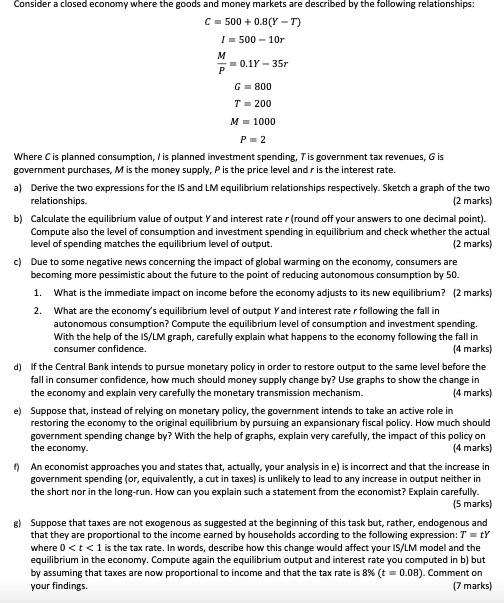
C=500+0.8(YT)I=50010rPM=0.1Y35rG=800T=200M=1000P=2 Where C is planned consumption, l is planned investment spending, T is government tax revenues, G is government purchases, M is the money supply, P is the price level and r is the interest rate. a) Derive the two expressions for the IS and LM equilibrium relationships respectively. Sketch a graph of the two relationships. (2 marks) b) Calculate the equilibrium value of output Y and interest rate r (round off your answers to one decimal point). Compute also the level of consumption and investment spending in equilibrium and check whether the actual level of spending matches the equilibrium level of output. (2 marks) c) Due to some negative news concerning the impact of global warming on the economy, consumers are becoming more pessimistic about the future to the point of reducing autonomous consumption by 50 . 1. What is the immediate impact on income before the economy adjusts to its new equilibrium? (2 marks) 2. What are the economy's equilibrium level of output Y and interest rate r following the fall in autonomous consumption? Compute the equilibrium level of consumption and investment spending. With the help of the IS/LM graph, carefully explain what happens to the economy following the fall in consumer confidence. (4 marks) d) If the Central Bank intends to pursue monetary policy in order to restore output to the same level before the fall in consumer confidence, how much should money supply change by? Use graphs to show the change in the economy and explain very carefully the monetary transmission mechanism. (4 marks) e) Suppose that, instead of relying on monetary policy, the government intends to take an active role in restoring the economy to the original equilibrium by pursuing an expansionary fiscal policy. How much should government spending change by? With the help of graphs, explain very carefully, the impact of this policy on the economy. (4 marks) f) An economist approaches you and states that, actually, your analysis in e) is incorrect and that the increase in government spending (or, equivalently, a cut in taxes) is unlikely to lead to any increase in output neither in the short nor in the long-run. How can you explain such a statement from the economist? Explain carefully. (5 marks) g) Suppose that taxes are not exogenous as suggested at the beginning of this task but, rather, endogenous and that they are proportional to the income earned by households according to the following expression: T=tY where 0
Step by Step Solution
There are 3 Steps involved in it

Get step-by-step solutions from verified subject matter experts
 Study Help