







Question: please ans all the questions in 15 mins Volume: 1 Issue: 5 Nov 2012. ISSN No 2277- 8160 Research Research Paper Management Labour Dissonance At
please ans all the questions in 15 mins
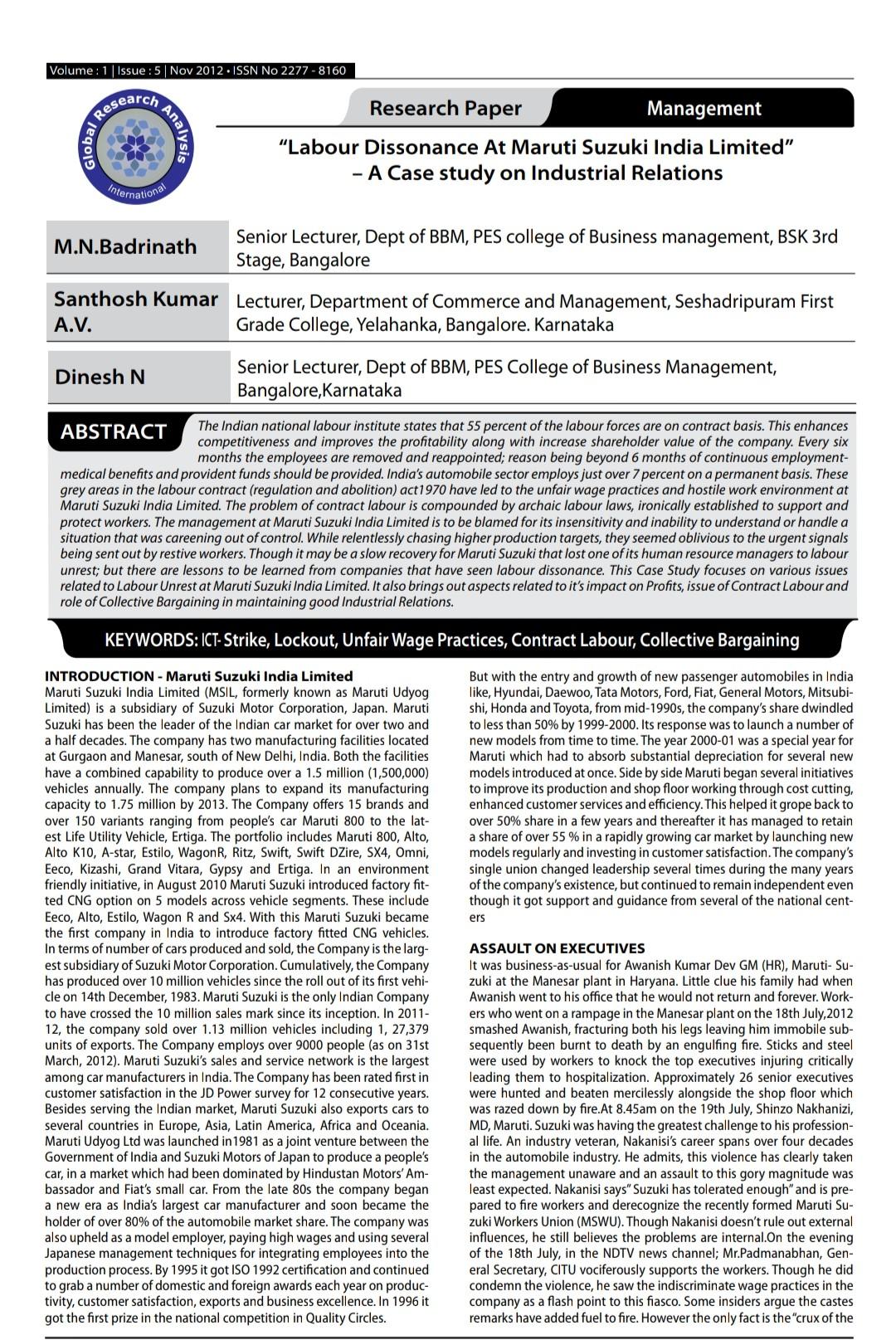
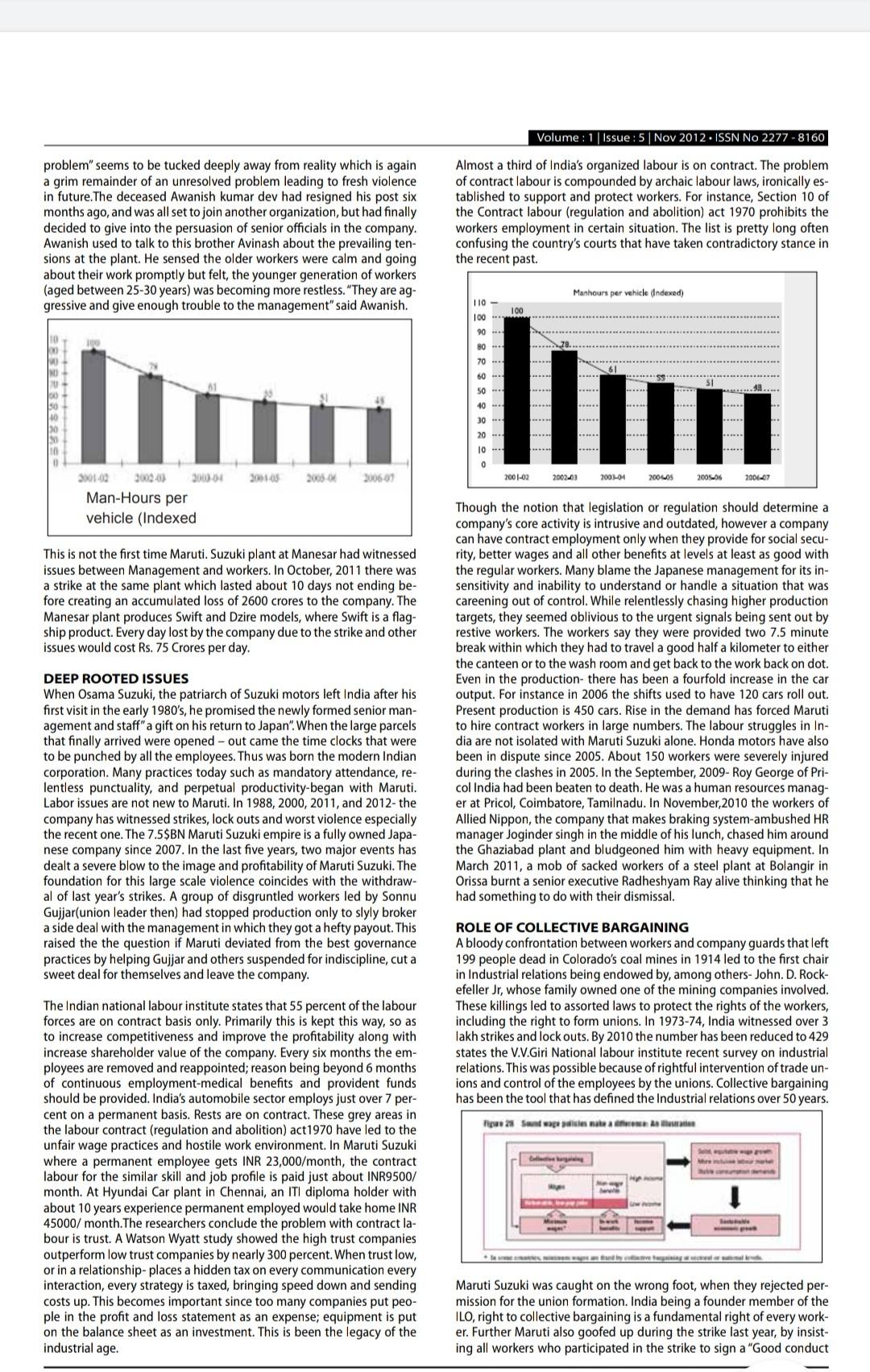
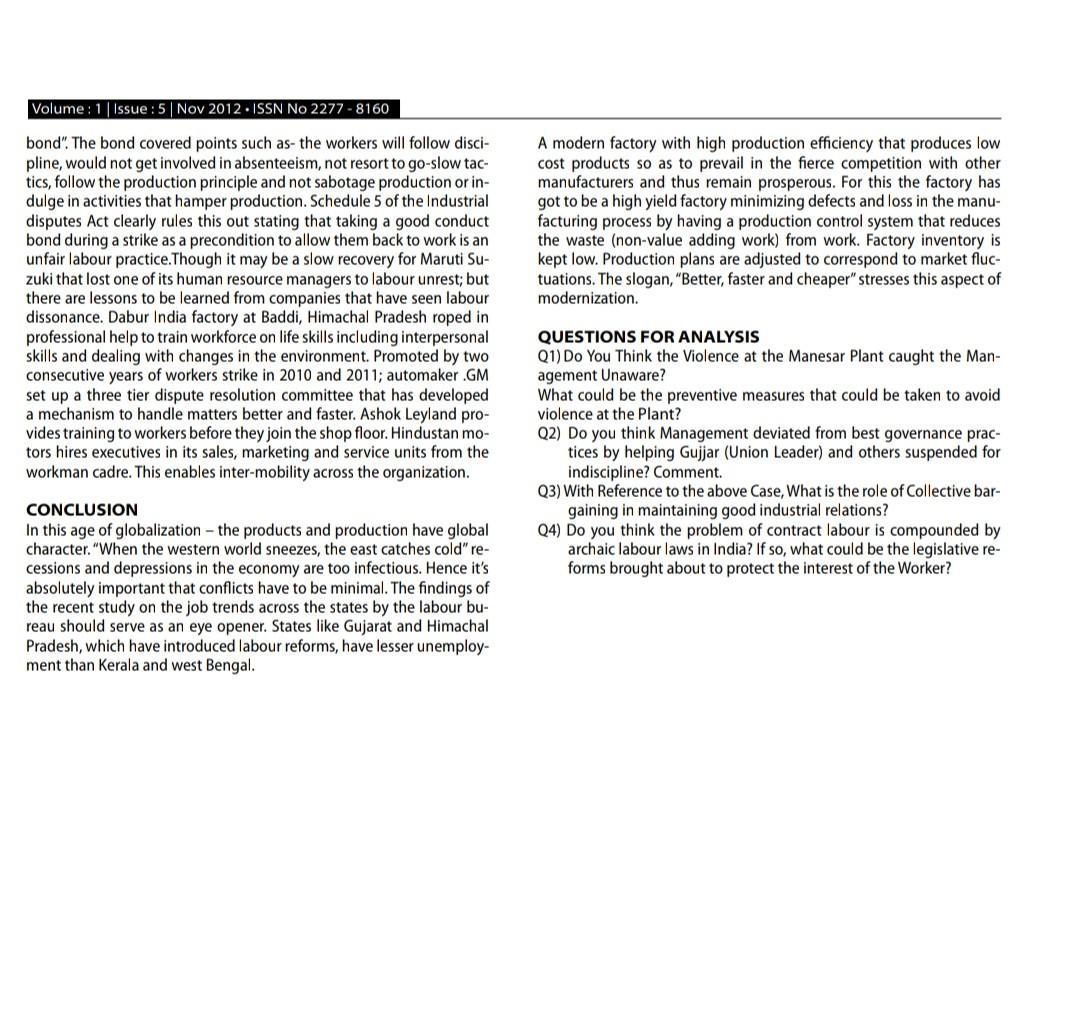
Volume: 1 Issue: 5 Nov 2012. ISSN No 2277- 8160 Research Research Paper Management "Labour Dissonance At Maruti Suzuki India Limited" - A Case study on Industrial Relations International M.N.Badrinath Senior Lecturer, Dept of BBM, PES college of Business management, BSK 3rd Stage, Bangalore Santhosh Kumar Lecturer, Department of Commerce and Management, Seshadripuram First A.V. Grade College, Yelahanka, Bangalore. Karnataka Dinesh N Senior Lecturer, Dept of BBM, PES College of Business Management, Bangalore,Karnataka ABSTRACT The Indian national labour institute states that 55 percent of the labour forces are on contract basis. This enhances competitiveness and improves the profitability along with increase shareholder value of the company. Every six months the employees are removed and reappointed; reason being beyond 6 months of continuous employment- medical benefits and provident funds should be provided. India's automobile sector employs just over 7 percent on a permanent basis. These grey areas in the labour contract (regulation and abolition) act1970 have led to the unfair wage practices and hostile work environment at Maruti Suzuki India Limited. The problem of contract labour is compounded by archaic labour laws, ironically established to support and protect workers. The management at Maruti Suzuki India Limited is to be blamed for its insensitivity and inability to understand or handle a situation that was careening out of control. While relentlessly chasing higher production targets, they seemed oblivious to the urgent signals being sent out by restive workers. Though it may be a slow recovery for Maruti Suzuki that lost one of its human resource managers to labour unrest; but there are lessons to be learned from companies that have seen labour dissonance. This Case Study focuses on various issues related to Labour Unrest at Maruti Suzuki India Limited. It also brings out aspects related to it's impact on Profits, issue of Contract Labour and role of Collective Bargaining in maintaining good Industrial Relations. KEYWORDS: ICT-Strike, Lockout, Unfair Wage Practices, Contract Labour, Collective Bargaining But with the entry and growth of new passenger automobiles in India like, Hyundai, Daewoo, Tata Motors, Ford, Fiat, General Motors, Mitsubi- shi, Honda and Toyota, from mid-1990s, the company's share dwindled to less than 50% by 1999-2000. Its response was to launch a number of new models from time to time. The year 2000-01 was a special year for Maruti which had to absorb substantial depreciation for several new models introduced at once. Side by side Maruti began several initiatives to improve its production and shop floor working through cost cutting, enhanced customer services and efficiency. This helped it grope back to over 50% share in a few years and thereafter it has managed to retain a share of over 55 % in a rapidly growing car market by launching new models regularly and investing in customer satisfaction. The company's single union changed leadership several times during the many years of the company's existence, but continued to remain independent even though it got support and guidance from several of the national cent- ers INTRODUCTION - Maruti Suzuki India Limited Maruti Suzuki India Limited (MSIL, formerly known as Maruti Udyog Limited) is a subsidiary of Suzuki Motor Corporation, Japan. Maruti Suzuki has been the leader of the Indian car market for over two and a half decades. The company has two manufacturing facilities located at Gurgaon and Manesar, south of New Delhi, India. Both the facilities have a combined capability to produce over a 1.5 million (1,500,000) vehicles annually. The company plans to expand its manufacturing capacity to 1.75 million by 2013. The Company offers 15 brands and over 150 variants ranging from people's car Maruti 800 to the lat- est Life Utility Vehicle, Ertiga. The portfolio includes Maruti 800, Alto, Alto K10, A-star, Estilo, Wagon R, Ritz, Swift, Swift DZire, SX4, Omni, Eeco, Kizashi, Grand Vitara, Gypsy and Ertiga. In an environment friendly initiative, in August 2010 Maruti Suzuki introduced factory fit- ted CNG option on 5 models across vehicle segments. These include Eeco, Alto, Estilo, Wagon R and Sx4. With this Maruti Suzuki became the first company in India to introduce factory fitted CNG vehicles. In terms of number of cars produced and sold, the Company is the larg- est subsidiary of Suzuki Motor Corporation. Cumulatively, the Company has produced over 10 million vehicles since the roll out of its first vehi- cle on 14th December, 1983. Maruti Suzuki is the only Indian Company to have crossed the 10 million sales mark since its inception. In 2011- 12, the company sold over 1.13 million vehicles including 1, 27,379 units of exports. The Company employs over 9000 people (as on 31st March, 2012). Maruti Suzuki's sales and service network is the largest among car manufacturers in India. The Company has been rated first in customer satisfaction in the JD Power survey for 12 consecutive years. Besides serving the Indian market, Maruti Suzuki also exports cars to several countries in Europe, Asia, Latin America, Africa and Oceania. Maruti Udyog Ltd was launched in 1981 as a joint venture between the Government of India and Suzuki Motors of Japan to produce a people's car, in a market which had been dominated by Hindustan Motors' Am- bassador and Fiat's small car. From the late 80s the company began a new era as India's largest car manufacturer and soon became the holder of over 80% of the automobile market share. The company was also upheld as a model employer, paying high wages and using several Japanese management techniques for integrating employees into the production process. By 1995 it got ISO 1992 certification and continued to grab a number of domestic and foreign awards each year on produc- tivity, customer satisfaction, exports and business excellence. 1996 it got the first prize in the national competition in Quality Circles. ASSAULT ON EXECUTIVES It was business-as-usual for Awanish Kumar Dev GM (HR), Maruti- Su- zuki at the Manesar plant in Haryana. Little clue his family had when Awanish went to his office that he would not return and forever. Work- ers who went on a rampage in the Manesar plant on the 18th July 2012 smashed Awanish, fracturing both his legs leaving him immobile sub- sequently been burnt to death by an engulfing fire. Sticks and steel were used by workers to knock the top executives injuring critically leading them to hospitalization. Approximately 26 senior executives were hunted and beaten mercilessly alongside the shop floor which was razed down by fire.At 8.45am on the 19th July, Shinzo Nakhanizi, MD, Maruti Suzuki was having the greatest challenge to his profession- al life. An industry veteran, Nakanisi's career spans over four decades in the automobile industry. He admits, this violence has clearly taken the management unaware and an assault to this gory magnitude was least expected. Nakanisi says" Suzuki has tolerated enough" and is pre- pared to fire workers and derecognize the recently formed Maruti Su- zuki Workers Union (MSWU). Though Nakanisi doesn't rule out external influences, he still believes the problems are internal.On the evening of the 18th July, in the NDTV news channel; Mr.Padmanabhan, Gen- eral Secretary, CITU vociferously supports the workers. Though he did condemn the violence, he saw the indiscriminate wage practices in the company as a flash point to this fiasco. Some insiders argue the castes remarks have added fuel to fire. However the only fact is the crux of the Volume: 1 Issue: 5 Nov 2012. ISSN No 2277-8160 problem" seems to be tucked deeply away from reality which is again a grim remainder of an unresolved problem leading to fresh violence in future. The deceased Awanish kumar dev had resigned his post six months ago, and was all set to join another organization, but had finally decided to give into the persuasion of senior officials in the company. Awanish used to talk to this brother Avinash about the prevailing ten- sions at the plant. He sensed the older workers were calm and going about their work promptly but felt, the younger generation of workers (aged between 25-30 years) was becoming more restless. "They are ag- gressive and give enough trouble to the management" said Awanish. Almost a third of India's organized labour is on contract. The problem of contract labour is compounded by archaic labour laws, ironically es- tablished to support and protect workers. For instance, Section 10 of the Contract labour (regulation and abolition) act 1970 prohibits the workers employment in certain situation. The list is pretty long often confusing the country's courts that have taken contradictory stance in the recent past. Manhours per vehicle (Indexed) 110 100 100 90 10 80. 20. 70 - 60 - 61 ...... 18 100 150 10 10 - 0 2005.04 300661 2001-02 200203 2004 2006 2005.06 2006-07 30010 300243 30004 Man-Hours per vehicle (Indexed This is not the first time Maruti Suzuki plant at Manesar had witnessed issues between Management and workers. In October, 2011 there was a strike at the same plant which lasted about 10 days not ending be- fore creating an accumulated loss of 2600 crores to the company. The Manesar plant produces Swift and Dzire models, where Swift is a flag- ship product. Every day lost by the company due to the strike and other issues would cost Rs. 75 Crores per day. DEEP ROOTED ISSUES When Osama Suzuki, the patriarch of Suzuki motors left India after his first visit in the early 1980's, he promised the newly formed senior man- agement and staff" a gift on his return to Japan". When the large parcels that finally arrived were opened - out came the time clocks that were to be punched by all the employees. Thus was born the modern Indian corporation. Many practices today such as mandatory attendance, re- lentless punctuality, and perpetual productivity-began with Maruti. Labor issues are not new to Maruti. In 1988, 2000, 2011, and 2012- the company has witnessed strikes, lock outs and worst violence especially the recent one. The 7.5$BN Maruti Suzuki empire is a fully owned Japa- nese company since 2007. In the last five years, two major events has dealt a severe blow to the image and profitability of Maruti Suzuki. The foundation for this large scale violence coincides with the withdraw- al of last year's strikes. A group of disgruntled workers led by Sonnu Gujjar(union leader then) had stopped production only to slyly broker a side deal with the management in which they got a hefty payout. This raised the the question if Maruti deviated from the best governance practices by helping Gujjar and others suspended for indiscipline, cut a sweet deal for themselves and leave the company. Though the notion that legislation or regulation should determine a company's core activity is intrusive and outdated, however a company can have contract employment only when they provide for social secu- rity, better wages and all other benefits at levels at least as good with the regular workers. Many blame the Japanese management for its in- sensitivity and inability to understand or handle a situation that was careening out of control. While relentlessly chasing higher production targets, they seemed oblivious to the urgent signals being sent out by restive workers. The workers say they were provided two 7.5 minute break within which they had to travel a good half a kilometer to either the canteen or to the wash room and get back to the work back on dot. Even in the production- there has been a fourfold increase in the car output. For instance in 2006 the shifts used to have 120 cars roll out. Present production is 450 cars. Rise in the demand has forced Maruti to hire contract workers in large numbers. The labour struggles in In- dia are not isolated with Maruti Suzuki alone. Honda motors have also been in dispute since 2005. About 150 workers were severely injured during the clashes in 2005. In the September, 2009- Roy George of Pri- col India had been beaten to death. He was a human resources manag- er at Pricol, Coimbatore, Tamilnadu. In November 2010 the workers of Allied Nippon, the company that makes braking system-ambushed HR manager Joginder singh in the middle of his lunch, chased him around the Ghaziabad plant and bludgeoned him with heavy equipment. In March 2011, a mob of sacked workers of a steel plant at Bolangir in Orissa burnt a senior executive Radheshyam Ray alive thinking that he had something to do with their dismissal. ROLE OF COLLECTIVE BARGAINING A bloody confrontation between workers and company guards that left 199 people dead in Colorado's coal mines in 1914 led to the first chair in Industrial relations being endowed by, among others-John. D. Rock- efeller Jr, whose family owned one of the mining companies involved. These killings led to assorted laws to protect the rights of the workers, including the right to form unions. In 1973-74, India witnessed over 3 lakh strikes and lock outs. By 2010 the number has been reduced to 429 states the V.V.Giri National labour institute recent survey on industrial relations. This was possible because of rightful intervention of trade un- ions and control of the employees by the unions. Collective bargaining has been the tool that has defined the Industrial relations over 50 years. Tiwa Saud apple make her as aten The Indian national labour institute states that 55 percent of the labour forces are on contract basis only. Primarily this is kept this way, so as to increase competitiveness and improve the profitability along with increase shareholder value of the company. Every six months the em- ployees are removed and reappointed; reason being beyond 6 months of continuous employment-medical benefits and provident funds should be provided. India's automobile sector employs just over 7 per- cent on a permanent basis. Rests are on contract. These grey areas in the labour contract (regulation and abolition) act1970 have led to the unfair wage practices and hostile work environment. In Maruti Suzuki where a permanent employee gets INR 23,000/month, the contract labour for the similar skill and job profile is paid just about INR9500/ month. At Hyundai Car plant in Chennai, an ITI diploma holder with about 10 years experience permanent employed would take home INR 45000/month.The researchers conclude the problem with contract la- bour is trust. A Watson Wyatt study showed the high trust companies outperform low trust companies by nearly 300 percent. When trust low, or in a relationship-places a hidden tax on every communication every interaction, every strategy is taxed, bringing speed down and sending costs up. This becomes important since too many companies put peo- ple in the profit and loss statement as an expense; equipment is put on the balance sheet as an investment. This is been the legacy of the industrial age. Maruti Suzuki was caught on the wrong foot, when they rejected per- mission for the union formation. India being a founder member of the ILO, right to collective bargaining is a fundamental right of every work- er. Further Maruti also goofed up during the strike last year, by insist- ing all workers who participated in the strike to sign a "Good conduct Volume: 1 Issue: 5 Nov 2012. ISSN No 2277-8160 A modern factory with high production efficiency that produces low cost products so as to prevail in the fierce competition with other manufacturers and thus remain prosperous. For this the factory has got to be a high yield factory minimizing defects and loss in the manu- facturing process by having a production control system that reduces the waste (non-value adding work) from work. Factory inventory is kept low. Production plans are adjusted to correspond to market fluc- tuations. The slogan, "Better, faster and cheaper" stresses this aspect of modernization. bond". The bond covered points such as the workers will follow disci- pline, would not get involved in absenteeism, not resort to go-slow tac- tics, follow the production principle and not sabotage production or in- dulge in activities that hamper production. Schedule 5 of the Industrial disputes Act clearly rules this out stating that taking a good conduct bond during a strike as a precondition to allow them back to work is an unfair labour practice. Though it may be a slow recovery for Maruti Su- zuki that lost one of its human resource managers to labour unrest; but there are lessons to be learned from companies that have seen labour dissonance. Dabur India factory at Baddi, Himachal Pradesh roped in professional help to train workforce on life skills including interpersonal skills and dealing with changes in the environment. Promoted by two consecutive years of workers strike in 2010 and 2011; automaker .GM set up a three tier dispute resolution committee that has developed a mechanism to handle matters better and faster. Ashok Leyland pro- vides training to workers before they join the shop floor. Hindustan mo- tors hires executives in its sales, marketing and service units from the workman cadre. This enables inter-mobility across the organization. QUESTIONS FOR ANALYSIS Q1) Do You Think the Violence at the Manesar Plant caught the Man- agement Unaware? What could be the preventive measures that could be taken to avoid violence at the Plant? Q2) Do you think Management deviated from best governance prac- tices by helping Gujjar (Union Leader) and others suspended for indiscipline? Comment. Q3) With Reference to the above Case, What is the role of Collective bar- gaining in maintaining good industrial relations? Q4) Do you think the problem of contract labour is compounded by archaic labour laws in India? If so, what could be the legislative re- forms brought about to protect the interest of the Worker? CONCLUSION In this age of globalization - the products and production have global character. "When the western world sneezes, the east catches cold" re- cessions and depressions in the economy are too infectious. Hence it's absolutely important that conflicts have to be minimal. The findings of the recent study on the job trends across the states by the labour bu- reau should serve as an eye opener. States like Gujarat and Himachal Pradesh, which have introduced labour reforms, have lesser unemploy- ment than Kerala and West BengalStep by Step Solution
There are 3 Steps involved in it
1 Expert Approved Answer
Step: 1 Unlock

Question Has Been Solved by an Expert!
Get step-by-step solutions from verified subject matter experts
Step: 2 Unlock
Step: 3 Unlock
 Study Help