







Question: (Please answer 1, 2, 4, 5, 6) (No excel please...) (1) Calculate the cost of debt capital (before and after tax) assuming no floatation costs.
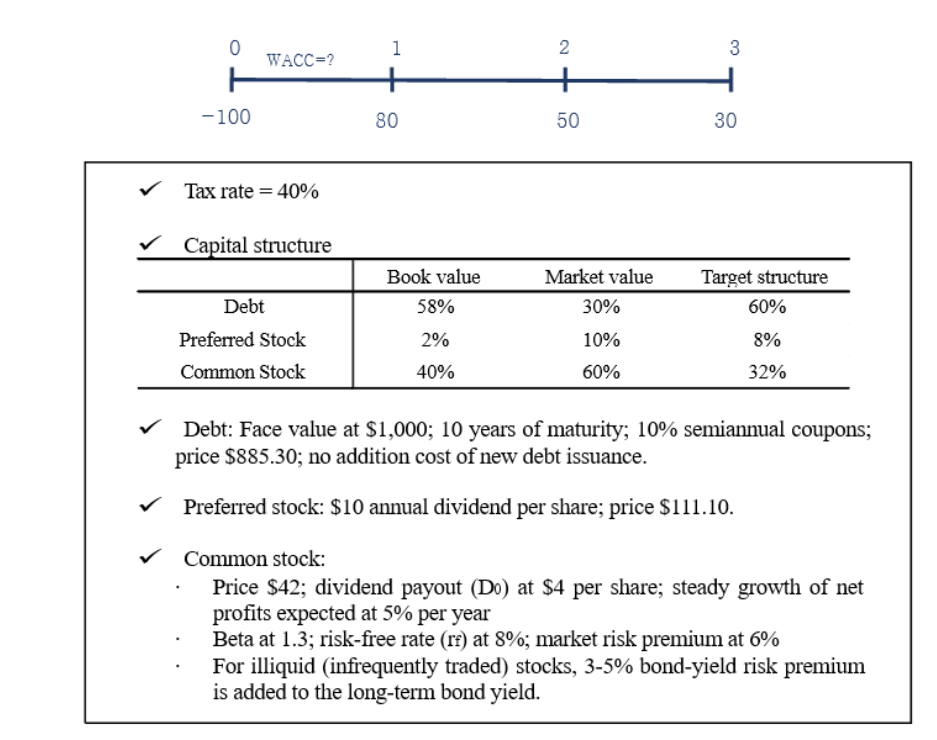
(Please answer 1, 2, 4, 5, 6) (No excel please...)
(1) Calculate the cost of debt capital (before and after tax) assuming no floatation costs.
(2) Calculate the cost of preferred stock assuming no floatation costs.
(3) Calculate the cost of common stock assuming no floatation cost. (ANSWERED)
i. Use the dividend discount model (DDM) under steady growth (Gordon model).
-15%
ii. Use the capital asset pricing model (CAPM).
-15.8%
iii. Add the mid-point of 3-5% bond-yield premium to the long-term bond yield obtained from Part 1.
-19%
(4) Using the average of the three measures of the common stock cost of capital from Part 3 as the cost of common stock, calculate the weighted average cost of capital (WACC).
(5) Calculate the internal rate of return (IRR) and the net present value (NPV) of the project as follows:
i. IRR:
ii. NPV
(6) Decide whether to accept or reject the project.
Debt: Face value at $1,000;10 years of maturity; 10% semiannual coupons; price $885.30; no addition cost of new debt issuance. Preferred stock: $10 annual dividend per share; price $111.10. Common stock: - Price $42; dividend payout (D0) at $4 per share; steady growth of net profits expected at 5% per year Beta at 1.3; risk-free rate (rf) at 8%; market risk premium at 6% For illiquid (infrequently traded) stocks, 3-5\% bond-yield risk premium is added to the long-term bond yield
Step by Step Solution
There are 3 Steps involved in it

Get step-by-step solutions from verified subject matter experts
 Study Help